


Last Mile Delivery Optimization
Last-Mile Transportation in 2026: Definition, Process, Costs, Challenges, and Software


Key Takeaways
- Last-mile transportation is the final movement and management layer that gets goods from a local node to the end recipient. It covers routing, dispatch, driver allocation, customer communication, proof of delivery, and exception handling.
- It is one of the most operationally complex parts of fulfilment because transport teams must balance time windows, stop density, traffic, vehicle capacity, labour availability, and failed-delivery risk in real time.
- Cost pressure is rising: Deloitte reports an over 10% increase in the cost of standard last-mile delivery service offered at checkout over the past two years.
- Last-mile delivery can represent 30–35% of total delivery cost, according to Deloitte, making route quality, fleet utilisation, and first-attempt success critical margin levers.
- Teams should monitor KPIs such as on-time delivery, first-attempt delivery rate, cost per stop, cost per order, miles per delivery, vehicle utilisation, ETA accuracy, and emissions per delivery.
- Locus supports last-mile transportation as an orchestration and dispatch-management layer that connects order allocation, route optimisation, execution, visibility, proof of delivery, integrations, and analytics.
Last-mile transportation is the movement and operational management of goods from a local fulfilment centre, distribution hub, retail store, or depot to the final delivery point. In practice, it includes routing, dispatch, driver and vehicle planning, customer notifications, proof of delivery, and exception handling.
For logistics leaders, this is the most customer-visible part of fulfilment and one of the hardest to control profitably. Faster delivery promises, rising stop density, and fragmented carrier networks mean businesses need tighter orchestration across inventory, transport, and customer communication. That is especially true for brands focused on last-mile efficiency in direct-to-consumer selling, where service quality and transport cost are closely linked.
This article focuses on commercial goods transportation. In some contexts, “last mile” can also refer to passenger transit, but here the scope is parcel, retail, grocery, B2B distribution, healthcare, field service, and bulky-goods delivery operations.
What is the last-mile?
The term “last mile” refers to the final step in a broader process whether in logistics, telecommunications, or even transportation where services or products are delivered directly to the end user. In the context of supply chains, it’s the segment that connects distribution hubs to the customer’s location, and it’s often the most logistically challenging and expensive.
Originally coined in the telecom industry, the term now plays a major role in e-commerce and retail, where customer satisfaction hinges on a timely, seamless delivery experience.
What is last-mile transportation?
Last-mile transportation is the operational system used to move goods from a local distribution or fulfilment point to the final recipient. It is broader than the handoff at the doorstep. It includes the planning, assignment, dispatch, tracking, delivery confirmation, and exception-control processes needed to complete the final leg reliably.
In enterprise operations, last-mile transportation usually involves:
- order intake and promise validation
- inventory and capacity checks
- route optimisation and multi-stop planning
- carrier, driver, and vehicle assignment
- time-window management
- customer notifications and ETA updates
- proof of delivery and documentation
- failed-delivery handling and reattempts
- returns pickup and reverse-logistics coordination
Where the last mile fits in the supply chain
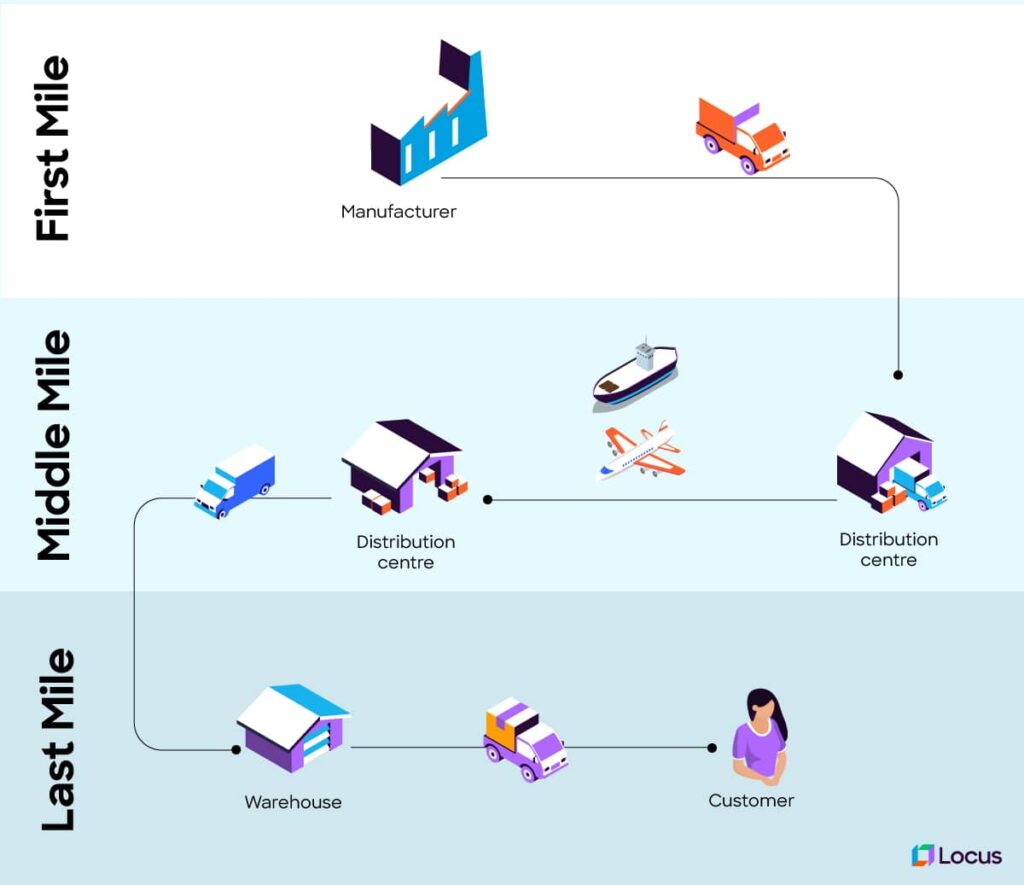
| Supply chain stage | What happens | Typical origin and destination | Primary goal |
| First mile | Goods move from supplier or manufacturer into the network | Factory to warehouse or distribution centre | Inbound flow and stock positioning |
| Middle mile | Goods move between network nodes | Distribution centre to store, hub, or local depot | Network balancing and replenishment |
| Last mile | Goods move to the final endpoint | Local hub, store, or depot to customer or delivery site | Service execution, SLA adherence, and customer experience |
What is last-mile delivery?
Last-mile delivery is the customer-facing execution event within last-mile transportation. It is the operational process of transporting goods from a fulfilment centre or local hub to the final destination, usually a home, office, store, job site, or pickup point.
In the supply chain, last-mile delivery follows:
- First mile: Movement from the manufacturer to a distribution centre.
- Middle mile: Transfer from the distribution centre to a local facility or retail outlet.
- Last mile: Final leg, from that local hub to the customer.

From groceries and clothing to electronics and furniture, efficient last-mile delivery ensures products arrive on time and in good condition. Innovations like route optimisation, real-time tracking, and contactless delivery are now essential for executing this phase successfully.
Last-mile delivery is therefore a subset of last-mile transportation: delivery is the event; transportation is the broader operating model that makes the event happen consistently and profitably.
Last-mile transportation vs last-mile delivery vs final-mile logistics
| Term | What it means | Best way to think about it |
| Last-mile transportation | The movement and operational management of goods in the final leg | The operating system |
| Last-mile delivery | The execution of the drop-off or handover to the recipient | The customer-facing event |
| Final-mile logistics | A broader logistics term often used interchangeably, especially in specialist, bulky, or scheduled delivery contexts | The planning and execution umbrella |
Can last-mile transportation refer to passenger transit?
Yes. In urban mobility, “last mile” can describe how passengers get from a transport node to their final destination. In this article, however, the term refers to commercial goods transportation and delivery operations.
Does store replenishment count?
Sometimes. If a business uses local stores, dark stores, or retail nodes as the endpoint for planned replenishment, that move may still be described as middle mile. If the store is functioning as the final operating node before direct customer delivery, the delivery from store to recipient is part of last-mile transportation.
Importance of last mile delivery
Last-mile transportation has become one of the most commercially important parts of the supply chain. It is no longer just the final movement of a package. It is where service commitments are tested, delivery costs are absorbed, and customer experience becomes measurable.
The last mile defines the customer experience
For many customers, the delivery experience is their only physical interaction with a brand. The quality of that experience directly influences how the brand is perceived. Accurate deliveries, proactive communication, and professional service create confidence and reinforce trust. On the other hand, delays, poor communication, or damaged goods can quickly undo months of marketing and sales effort.
This stage has shifted from being a logistics necessity to a key touchpoint in the customer journey. Brands that treat last-mile delivery as a customer experience function, not just a transport task, are better positioned to improve retention and reduce service escalations. Its direct interaction with the end customer makes last-mile delivery one of the most influential elements in shaping customer experience and brand perception.
It directly impacts revenue and retention
Customer expectations around speed, visibility, and reliability remain high across both B2C and B2B environments. If expectations are not met, customers do not hesitate to switch providers or reduce spend.
Poor last-mile execution leads to lower satisfaction, negative reviews, increased contact-centre load, and reduced lifetime value. Consistent delivery performance, by contrast, supports repeat purchases, account retention, and better SLA compliance.
The last mile is a major cost centre
The last mile typically absorbs a disproportionate share of delivery spend. According to Deloitte, last-mile delivery accounts for as much as 30–35% of the total delivery cost. At the wider market level, McKinsey estimates that the cost of global parcel delivery amounts to about €70 billion.
Those economics explain why route density, first-attempt delivery, carrier performance, and vehicle utilisation matter so much. Small execution failures multiply quickly when each route contains many stops, narrow time windows, and low tolerance for delays.
Last-mile challenges are changing how companies deliver
The demands of last-mile transportation are forcing companies to rethink network design. Distribution models are shifting toward decentralisation, with inventory stored closer to demand. Retailers are investing in store fulfilment, micro-fulfilment, route optimisation, dispatch automation, and live visibility to improve service without losing control of cost.
These changes are not just responses to operational friction. They are strategic moves aimed at aligning transport capability with customer expectations, carbon goals, and increasingly volatile order patterns.
Benefits of strong last-mile transportation management
When the final leg is managed well, businesses typically gain:
- Better SLA adherence: Tighter control over time windows, dispatch, and driver allocation.
- Lower cost-to-serve: Fewer unnecessary miles, less idle time, better stop density, and fewer reattempts.
- Higher first-attempt success: Better address quality, accurate ETAs, and proactive customer communication.
- Improved fleet utilisation: More productive route design across owned, outsourced, and mixed fleets.
- Stronger customer experience: Reliable delivery windows and clearer post-purchase visibility.
- More resilient operations: Faster response to disruptions such as traffic, weather, or driver shortages.
- Better sustainability outcomes: Lower mileage, lower fuel consumption, and better support for emissions reporting.
How does last-mile transportation work?
For operations executives and logistics strategists, the last mile is not just the endpoint of a delivery, it is a system-wide performance indicator. Everything upstream, from demand forecasting to warehouse layout, ultimately shows its success or failure in this final stretch.
Below is a broader view of how last-mile transportation works in practice, who owns each stage, what system is involved, and which KPI is affected.
Step 1: The delivery promise starts at checkout or order creation
Owner: Commerce, customer service, or order management
System: OMS, e-commerce platform, ERP
Decision: Can the business offer same-day, next-day, scheduled, or appointment-based delivery?
KPIs affected: Promise accuracy, SLA adherence, customer-contact rate
The last mile begins before fulfilment. As soon as a delivery option is selected, the business commits transport capacity, inventory, and timing. If checkout logic is disconnected from downstream constraints, the operation can miss the SLA before a package even moves.
Step 2: Inventory and capacity are validated
Owner: Inventory planning, fulfilment, transportation planning
System: OMS, WMS, inventory visibility tools
Decision: Which node should fulfil the order, and does the network have transport capacity to serve it?
KPIs affected: Order cycle time, capacity utilisation, cost per order
This is where businesses decide whether to ship from a distribution centre, store, dark store, or micro-fulfilment node. Capacity planning matters here, not only stock availability.
Step 3: The fulfilment centre processes the order
Owner: Warehouse or store operations
System: WMS, picking applications
Decision: How should the order be picked, packed, labelled, and staged?
KPIs affected: Pick accuracy, staging time, cut-off adherence
After checkout, the warehouse or fulfilment centre begins order processing. Items are picked, packed, and staged for handoff. Delays here compress delivery windows and reduce downstream route efficiency.
Step 4: Shipments are consolidated and load-planned
Owner: Transportation planning, dock operations
System: WMS, TMS, dispatch platform
Decision: Which orders should move together, in which vehicle, and in what loading sequence?
KPIs affected: Vehicle utilisation, cost per stop, miles per delivery
For high-volume networks, consolidation and load planning determine whether routes leave full, balanced, and sequenced for efficient execution.
Step 5: Packages are assigned to carriers, drivers, and vehicles
Owner: Dispatch, transportation operations
System: Dispatch platform, TMS, carrier-management tools
Decision: Which fleet, carrier, or driver should execute the stop?
KPIs affected: On-time delivery, route adherence, carrier performance
Once packages are staged, they need to be assigned to routes and delivery partners. This decision determines cost-per-drop, route density, and service feasibility. High-performing logistics teams assign deliveries using zone, service type, volume, vehicle capacity, equipment requirements, and carrier availability. Static rules often lead to uneven distribution or underused vehicles. Dynamic allocation methods and dynamic route planning are increasingly replacing fixed routing plans.
Step 6: Routes are optimised
Owner: Transportation planning, dispatch
System: Route optimisation engine, dispatch software
Decision: What is the most efficient stop sequence within all constraints?
KPIs affected: Miles travelled, fuel consumption, ETA accuracy, on-time rate
Route planning must go beyond geography. Traffic, building access, stop duration, customer availability, vehicle type, driver shifts, low-emission zones, and delivery windows all affect route quality.
Step 7: Dispatch execution begins
Owner: Dispatch control tower
System: Dispatch software, driver app
Decision: When should routes be released, and what instructions should drivers receive?
KPIs affected: On-time departure, route adherence, driver productivity
Dispatch teams coordinate loading, route release, handoffs, and driver communication. In complex networks, this control-tower role is essential for balancing owned fleets, 3PLs, and regional carriers.
Step 8: Live tracking and customer notifications run in parallel
Owner: Dispatch, customer experience
System: Driver app, tracking layer, CRM
Decision: What should the customer know, and when?
KPIs affected: ETA accuracy, customer-contact rate, delivery success
Visibility is not just for internal control. It also reduces inbound “where is my order?” volume and helps customers prepare for receipt, especially for age-restricted, temperature-sensitive, or bulky deliveries.
Step 9: Delivery is attempted and documented
Owner: Driver, field operations
System: Driver app, ePOD tools
Decision: Was the delivery completed successfully, and what proof is required?
KPIs affected: First-attempt delivery rate, proof-of-delivery compliance, failed-delivery rate
Proof of delivery may include signature, photo, barcode scan, geo-stamp, or document capture depending on the industry.
Step 10: Exceptions are managed in real time
Owner: Dispatch, customer service, carrier manager
System: Dispatch platform, driver app, CRM
Decision: Reattempt, reschedule, reroute, escalate, or return?
KPIs affected: Reattempt rate, SLA adherence, customer satisfaction
Customer unavailable, incorrect address, traffic disruption, vehicle breakdown, capacity shortfall, and weather events all require immediate intervention if service levels are to be protected.
Step 11: Returns or reverse-logistics handoff is coordinated
Owner: Reverse-logistics operations, dispatch
System: OMS, returns system, dispatch platform
Decision: When should return pickups be scheduled, and how should they be consolidated?
KPIs affected: Return pickup completion rate, backhaul utilisation, cost per return
Return pickups share capacity with forward deliveries and should be planned as part of the same transportation operating model, not as an afterthought.
Step 12: Performance is reconciled and analysed
Owner: Transportation leadership, finance, analytics
System: BI tools, TMS, dispatch analytics
Decision: Which routes, carriers, and nodes performed to plan?
KPIs affected: Cost per order, cost per stop, carrier scorecards, settlement accuracy
Enterprise last-mile transportation does not stop at delivery completion. Carrier reconciliation, driver settlement, SLA reporting, and root-cause analysis are required to improve the next day’s plan.
Why the last mile requires coordination, not just speed
Each step in the last-mile process affects the next. A delay at fulfilment compresses delivery windows. Poor routing inflates cost per order. A failed drop creates reattempts and customer dissatisfaction. Treating each phase as a silo leads to inconsistent service and rising operational complexity.
Leading logistics teams approach the last mile as an interconnected system. They focus on orchestration, ensuring that systems, people, and processes work together in real time to deliver not just parcels, but on-time, high-quality outcomes.
Download our whitepaper: Find the Right Balance in your Last Mile Delivery
What makes last-mile delivery successful?
Delivering the order to the customer on time is important, but it is not the only factor in determining a positive outcome. Reliable last-mile transportation depends on speed, route efficiency, ETA accuracy, transparency, exception control, and the ability to match service levels to actual operating capacity.
Service expectations are also becoming more demanding. According to the World Economic Forum, same-day delivery and instant delivery are growing by 36% and 17% annually, respectively. That growth increases pressure on local inventory placement, route planning, dispatcher responsiveness, and driver productivity.
Successful last-mile operations therefore do not optimise only for speed. They optimise for the right combination of cost, reliability, visibility, and first-attempt completion.
KPIs that matter in last-mile transportation
The right KPI set should show both service quality and cost efficiency. Optimising one metric in isolation can be counterproductive. For example, reducing miles travelled means little if it increases failed deliveries or misses appointment windows.
| KPI | What it measures | Why it matters |
| On-time delivery rate | Share of deliveries completed within the promised window | Core SLA indicator |
| On-time-in-full (OTIF) | Deliveries that arrive on time and with the complete order | Critical for B2B and replenishment |
| First-attempt delivery rate | Share of orders delivered successfully on the first visit | Reduces reattempt cost |
| Delivery success rate | Total successful deliveries versus attempted deliveries | Overall execution quality |
| Failed delivery rate | Share of deliveries not completed as planned | Indicates address, timing, or execution issues |
| Reattempt rate | Share of deliveries requiring another visit | Direct cost and capacity drain |
| Cost per stop | Delivery cost divided by stops completed | Useful for route economics |
| Cost per order | Total delivery cost divided by orders delivered | Executive-level cost view |
| Miles per delivery | Distance travelled per completed order | Efficiency and sustainability signal |
| Route adherence | Degree to which drivers follow planned routes | Dispatch control indicator |
| Vehicle utilisation | Capacity used versus capacity available | Important for fleet productivity |
| Driver productivity | Stops, deliveries, or tasks completed per shift | Labour efficiency indicator |
| ETA accuracy | How closely predicted arrival times match actual arrivals | Customer experience and planning quality |
| Customer-contact rate | How often customers contact support about orders | Proxy for visibility and trust |
| Fuel consumption | Fuel used per route or delivery | Cost and emissions input |
| Emissions per delivery | Estimated carbon output per completed order | Sustainability reporting metric |
| Return pickup completion rate | Share of scheduled returns successfully collected | Reverse-logistics control |
Use these metrics by segment. Grocery, bulky goods, B2B distribution, and parcel networks should not be judged with exactly the same operational lens.
Understanding The Last-Mile Problem
The last mile is a structural challenge. Customers want fast, precise, often low-cost delivery, while operators manage fragmented capacity, variable demand, high stop counts, and constant disruption.
Cost pressure is also worsening. Deloitte reports an over 10% increase in the cost of standard last-mile delivery service offered at checkout over the past two years. At the same time, many transport teams still face driver shortages, route inefficiencies, and poor network visibility.
Not only are last-mile processes difficult to plan, but delivery volumes fluctuate by season, promotion, geography, and channel. Planning a standardised route is difficult because every route is shaped by variables such as traffic congestion, limited parking, unclear addresses, gated access, customer availability, and time-window commitments. An element of unpredictability always remains, which is why transportation control and rapid re-optimisation matter so much.
Key Challenges in Last-Mile Delivery
Last-mile transportation challenges are usually not isolated. They show up as combined pressure on cost, service, and control.
1. Cost and margin pressure
Labour, fuel, carrier fees, reattempts, low route density, and customer service contacts all raise cost-to-serve. When route density is weak, every failed stop becomes more expensive.
2. Driver and capacity constraints
Qualified drivers, seasonal labour, outsourced capacity, and shift limits all affect the network’s ability to meet promised windows. Capacity shortfalls are especially difficult during peaks and same-day operations.
3. Urban delivery constraints
Congestion, limited parking, restricted access, security check-ins, and high stop density slow execution. In cities, the shortest route is not always the best operational route.
4. Rural and low-density economics
Longer distances, fewer drops per route, and lower consolidation opportunities drive up cost per stop and make narrow delivery windows harder to maintain.
5. Customer expectations
Customers increasingly expect same-day delivery, accurate ETAs, live tracking, flexible rescheduling, and clear proof of delivery. Each added service promise introduces operational complexity.
6. System fragmentation
Disconnected OMS, WMS, TMS, carrier portals, and driver tools make it harder to validate addresses, share accurate statuses, and respond quickly to exceptions.
Challenges, impacts, and mitigations
| Challenge | Operational impact | Common mitigation |
| Rising cost per delivery | Margin erosion | Route optimisation, order consolidation, higher stop density |
| Driver shortage | Missed windows and capacity gaps | Hybrid fleets, shift planning, carrier orchestration |
| Poor visibility | More customer contacts and delayed issue resolution | Live tracking, ETA prediction, dispatcher control tower |
| Incorrect addresses | Failed deliveries and reattempts | Address validation, geocoding, pre-delivery confirmation |
| Traffic and urban constraints | Lower route productivity | Dynamic routing, zone-aware planning, better stop sequencing |
| Low rural density | High cost per stop | Scheduled windows, regional carriers, grouped deliveries |
| Fragmented systems | Slow decision-making | API integrations across OMS, WMS, TMS, CRM, and driver apps |
The practical response is not a single tactic. It is a combination of route optimisation, dispatch automation, address quality control, capacity planning, customer notifications, and better carrier governance.
Top 5 Trends in Last-Mile Delivery for 2026
Last-mile delivery is no longer just a logistics function. It has become a strategic differentiator, a cost-control lever, and a direct extension of customer experience. Here are five trends shaping how high-performing logistics teams approach the last mile in 2026.
1. AI-powered routing is moving into daily operations
AI-powered route optimization for last-mile delivery is shifting from pilot projects to operational infrastructure. Logistics teams are using these systems to continuously adjust routes based on traffic, service commitments, stop duration, and historical delivery behaviour. Mature use cases now include:
- reduced delivery mileage and fuel use
- better driver allocation and route density
- stronger ETA accuracy and on-time delivery performance
2. Local fulfilment networks are being redesigned around speed and flexibility
Retail distribution centres, local hubs, and store networks are increasingly being used as fulfilment nodes for direct delivery. This reduces transport distance but increases planning complexity. Operators need tighter integration across inventory visibility, order promising, and dispatch execution.
3. Same-day and instant delivery are reshaping operating models
The World Economic Forum reports that same-day delivery and instant delivery are growing by 36% and 17% annually. That growth is pushing businesses toward shorter cut-off times, smaller local service zones, and faster dispatch cycles.
4. Green logistics is becoming an operating requirement
Sustainability is moving from brand message to transport design principle. Businesses are reducing emissions with better route design, more consolidated delivery patterns, and selective investment in electric vehicles in last-mile logistics. In practice, greener last-mile operations depend on:
- lower miles travelled per order
- better vehicle and route matching
- support for low-emission zones and carbon reporting
5. Predictive and exception-led control is becoming more important than static planning
The next step in maturity is not just planning better routes before departure. It is managing disruptions after departure. Transportation teams increasingly use predictive analytics, live event monitoring, and automated alerts to identify capacity shortfalls, missed windows, or delivery-risk signals early enough to act.
Mature vs emerging capabilities
| Mature operational capabilities | Emerging or limited-deployment capabilities |
| AI routing, dynamic re-optimisation, ETA prediction, live tracking, ePOD, dispatch automation, analytics | Drones, fully autonomous vehicles, sidewalk robots in limited geographies |
Logistics teams that adapt to these trends with the right strategy, systems, and partner network will be better equipped to protect margins while maintaining service quality.
Last-mile transportation operating models
The right operating model depends on shipment type, delivery density, service level, geography, and the amount of control the business wants to retain.
| Operating model | Best fit | Advantages | Trade-offs | Technology needs |
| Owned fleet | High-volume routes, brand-controlled experience, predictable density | Strong control, branded service, better process standardisation | High fixed cost, labour management, asset utilisation risk | Dispatch, routing, driver app, telematics |
| 3PL delivery | Variable demand, regional expansion, outsourced execution | Flexible capacity, lower asset ownership | Less direct control, variable data quality | Carrier visibility, scorecards, SLA tracking |
| Regional carriers | Geography-specific delivery or specialised service areas | Local expertise, regional density | Integration and performance variability | Carrier orchestration, tracking, analytics |
| Independent contractors or gig drivers | Peak demand, on-demand delivery, short local radius | Flexible surge capacity | Compliance, consistency, turnover, limited control | Fast dispatch, mobile workflows, proof of delivery |
| Store-based fulfilment | Retail networks, hyperlocal delivery | Reduced lead time, inventory proximity | Store labour impact, inventory accuracy challenges | Inventory sync, routing, order orchestration |
| Micro-fulfilment or dark stores | Fast-moving SKUs in dense urban zones | Faster response and shorter routes | Higher network complexity | Demand planning, route optimisation |
| Parcel lockers or pickup points | Missed-delivery reduction, dense residential areas | Lower failed-delivery risk | Customer travel required | Notification workflows, location selection |
| Curbside pickup | Omnichannel retail and BOPIS | Avoids last-mile delivery cost | Requires customer travel and scheduling | Order readiness and arrival coordination |
| Hybrid networks | Mixed service levels and geographies | Flexible balance of cost and control | Harder governance | Multi-fleet dispatch, carrier performance management |
Hybrid fleet management matters more in 2026
Many enterprises now operate a combination of owned fleets, 3PLs, regional carriers, gig capacity, ICE vehicles, EVs, and different equipment types. That makes last-mile transportation a governance problem as much as a routing problem. Businesses need clear service rules, carrier selection logic, outsourced-fleet visibility, and performance scorecards across all capacity sources.
Industry examples: how last-mile transportation changes by sector
Retail and e-commerce
Retail networks need reliable home delivery, returns pickup, order-status notifications, and cost control across large SKU assortments. Peak events, promotions, and split shipments create volatility.
Grocery and food
These operations run on narrow time windows, substitution handling, temperature sensitivity, and high order frequency. Short dwell times and live customer communication are essential.
B2B distribution
B2B deliveries often involve appointment windows, business-hour access, multi-location drops, invoice or signature capture, and loading-dock restrictions. OTIF matters more than speed alone.
Pharmaceuticals and healthcare
Healthcare transport requires chain of custody, compliance controls, time and temperature monitoring, and stronger delivery confirmation requirements.
Furniture and bulky goods
Bulky-item delivery depends on vehicle and equipment constraints, room-of-choice delivery, installation services, two-person crews, and tightly scheduled appointments.
CPG and store replenishment
These operations prioritise planned schedules, inventory movement, proof of receipt, and coordination between transportation and store operations.
Parcel, courier, and express
High stop density, fast cycle times, and route productivity dominate. Success depends on ETA accuracy, scanning discipline, and efficient multi-stop execution.
Field service
Transport may involve spare parts, technician routing, service appointments, and proof of task completion, not just parcel handover.
3PL and multi-client operations
3PLs must handle multiple service models, customer-specific SLAs, and mixed documentation standards while maintaining shared fleet productivity.
Optimize Every Last-Mile Route Before It Hits the Road
Reduce delivery miles, improve fleet utilization, and meet tighter time windows with route optimization built for complex last-mile transportation networks.
Exception management in last-mile transportation
Exception management is where operational maturity becomes visible. Common last-mile exceptions include:
- customer unavailable at time of delivery
- incorrect or incomplete address
- vehicle breakdown
- traffic disruption
- damaged shipment
- missed time window
- failed payment or verification
- weather disruption
- customer-requested rescheduling
- capacity shortfall after route release
The goal is not only to record the exception. It is to intervene quickly enough to preserve the SLA where possible. That usually means giving dispatchers the ability to reassign stops, re-optimise live routes, notify customers, escalate to an alternative carrier, or trigger a controlled reattempt with a clear audit trail.
A good last-mile transportation process treats exceptions as an execution workflow, not a manual afterthought.
Returns and reverse logistics
Returns are part of last-mile transportation economics, especially in retail, e-commerce, and subscription models. Return pickups use the same fleet capacity, customer communication flows, and route-planning logic as forward deliveries.
A well-run reverse-logistics process usually includes:
- return authorisation before pickup
- route planning for return collection
- consolidation of picked-up returns
- visibility from doorstep to processing centre
- coordination with forward-delivery capacity
- proof of pickup and exception handling
For many businesses, return pickup completion rate is now a key service metric. If returns are ignored in transportation planning, forward routes can appear efficient on paper while total network cost rises in practice.
What is last-mile transportation software?
Last-mile transportation software is the technology layer that helps businesses plan, execute, monitor, and improve final-mile delivery operations. It typically combines route optimisation, dispatch management, driver workflows, live visibility, proof of delivery, analytics, and integrations with upstream systems.
Core capabilities to expect
- dynamic route optimisation
- multi-vehicle and multi-stop planning
- support for delivery time windows and appointments
- hybrid-fleet and carrier management
- dispatcher control tower
- GPS tracking and ETA prediction
- driver app workflows
- customer notifications
- electronic proof of delivery
- geocoding and address validation
- exception management
- analytics and reporting
- API integrations with WMS, OMS, TMS, CRM, and ERP platforms
- governance, security, and multi-region scalability
TMS vs route planner vs dispatch platform vs last-mile software
| System type | Primary focus | Limitation in last-mile execution |
| General TMS | Planning and managing broader transportation flows | Often not granular enough for driver-level final-mile dispatch and proof of delivery |
| Route planner | Stop sequencing and route efficiency | May lack live dispatch, customer communication, and exceptions handling |
| Dispatch platform | Real-time control of orders, drivers, and route execution | Needs strong optimisation and integrations to scale |
| Fleet-management platform | Vehicle maintenance, telematics, asset oversight | Not designed to orchestrate fulfilment-to-delivery workflows |
| Last-mile delivery management system | End-to-end final-mile planning, dispatch, execution, tracking, and analytics | Best when connected to OMS, WMS, TMS, and customer systems |
What should businesses look for in a platform?
When evaluating a last-mile transportation management system, buyers should prioritise:
- support for dynamic optimisation, not static planning only
- re-routing capability after dispatch
- strong constraints support for capacity, service rules, and access restrictions
- hybrid fleet and carrier orchestration
- dispatcher visibility and intervention tools
- driver mobile workflows and ePOD
- customer communication features
- integration depth across existing systems
- analytics for SLA, cost, and carrier performance
- governance, security, and implementation support
- scalability across regions, brands, business units, and service models
How Locus Streamlines Last-mile Delivery with Ease?
Last-mile transportation continues to be one of the most complex and costly stages in the supply chain. Orders may be delayed, staged late, or assigned to the wrong capacity. Drivers are often dispatched on suboptimal routes. ETA quality can degrade quickly when traffic, time windows, and route density shift during the day. Fragmented systems make it harder for dispatchers, drivers, and customer service teams to work from the same operating picture.
To address these issues, more logistics providers are investing in technology that improves orchestration, automation, and control. Locus’ dispatch-management platform is designed to support that operating layer across order allocation, route planning, dispatch execution, driver workflows, visibility, proof of delivery, and analytics. Here are six practical ways it supports logistics optimization.
1. Unified orchestration across fulfilment and transport
Locus acts as a control layer across the fulfilment cycle, connecting order allocation, routing, dispatch, tracking, and task management. That helps teams reduce handoff delays and make transport decisions using the same operational data.
2. Smarter route optimisation for delivery density and SLA adherence
The platform is designed to consider 180+ operational constraints when generating routes, including time windows, vehicle type, order priority, geography, and service rules. It also supports multi-stop routes and optimization of delivery routes. The operational objective is not just shorter routes, but better cost-to-serve, stronger vehicle utilisation, and more reliable delivery performance.
3. Dispatch and driver execution in one workflow
Locus supports dispatch teams with route release, assignment, and live control, while the driver app provides navigation, task visibility, communication, and proof of delivery. This helps improve route adherence and first-attempt completion.
4. Visibility and exception management
Dispatchers can monitor deliveries from pickup to proof of delivery, track order-level status, and respond to disruptions faster. Better visibility also helps customer service teams provide more accurate updates.
5. Integrations with existing enterprise systems
The platform integrates with WMS, OMS, TMS, and CRM systems so businesses can preserve their broader tech stack while improving final-mile execution. Integration quality matters because ETA accuracy, dispatch timing, and customer communication all depend on timely data exchange.
6. Sustainability through better transportation decisions
Locus helps reduce unnecessary mileage by planning more efficient routes and accounting for factors such as traffic patterns, zone restrictions, vehicle types, and rider preferences. The operational result is lower miles travelled, better fuel efficiency, and stronger support for sustainability goals.
The last mile does not have to remain an opaque, high-friction cost centre. With the right transportation operating model, better route design, and stronger dispatch control, businesses can improve service while protecting margins. Speak to our experts and see how Locus can support your last-mile transportation strategy.
Lower Last-Mile Emissions Without Slowing Delivery
Plan greener delivery operations with optimized routes, reduced miles, and better fleet decisions that support both sustainability and service-level goals.
Conclusion
Last-mile transportation is the customer-facing stage of fulfilment that connects a local hub, store, or distribution facility with the final recipient. It is also one of the most complex and expensive parts of the supply chain because businesses must coordinate route planning, capacity, drivers, customer communication, and proof of delivery under real-world constraints.
The right operating model depends on shipment type, geography, delivery density, service commitments, and whether the business relies on an in-house fleet, a 3PL, regional carriers, gig capacity, or a hybrid mix. Performance should be measured with practical KPIs such as cost per stop, on-time delivery, first-attempt success, miles per route, ETA accuracy, and vehicle utilisation.
Technology helps by bringing together route optimisation, dispatch control, live tracking, proof of delivery, analytics, and integrations with OMS, WMS, and TMS systems. For transportation leaders, the priority is not simply to move faster. It is to build a last-mile operating model that is controllable, measurable, scalable, and resilient.
Frequently Asked Questions
What is last-mile transportation?
Last-mile transportation is the movement of goods from a local fulfilment centre, distribution hub, store, or depot to the final delivery address. It also includes the operational management needed to complete that move, such as routing, dispatch, driver assignment, tracking, proof of delivery, and exception handling.
Is last-mile transportation the same as last-mile delivery?
Not exactly. Last-mile delivery refers to the actual execution of getting an order to the recipient. Last-mile transportation is broader and includes the planning, dispatch, capacity allocation, visibility, and control processes that make those deliveries possible.
What does “last mile” mean in logistics?
In logistics, the “last mile” means the final leg of the supply chain where goods move from a local node to the end customer or final delivery point. It is usually the most customer-visible stage and one of the hardest to manage efficiently.
What is the difference between TMS and last-mile software?
A general TMS manages broader transportation planning and administration across the network. Last-mile software focuses on the granular realities of final delivery, such as stop sequencing, driver dispatch, live tracking, proof of delivery, ETA updates, and re-optimisation after departure. Many enterprises use both together.
How do businesses manage hybrid fleets?
They set rules for when to use owned fleets, 3PLs, regional carriers, contractor drivers, EVs, or ICE vehicles, then apply dispatch logic and performance tracking across all of them. The goal is to balance control, cost, service, and capacity without losing visibility.
How does last-mile transportation support sustainability?
It supports sustainability by reducing miles travelled, improving delivery density, choosing the right vehicle for the job, and avoiding unnecessary reattempts. Better planning also helps businesses use EVs more effectively and report emissions per delivery more accurately.
How does software integrate with WMS/OMS/TMS?
Integration usually happens through APIs or middleware. The OMS passes order and promise data, the WMS shares fulfilment and staging status, the TMS provides broader transportation context, and the last-mile platform uses that data for routing, dispatch, tracking, proof of delivery, and analytics. Strong integration improves timing, ETA accuracy, and exception response.


General
Top 10 Fleet Routing Software for Enterprise Logistics Teams in 2026

Sep 23, 2026
Most fleet routing software lists were written for small couriers. This one was not. Top 10 platforms evaluated on what actually matters at enterprise scale.
Read more
General
10 Best Transportation Dispatch Software for Fleet Operations in 2026
Sep 23, 2026
Compare the 15 best transportation dispatch software tools in 2026. Discover solutions that improve route planning, automation, and delivery visibility.
Read moreInsights Worth Your Time




















Last-Mile Transportation in 2026: Definition, Process, Costs, Challenges, and Software