


Transportation Management System
Returns Management Is the Ultimate Test for Your TMS. Here’s Why

Returns aren’t a new problem. But they’ve become a much bigger one than most logistics leaders admit. In 2024, U.S. online sales topped $1.5 trillion. Nearly a quarter of that, about $367 billion, came back1. That’s a second supply chain running in reverse, silently draining resources, eroding margins, and frustrating customers. And yet, returns remain as an operational nuisance.
The truth is, returns cost more than money; they cost customer loyalty. And in a post-purchase world, the return experience often matters more than the delivery one.
How poor returns management affects the bottom line
Modern ecommerce shoppers decide whether to click “buy” based on how easy it’ll be to return the item. If that experience goes sideways with slow pickups or vague refund timelines, it shows up in NPS surveys, and worst of all, churn.
According to the National Retail Federation (NRF), 67% of customers say they wouldn’t shop from a retailer after a bad return experience2. That’s a CLV crisis.
And it doesn’t stop there. Returns pile on hidden costs across the chain: from additional routing miles to reconditioning and restocking, to even regulatory write-offs or disposal. And unlike forward logistics, which are planned, optimized, and routed with precision, returns tend to be reactive, unplanned, and fragmented.
That’s where the bleed happens:
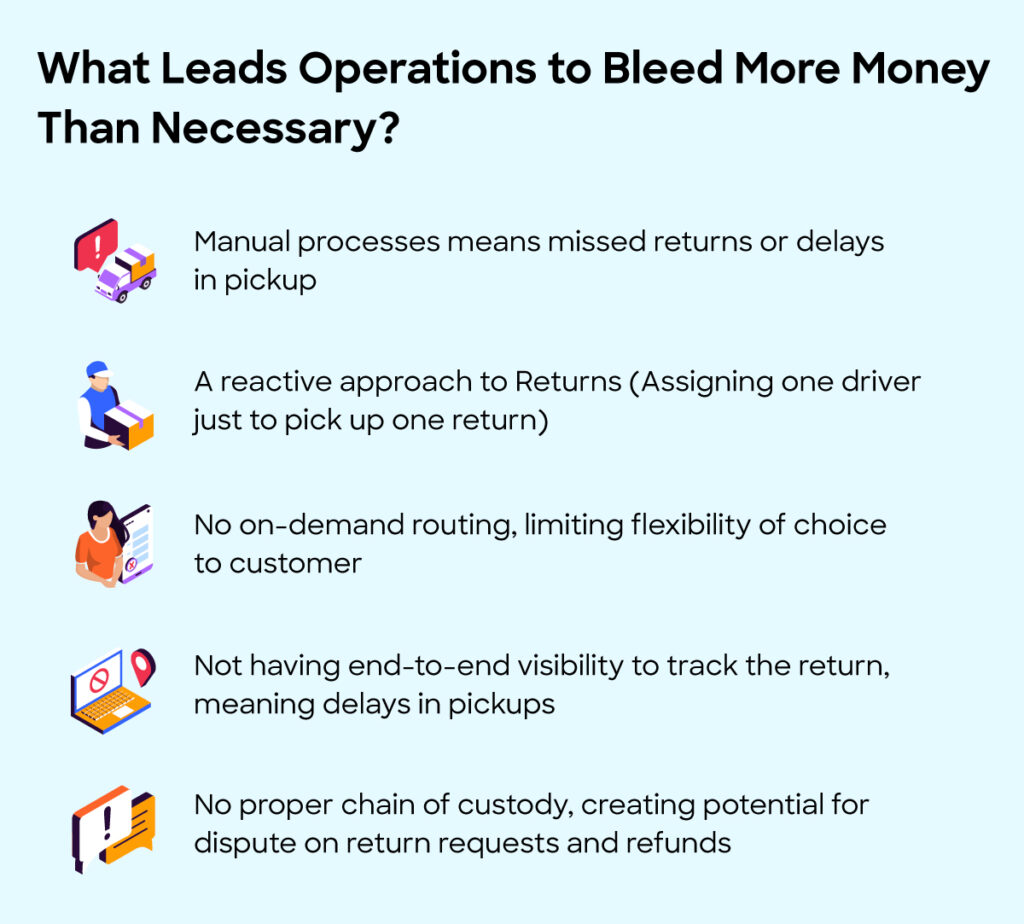
How poor returns management hurts ecommerce and retail businesses
Why enterprises struggle with returns
Most enterprise supply chains are still running on systems built for a world that didn’t have return problems. Early TMS and ERP platforms were designed for outbound freight, not reverse orchestration.
The traditional systems are monolithic and siloed. They were built for outbound freight, not reverse orchestration. They don’t like real-time collaboration with other systems like OMS, WMS, customer service tools, or 3PL platforms.
So what happens is that the ops team can’t see where the return is. The CX team can’t promise a timeline. Inventory numbers get out of sync. And leadership doesn’t have a clean view of how returns are eating into margins, or how to stop it.
Returns thus remains a black hole. Because the outdated systems that run most supply chain pipelines make it that way.
Improve returns management with modern TMS capabilities
E-commerce and retail businesses need new capabilities to have proper returns management in place. For one, on-ground visibility is critical. Real-time, SKU-level visibility into what’s coming back, from where, and how soon. Without this, you’re guessing at inventory, refund timelines, and even potential fraud cases.
Second, consolidation. A smart system should group forward and return shipments on the same route. You’re already paying for the route. Why not increase drop density and reduce the fuel burn?
Third, validation. Real-time proof-of-pickup checklists mean customers get instant updates and replacement/refund triggers. No more “wait 5-7 days” emails.
Then there’s flexibility:
- Assigning the right drivers for return pickups based on real-time factors like availability and proximity.
- Offering customers return slots that work for them.
- Maintaining clean return histories to feed into your planning models.
You need all these capabilities in your system to stop returns from being a liability.
Want to learn more about streamlining returns management? Check out this whitepaper.
Evolve Without Rip-and-Replace
Enterprise leaders resist overhauls for a reason. Rip-and-replace sounds like heart surgery. It’s easier to delay than disrupt.
But modern platforms like Locus don’t ask you to tear down your house. We work modularly, integrating return orchestration into your existing stack without rearchitecting everything. That’s how we helped a leading apparel brand achieve 96% first-attempt return pickups (FADR) and cut fuel usage by 27%.
So the real question is simple: Are you ready to treat returns with the same rigor you apply to delivery? If yes, we can help. Feel free to talk to our experts.
References


CEP and 3PL
Courier Dispatch Challenges: Common Problems and How to Solve Them

Aug 6, 2025
Explore common courier dispatch challenges, delays, high costs, and visibility gaps and learn proven solutions like dynamic route planning and real-time tracking.
Read more
Last Mile Delivery Optimization
Best Last-Mile Delivery Software in 2026: The Complete Enterprise Guide

Aug 29, 2025
Discover the best last-mile delivery software for enterprises in 2025. Compare AI-powered platforms that reduce costs by 30% and optimize delivery operations.
Read moreInsights Worth Your Time




















Returns Management Is the Ultimate Test for Your TMS. Here’s Why