


Retail & CPG
What is Retail Logistics? Key Aspects, Types & Trend [2025]
Key Takeaways
- Retail logistics manages procurement, storage, distribution, and returns, critical for meeting 2025’s rising service-level and efficiency demands.
- Effective logistics prevents stockouts, lowers costs, and enhances customer satisfaction across omnichannel retail environments.
- Core aspects include forecasting, warehousing, transportation, and reverse logistics, all requiring coordination for resilience.
- Trends for 2025 include AI-driven forecasting, micro-fulfillment, sustainable routing, and digital twins for scenario planning.
- Locus empowers enterprises with AI-driven planning, dispatch, and visibility tools that cut manual effort and improve last-mile productivity.
“Why are shelves sitting empty when warehouses still hold stock? Why do delivery expenses increase even as order volumes rise? Why do product returns keep cutting into margins?”
Each of these questions signals a breakdown in retail logistics. Disconnected procurement, inventory, transportation, and reverse logistics processes create inefficiencies that ripple across the supply chain. The result is misaligned inventory, higher last-mile costs, and eroded profitability. Omnichannel retail has made logistics the frontline of customer experience. Without coordination across sourcing, inventory, and delivery, even strong retailers struggle to stay competitive.
This blog explores retail logistics in depth, what it encompasses, why it has become critical in 2025, and the key aspects and types shaping retail operations. It also examines the challenges and market trends leaders must prepare for, and highlights how AI-driven platforms like Locus deliver visibility, cost control, and scalability.
What is Retail Logistics?
Retail logistics is the discipline of managing how products move from suppliers to stores and, increasingly, to customers’ doorsteps. It brings together procurement, inventory planning, warehousing, transportation, and reverse logistics into a single workflow.
When a retailer replenishes stores overnight, ships an e-commerce order the same day, and processes a return the next afternoon, retail logistics is at work. What makes it complex is the constant need to balance delivery speed, operational cost, and product diversity while serving customers with very different expectations.
Grocery chains rely on retail logistics to replenish perishable items daily across multiple stores without creating waste. Decathlon, the French sporting goods retailer, manages thousands of SKUs across categories like cycling, hiking, and fitness equipment, requiring logistics systems that can efficiently support both large-format stores and online fulfillment.
Big Lots, a U.S. discount retailer, faces a different challenge, its logistics teams handle a constantly changing assortment of products, from furniture to packaged food, making demand forecasting and replenishment especially complex.
By 2025, retail logistics functions as a strategic driver of retail performance. It influences customer satisfaction, reduces operational costs, and shapes the ability of retailers to scale sustainably.
Importance of Retail Logistics
Operational gaps in retail often surface in very visible ways. Shelves sit unstocked even though goods are available in storage. Transport costs creep upward because delivery routes are inefficient or poorly sequenced. Customers lose patience when return pickups and refunds take longer than promised. These breakdowns directly erode both revenue and trust.
The Landmark Group, a retail and hospitality conglomerate with 2,200 stores and 10 e-commerce platforms spanning the Middle East, North Africa, India, and Southeast Asia, confronted these issues as it scaled. Planning was manual, consuming nearly 30 minutes for a single fulfillment plan.
After integrating Locus’ order management and route planning systems, planning cycles shrank to two or three minutes, dependence on manual work dropped by more than 80%, and last-mile productivity rose by up to 5%. Drivers began following optimized navigation paths, planners worked with real-time dashboards, and teams aligned tasks without friction. Logistics shifted from a time-intensive chore to a source of measurable advantage.
Well-designed retail logistics also creates value in broader ways:
- Inventory balance: Smarter forecasting curbs stockouts and reduces excess carrying costs.
- Customer experience: Faster deliveries and streamlined returns improve satisfaction and encourage repeat purchases.
- Supply chain visibility: Continuous data feeds allow leaders to anticipate and address disruptions before they escalate.
- Sustainability: Route optimization lowers fuel usage, supporting both cost control and environmental goals.
- Omnichannel readiness: Integrated logistics lets online and offline channels function as one, ensuring consistency across touchpoints.
The retailers positioned to win in 2025 will be those that translate logistics excellence into tangible outcomes, higher productivity, lower costs, and stronger customer loyalty.
Key Aspects of Retail Logistics
Enterprise retailers manage global supply chains that involve thousands of SKUs, multiple distribution hubs, and increasingly complex fulfillment channels. To keep operations efficient and customer expectations in check, retail logistics rests on a few critical components:
• Inventory Management and Forecasting
Forecast accuracy determines how much capital gets locked in stock and whether customers find what they came for. Enterprises now rely on demand-sensing models that factor in seasonality, promotions, and local buying patterns. Improving forecast accuracy by even 2–3% can release significant working capital.
• Warehouse and Fulfillment Operations
Distribution centers have become the heart of omnichannel retail. Automated picking systems, intelligent slotting, and micro-fulfillment centers positioned near dense urban zones help increase throughput while lowering delivery lead times.
• Transportation and Last-Mile Delivery
Transport costs remain one of the largest line items for retailers. AI-powered route optimization improves fleet utilization, cuts idle time, and ensures on-time delivery within tight windows. Locus DispatchIQ, for instance, dynamically adjusts routes based on traffic, weather, and driver availability, helping enterprises achieve up to 15% efficiency gains.
• Reverse Logistics
Returns are no longer an afterthought. With customers expecting flexible return policies, enterprises need structured workflows to recover value from returned goods, whether through resale, refurbishment, or recycling. Streamlined reverse logistics also strengthens ESG reporting and brand credibility.
• Technology and Visibility
Real-time dashboards and predictive analytics give leaders control over inventory positions, delivery progress, and potential bottlenecks. With Locus’ Control Tower, enterprises gain a unified view of logistics operations, enabling faster decisions and coordinated responses across teams.
When these aspects function in conjunction with each other, logistics shifts from a cost burden to a strategic asset, shaping margins, service levels, and long-term scalability.
Types of Retail Logistics
Retail logistics encompasses multiple flows of goods, each serving a distinct purpose in ensuring products reach customers efficiently and profitably. Understanding these flows helps retailers align operations with both cost structures and service expectations.
• Inbound Logistics
Goods travel from suppliers to warehouses or regional distribution centers. For example, apparel chains often import products from factories across Asia and consolidate them at hubs near major markets. Delays in this leg can cascade into stockouts at stores, making supplier coordination and shipment visibility critical.
• Outbound Logistics
Once products leave warehouses, they must reach stores or customers quickly. A retailer like Big Lots, with its wide and constantly changing assortment, relies on carefully sequenced truckloads to replenish shelves without driving up transportation costs. Outbound logistics directly influences both availability and last-mile efficiency.
• Reverse Logistics
Returns, repairs, and recycling represent a growing share of retail flows. Decathlon, which sells equipment across categories from cycling to fitness, manages thousands of returns daily. Efficient reverse logistics allows the company to reshelve, refurbish, or recycle items instead of absorbing them as pure losses, protecting both margins and sustainability goals.
• Omnichannel Logistics
Retailers increasingly integrate stores, fulfillment centers, and e-commerce platforms into one network. Reliance Retail, for instance, manages bulk shipments to hypermarkets while also enabling hyperlocal deliveries from neighborhood stores. Such integration supports models like ship-from-store and buy-online-pickup-in-store, which customers now expect as standard.
When these flows operate as separate silos, inefficiencies compound. Enterprises that integrate inbound, outbound, reverse, and omnichannel logistics gain faster fulfillment, tighter control of costs, and the flexibility to adapt to market shifts. Locus supports this integration by providing an AI-driven platform that connects all logistics flows into a single, intelligent system.
Challenges in Retail Logistics
Retail logistics presents a set of systemic obstacles that enterprises must solve to stay profitable and competitive.
• Fragmented Supplier Networks
Enterprises sourcing from multiple regions often face shipment delays due to inconsistent supplier performance. When one supplier misses a dispatch, downstream distribution schedules unravel, leading to empty shelves despite full upstream inventory.
• Inventory Distortion
Poor demand alignment causes the wrong SKUs to pile up in storage while high-demand items remain unavailable. For example, a retailer may end up with surplus winter coats in one region while another market runs out of stock mid-season.
• High Service-Level Pressures
Customers increasingly expect narrow delivery windows and real-time updates. Meeting these commitments requires precise coordination; a missed slot not only triggers failed deliveries but also forces costly reattempts.
• Complex SKU Proliferation
Enterprises expanding product catalogs encounter higher picking errors, slower warehouse operations, and inefficient truck loading. The more diverse the assortment, the harder it becomes to maintain accuracy at scale.
• Cross-Border Compliance
For retailers operating internationally, varying customs regulations, tariffs, and paperwork add cost and delay. A single missing compliance document can hold an entire shipment at a port, derailing delivery timelines downstream.
Together, these challenges highlight how logistics inefficiencies can accumulate, from supplier sourcing to cross-border distribution, and why enterprises require more agile, coordinated systems to sustain growth.
Retail Logistics Market: Trends [2025]
Retail logistics in 2025 demands a multi-horizon approach. Enterprises must stabilize operations in the near term, scale omnichannel fulfillment over the medium term, and build resilience for long-term competitiveness. Leaders that execute across all three horizons lower operating costs, strengthen margins, and protect customer loyalty in a market where expectations continue to accelerate.
Short Term (0–12 months): Stabilizing Operations
The immediate focus for most retailers is precision. Forecasting errors, inaccurate addresses, and overpromised delivery windows still drive unnecessary costs.
- AI-driven forecasting now incorporates point-of-sale data, promotional calendars, and external variables such as weather and local events. Even a 3–5% lift in forecast accuracy translates into millions in released working capital.
- Data governance and address validation directly reduce reattempted deliveries. Retailers that systematically cleanse customer addresses cut redelivery costs by 10–15%.
- Service-tier alignment ensures that promised delivery speeds reflect actual cost-to-serve. Clear segmentation between premium, standard, and economy windows reduces SLA penalties by 5–8%.
Mid Term (12–24 months): Scaling Omnichannel
After stabilizing core operations, enterprises turn to seamless omnichannel fulfillment. Integrating physical stores, distribution centers, and e-commerce channels allows scale without eroding profitability.
- Micro-fulfillment centers and ship-from-store models reduce average delivery lead times by 20–25% while trimming linehaul expenses.
- Dynamic dispatching and auto-routing increase fleet utilization by 10–15% and maintain predictable delivery times, even during high-demand periods.
- Structured reverse logistics uses automated triage to determine whether items should be resold, refurbished, or recycled. Recent enterprise resilience reports highlight that returns and operational disruptions continue to absorb a significant share of category revenue, with some outages costing over $1 million. Retailers that invest in structured reverse logistics and automation reduce these losses, improving uptime and protecting revenue that would otherwise be eroded by inefficiencies.
Long Term (24+ months): Building Resilience and Sustainability
Enterprises that plan beyond the short cycle embed agility into their networks, protecting against volatility in supply, fuel, and labor markets.
- Digital twins of logistics networks simulate port delays, demand surges, or fuel price swings, compressing scenario planning cycles from weeks to hours and enabling proactive intervention.
- Carbon-aware routing and packaging optimization integrate sustainability into daily workflows. Enterprises that route with emissions as a constraint typically cut CO? per mile by 10–20% while lowering fuel expenditure.
- Balanced automation adoption combines robotics with orchestrated workforce planning. AMRs and goods-to-person systems improve warehouse throughput significantly, while labor scheduling prevents overstaffing during off-peak periods.
Retail logistics in 2025 is no longer defined by operational throughput alone. Enterprises that measure and continuously improve KPIs such as forecast accuracy, fleet utilization, recovery rates, and emissions intensity are the ones turning logistics into a lasting strategic advantage.
Best Practices in Retail Logistics
Retail logistics excellence comes from disciplined execution, not isolated fixes. The following practices help enterprises sustain efficiency at scale:
- Define clear delivery service tiers
Establish differentiated promises, premium, standard, economy, anchored to delivery economics. This ensures predictable costs while offering flexibility to customers. - Maintain rigorous data governance
Standardize address data, SKU masters, and geofences across systems. Clean, consistent data prevents avoidable exceptions in planning and execution. - Segment orders and deliveries
Prioritize by value, perishability, or urgency while consolidating low-density shipments. Segmentation ensures resources are allocated where they have the greatest impact. - Implement multi-echelon inventory planning
Balance stock across distribution centers, hubs, and stores. This reduces variability risks and strengthens product availability where demand is highest. - Instrument reverse logistics
Track returns with the same precision as outbound flows. Structured workflows for inspection, triage, and recovery ensure returned goods re-enter circulation quickly. - Standardize exception playbooks
Define ownership and escalation steps for disruptions such as failed deliveries, dwell time, or missed pickups. Codified playbooks limit operational downtime. - Scorecard external partners
Continuously evaluate carriers and vendors on delivery accuracy, timeliness, and compliance. Linking performance to incentives drives accountability across the chain. - Pilot and scale innovations deliberately
Test emerging capabilities, automation, EV fleets, or micro-fulfillment, in controlled environments. Once stable, scale them systematically to avoid network-wide disruption.
Retail Logistics in 2025: Turning Strategy into Execution with Locus
Retail logistics in 2025 demands speed, accuracy, and resilience that manual systems and fragmented tools cannot deliver. Planning must shift from hours to minutes, delivery routes must update dynamically in real time, and returns must be recovered as revenue instead of written off as losses.
Locus addresses these needs with purpose-built capabilities:
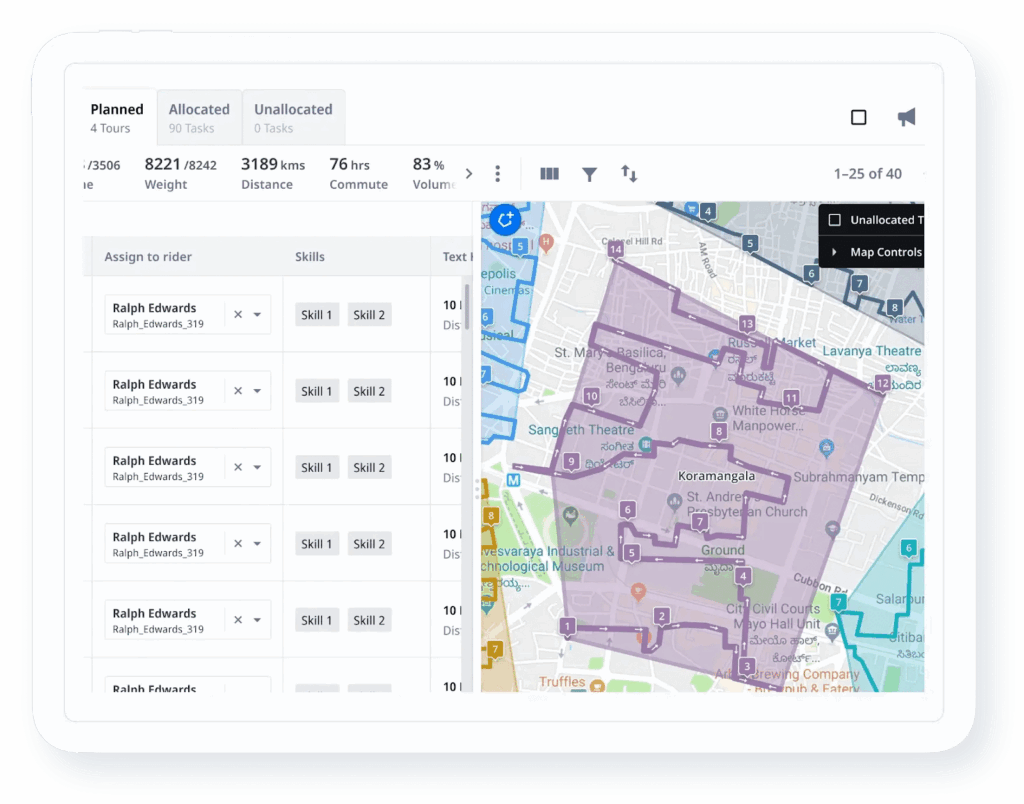
- DispatchIQ improves route efficiency and fleet utilization, reducing wasted miles and delivery costs.
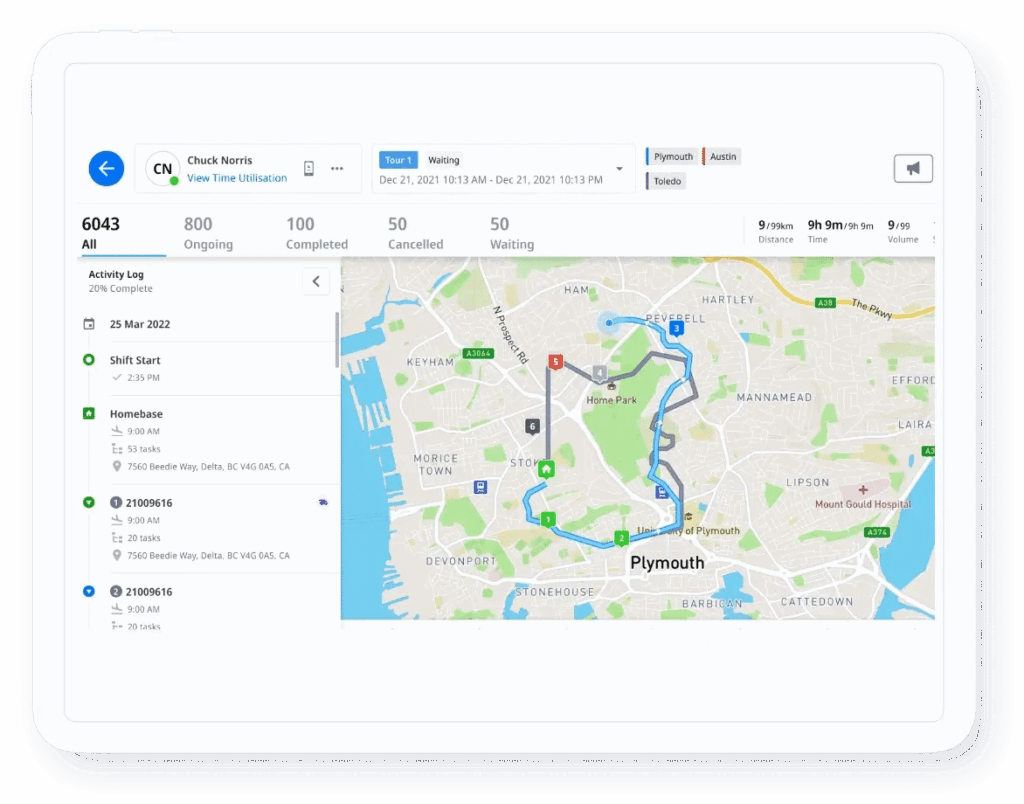
- Control Tower consolidates inbound, outbound, reverse, and omnichannel logistics into one view, giving decision-makers real-time visibility and control.
Enterprises that want logistics to become a competitive advantage rather than a cost center can start now. Book a demo with Locus to see how AI-driven orchestration delivers measurable gains in efficiency, visibility, and customer satisfaction.
Frequently Asked Questions (FAQs)
1. How does retail logistics differ from supply chain management?
Retail logistics focuses specifically on the movement, storage, and delivery of goods in retail operations, while supply chain management covers broader functions including sourcing, procurement, and production.
2. What role does technology play in modern retail logistics?
Technology provides real-time visibility, predictive analytics, and automation across logistics flows. These tools help enterprises streamline execution, reduce errors, and make faster decisions under pressure.
3. How can retailers make logistics more sustainable?
By optimizing delivery routes, reducing packaging waste, and adopting electric vehicles, retailers can cut carbon emissions while improving cost efficiency in last-mile operations.
4. Why is reverse logistics becoming more important?
Rising return volumes in e-commerce and omnichannel retail make reverse logistics essential for recovering value, improving sustainability, and meeting customer expectations for fast, flexible return options.
5. How does retail logistics software improve decision-making?
Platforms like Locus provide unified visibility across inbound, outbound, reverse, and omnichannel flows. This consolidated view helps retailers respond quickly to disruptions while controlling costs and maintaining service levels.

General
What is Integrated Logistics? Key Components & Benefits

Sep 15, 2025
Discover what integrated logistics is, its key components, and how AI-powered integration delivers 25-50% cost reductions while improving supply chain efficiency and customer satisfaction.
Read more
AI in Action at Locus
The Practical Path to AI-Ready TMS: Embellishments that Work Today

Sep 22, 2025
AI Embellishments deliver smarter workflows through practical, low-risk steps that prepare your TMS for the agent-driven future.
Read moreInsights Worth Your Time




















What is Retail Logistics? Key Aspects, Types & Trend [2025]