

Blog, CEP and 3PL
What if the Oil Slipped?

The potential aftermath of Saudi Arabia attacks on world logistics.
Key Takeaways
- The September 2019 drone attacks on Saudi oil facilities disrupted 5% of global crude supply, triggering the largest single-day oil price spike in 30 years and exposing critical infrastructure vulnerabilities.
- Rising fuel costs create a domino effect throughout the supply chain, forcing carriers to raise prices, increasing shipping costs, and ultimately leading to higher consumer prices.
- Companies must focus on improving truck utilization, warehouse consolidation, and evaluating nearshoring versus offshoring options to protect against fuel supply disruptions and price volatility.
- Locus’s AI-powered logistics optimization platform helps businesses minimize fuel usage and optimize operations through real-time tracking and intelligent route planning during supply chain disruptions.
On Saturday, September 14, 2019, Saudi Arabia faced drone attacks at two major oil production facilities – Abqaiq and Khurais, run by state-owned Saudi Aramco. The attack crippled the world’s largest crude oil processing plant cutting down output by 5.7 million barrels per day (BPD), impacting nearly 5 percent of the world’s total crude oil supply and half of Saudi’s oil production. As a single-impact event, it was probably the largest disruption to the oil market ever.
How did the world economy react?
By Monday, the international benchmark Brent Crude jumped almost 20 percent, the highest-ever surge in the past 30 years. The development triggered panic among global traders, who expected a sharp rise in oil prices if Saudi Arabia failed to restore its full oil production capacity in a few weeks. Some analysts opined that global strategic reserves would have to be tapped to avoid a major price spike. Not only was the focus on when the processing plant will return but also whether it can be secured.
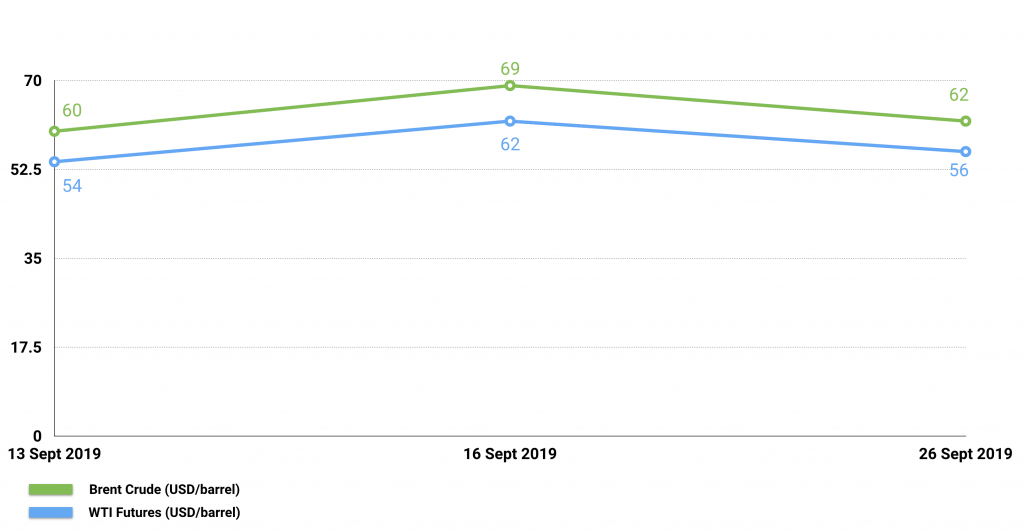
- Oil, like any other commodity, is not immune to market sentiments. The buildup of the US inventories – 2.4 mn barrels, and an optimistic outlook that Saudi Aramco would resume operations sooner than expected, meant that rising prices came to a halt and flattened out. Two externalities leading to recent volatility in oil prices being:
- Slowdown in Chinese industrial and factory output, depressing demand while China scales back on strategic and commercial crude purchases
- Possibility of a trade deal between China and the USA, given that China has resumed buying US agricultural produce
The rise in oil prices adversely affects India’s current account deficit and leads to a depreciation of the Indian rupee, as India is a major crude importer. Subsequently, India is seeking to diversify its oil basket and post bilateral meets at the Eastern Economic Forum 2019, is looking at options to import oil from Russia and invest in Russian crude, to meet her security needs.
Situation under control for now
Even though oil prices eased significantly since Monday’s shock plunge, a cap on Saudi’s oil exports for a few weeks can disrupt the entire logistics ecosystem and industries dependent on it. After all, the attack affected the flows of both crude oil and refined products, as Saudi Arabia cut deliveries to its processing plants to maintain exports. This was not even the first attack on Suadi Arabia’s oil plants in the recent past, highlighting the vulnerability of the Arabian peninsula’s oil production and the far-reaching implications of political clashes in the Middle East on the rest of the world.
The potential impact of such attacks
For global logistics and economy, the real risk is not the attack itself, but rather the potential of the attack to vital energy infrastructure. With the U.S. and Saudi already accusing Iran of the attacks, there is a dangerous game of chicken at play here. In case there are any further escalations in the future or any more such attacks on oil plants in Saudi Arabia, or elsewhere, the whole of the logistics world will feel the heat of fuel shortage and price hike. Consequently, companies with high price sensitivities will need to implement suitable hedging strategies to offset Fx risks.
To begin with, if the cost of fuel rises, carriers are forced to raise prices or take losses. In turn, the cost of fuel affects not only the logistics company but also the shipper and its profit source as well. It is an outward domino effect: if it costs more for the freight carrier to transport the freight, the shipper is going to be charged more to make up for this. If the shipper is going to be charged more to transport the cargo, the receiver is going to be charged more to make up for their added costs.
The preferred means for transportation will shift as well as it becomes less and less economically viable to move freight using fuel-inefficient methods relative to the market. For instance, if the cost of rail usage is low and fuel costs are high, a logistics company may ship more freight via intermodal carriers than over the road trucks.
This means the products are going to be sold to consumers at higher costs to make up for higher transportation and fuel costs. Basically, higher fuel costs cause product inflation and affect every aspect of production transportation along the way. Petrochemicals have suffered the most from oil price shocks. The tire, plastic and FMCG industry for instance, which have a high price sensitivity to oil, has usually transferred increased costs to consumers.
The bottom line: higher fuel costs means a higher price passed on to consumers. The consumer in return might opt to buy less because of decreasing disposable incomes, sending the global economy into a downward spiral.
How organizations are becoming ready for such scenarios
With the fuel shortage already a concern for supply chains all around the world, any incident akin to the Saudi oil attacks can further add to the woes. For being prepared for such incidences, businesses need to focus on the following steps:
- Companies need to improve truckload utilization, make better use of their transport capacity.
- Utilization of shared resources: 3PL players and warehouse consolidation need to increase. Large consolidated warehouses should aggregate orders into Full Truck Load (FTL) shipments to reduce costs.
- In a volatile environment, businesses need to decide between “offshoring” and “nearshoring”, in order to optimize their supply chains.
- Companies need to enable more technology in their operations: telematic solutions like real-time tracking of resources, via GPS, is increasingly becoming a necessity.
Many businesses, therefore are using AI-enabled solutions for Supply Chain that help them in the decision-making process for working with minimal fuel and optimizing their operations.
One such technology platform is Locus. To know more about our services Schedule a Demo!.
Sources: Directdrivelogistics , ET

This post was authored by: Sreshtha Das

E-Commerce
The Great Supply Chain Balancing Act: Juggling the Festive Season Rush
Sep 16, 2019
Key Takeaways Festive celebrations are a global phenomenon, marked by a rich tapestry of traditions and customs unique to every region. Whether it’s the resplendent lights of Diwali in India, or the vibrant festivities of Brazil’s Carnival, these occasions transform societies into pulsating hubs of activity. Yet, behind the scenes, retailers grapple with a formidable […]
Read more
Blog
No Deal Brexit: A Nightmare for European Logistics?

Oct 14, 2019
Key Takeaways Brexit has been a sensational controversy for a long time now but long-delayed for several reasons. However, D-Day is approaching soon. The much-awaited divorce between the UK and the EU is scheduled to take place at 23:00 GMT on the 31st of October, making the Halloween of 2019 even more eventful. Brexit marks […]
Read moreInsights Worth Your Time

















What if the Oil Slipped?