


Dispatch Management
Automated Sorting Systems Explained: Types, Use Cases & Benefits
Key Takeaways
- The global automated sortation system market is valued at USD 9.3 billion in 2025 and projected to reach USD 16.2 billion by 2034, confirming sortation as a strategic investment priority.
- Manual parcel sorting becomes inefficient and costly when handling thousands of packages, leading to increased errors, delivery delays, and unsustainable labor costs for enterprise operations.
- Address inconsistencies and incorrect geocoding cause 7–8% of deliveries to be misrouted, significantly impacting delivery times and operational costs in last-mile logistics.
- Locus’ AI-powered auto-sortation reduces shipment processing time by 65%, cuts required labor hours by 50%, and increases daily delivery capacity by 27%.
- Locus’ proprietary geocoding engine achieves door-level accuracy in complex address environments—something generic APIs cannot match—by leveraging real-world data from 360+ enterprises.
Today’s digital consumers are informed, demanding, and unforgiving when it comes to delivery speed. For enterprise retailers, 3PLs, and e-commerce operations leaders managing high-volume fulfillment centers, manual parcel sorting is no longer sustainable. As package volumes surge—driven by a global automated sortation system market projected to reach USD 16.2 billion by 2034—the gap between what warehouses need to deliver and what manual processes can handle is widening fast.
Address inconsistencies, vague landmarks, and incorrect geocoding cause 7–8% of shipments to be misrouted, escalating costs and eroding customer trust. Meanwhile, 60% of companies already use conveyor and sortation systems in fulfillment operations, and another 40% plan to upgrade or implement them within the next two years.The solution lies in intelligent, AI-powered automated sortation—systems that combine precision geocoding, machine-learning route assignment, and real-time data to replace guesswork with speed. This guide explains how automated sortation systems work, the types available, their measurable benefits, and how Locus’ proprietary technology solves the dual challenges of address accuracy and last-mile delivery efficiency for FMCG, retail, and logistics enterprises.
What Is an Automated Sortation System in a Warehouse?
An automated sortation system moves and organizes items to their correct locations inside a warehouse or distribution center with minimal human intervention. It operates through a three-step process:
- Induction: Items are placed onto a conveyor, either manually or through an automated feed mechanism.
- Identification: Barcode scanners, RFID sensors, or optical cameras read package data to determine destination, order type, and priority.
- Sorting/Diverting: Mechanical mechanisms—shoes, trays, belts, or wheels—route each item to the correct chute, lane, or zone based on delivery route, geographic region, or fulfillment priority.
Think of it as a smart traffic system inside the warehouse, guiding every parcel smoothly to where it needs to go. Operating at over 99.9% accuracy, automated sortation systems replace error-prone manual processes with high-speed, consistent throughput—critical for enterprise retailers, 3PLs, and e-commerce operations processing thousands of orders daily.
With AI-powered tools like Locus Auto-Sortation, this process becomes faster and more reliable. Real-time data and machine-learning algorithms scan, categorize, and assign parcels automatically. The system analyzes package size, weight, delivery destination, and fleet availability to allocate each shipment to the optimal route and driver, enabling warehouses to process higher volumes with significantly less effort.
Key Components of an Automated Sortation System
An automated sortation system is one part of a broader warehouse material handling flow. Its performance depends on how consistently parcels move from entry to identification, diversion, discharge, and dispatch staging. The core components typically include:
- Induction points: The starting point where parcels, cartons, totes, or polybags enter the sortation line. Induction can be manual, semi-automated, or connected to upstream conveyor feeds.
- Identification stations: Barcode scanners, RFID readers, optical cameras, or dimensioning systems capture package data and link each item to an order, destination, service level, or route.
- Conveyor belts and transport lanes: Conveyors move items at a controlled speed through the sortation system, keeping flow consistent between induction, scanning, and diversion.
- Sensors: Photo-eyes, weight sensors, spacing sensors, and tracking logic help detect item position, gaps, jams, and exceptions before they impact throughput.
- Diverters: Shoes, wheels, trays, belts, or push mechanisms move parcels away from the main line and towards the correct destination.
- Discharge points: The physical locations where items leave the main sorter and are directed into a chute, lane, bin, or staging area.
- Outfeeds: Downstream conveyor lanes, chutes, gravity rollers, or staging lines that carry sorted items towards packing, consolidation, loading, or dispatch.
- Sorting bins and totes: Containers used to group orders, parcels, returns, or route-specific shipments after diversion.
- Control software: The WCS, WES, WMS, or routing intelligence layer that translates order, inventory, destination, and dispatch data into real-time sorting instructions.
For enterprises, the most important question is not only whether the mechanical sorter can move items quickly. It is whether the full system—from induction points to outfeeds—can make accurate decisions at operational speed, especially when delivery addresses, route plans, SLAs, and capacity constraints change throughout the day.
Types of Automated Sortation Systems
Automated warehouses use different types of sortation systems depending on product type, handling speed, throughput requirements, and facility layout. Understanding each system’s mechanics helps operations leaders select the right solution for their volume and product mix.
Linear vs. Loop Sortation Layouts
Beyond the mechanical sorter type, automated sortation systems can also be grouped by layout. Linear sortation systems move items along a straight conveyor path, with discharge points positioned along one or both sides of the line. They are often suitable for facilities with predictable flow, clear dispatch lanes, and straightforward space planning.
Loop sortation systems recirculate items around a closed loop, allowing parcels to pass multiple discharge points until the correct chute, tote, bin, or outfeed is available. This layout can support high-volume operations with many destinations, multiple discharge points, and greater flexibility when exceptions or temporary congestion occur.
| Sorter Type | How It Works | Best For | Throughput Range |
|---|---|---|---|
| Tilt-Tray Sorters | Trays mounted on a moving conveyor tilt to slide items into the correct chute when they reach their destination. | Parcels and small items requiring gentle handling. | 10,000–27,000 units/hr |
| Cross-Belt Sorters | Small motorized belts on a continuous track move items in different directions for precise placement. | Mixed-size packages requiring high-speed, accurate sorting. | 15,000–27,000 units/hr |
| Sliding Shoe Sorters | Sliding shoes attached to a conveyor push items laterally into the correct lane. | Cartons, boxes, and polybags of various sizes. | 3,000–5,000 units/hr |
| Push-Tray Sorters | A mechanical arm or pusher moves items off the conveyor into bins without tilting or dropping. | Delicate products such as apparel or electronics. | 2,000–4,000 units/hr |
| Pop-Up Wheel Sorters | Rollers or wheels pop up at specific points to divert items along different paths. | Medium-speed operations needing a simple, cost-effective setup. | 2,000–6,000 units/hr |
| Robotic Sorters (AGV/AMR) | Autonomous mobile robots carry and sort items between zones without fixed conveyor infrastructure. | Flexible, modular setups with variable item types. | 30–60 parcels/min |
Modern AI-based tools like Locus Auto-Sortation integrate with any of these physical systems to automate the routing logic layer—determining which package goes where based on real-time geocoding, delivery windows, and rider availability—eliminating manual decision-making entirely.
Benefits of an Automated Sortation System
Automated sortation brings measurable advantages across speed, accuracy, and cost efficiency. For enterprise retailers, 3PLs, and FMCG distributors, these are not incremental improvements—they are operational transformations. Here is how it helps operations perform better.
Speed and Throughput
Automated sortation moves and routes parcels continuously without human intervention. High-speed cross-belt and tilt-tray sorters handle up to 27,000 units per hour, reducing manual touchpoints, shortening cycle times, and boosting overall throughput. Warehouses process thousands of orders per hour with consistent pace and precision. Locus clients have achieved a 65% reduction in shipment processing time by automating sorting and route allocation.
Accuracy
Using barcode scanners, RFID sensors, or optical scanning, the system identifies each package and directs it to the correct chute or zone. This eliminates manual sorting mistakes. Automated sortation operates at over 99.9% accuracy, ensuring every parcel reaches the right destination on time—a critical factor for enterprises managing flawless sorting accuracy at scale.
Cost Efficiency
By automating repetitive sorting and reducing reliance on manual labor, businesses save on staffing costs and avoid costly rework. Locus clients report a 50% reduction in manual labor hours, with improved accuracy minimizing returns and increasing profit margins. The global automated sorting systems segment generated USD 4,495.1 million in revenue in 2025, reflecting the strong ROI enterprises are realizing from these investments.
Scalability
Automated sortation easily adapts to fluctuating order volumes and seasonal peaks without requiring additional manpower or space. Modular architectures allow businesses to expand capacity incrementally—a critical advantage for e-commerce giants scaling their logistics operations.
Real-Time Visibility
Integrated software provides real-time insights into package flow, equipment status, and performance metrics. This visibility allows managers to spot delays, forecast demand, and make data-driven decisions to optimize throughput and resource allocation. When combined with a WMS or WES, sortation data feeds directly into fulfillment planning—enabling dynamic adjustments throughout the day.
Common Use Cases for Automated Sortation Systems
Automated sortation systems are used wherever high-volume parcel, carton, tote, or order movement must be completed with speed and accuracy. For enterprise operations, the strongest use cases are in sectors where delivery promise, SKU complexity, and peak-day volatility directly affect revenue and customer experience.
- Retail distribution: Retailers use automated sortation to move store replenishment, click-and-collect orders, and direct-to-consumer parcels into the right outbound lanes, helping teams manage both store and online demand from shared facilities.
- E-commerce fulfilment: E-commerce operations rely on automated sortation to process mixed order profiles, route parcels by carrier or delivery zone, and maintain fast dispatch cycles during sale events and seasonal peaks.
- FMCG and CPG logistics: FMCG and CPG businesses use sortation to handle high-volume, time-sensitive flows across distributors, modern trade, general trade, and direct delivery networks.
- Food and beverage distribution: Food and beverage operations benefit from rapid, accurate sortation where freshness, route sequencing, temperature-sensitive handling, and delivery windows are critical to service quality.
- 3PL and courier logistics: 3PLs and courier networks use sortation to consolidate shipments from multiple shippers, split them by service level or destination, and stage them for efficient last-mile dispatch.
Where Sortation Fits in Fulfillment Workflows
Sortation supports several operational workflows beyond simply moving parcels from one chute to another:
- Order fulfillment: Once orders are picked and packed, sortation directs parcels to the correct dispatch lane, carrier, delivery zone, or route.
- Kitting workflows: Items required for the same kit, bundle, or fulfilment task can be grouped into totes or bins before downstream consolidation.
- Cross-docking: Inbound goods can be quickly identified and moved to outbound lanes with minimal storage time, reducing dwell time inside the facility.
- Returns handling: Returned items can be sorted by disposition path, such as inspection, restock, refurbishment, vendor return, or disposal.
- Dispatch staging: Sorted parcels can be sequenced into route-ready lanes, totes, bins, or outfeeds so drivers and riders spend less time waiting and more time delivering.
Locus strengthens this workflow at the intelligence layer. Rather than replacing warehouse hardware, Locus helps enterprises make better parcel-to-route and parcel-to-rider decisions by combining geocoding, clustering, route optimisation, and dispatch orchestration.
The Risks of Manual Sorting Methods
For enterprise supply chain leaders, manual warehouse sorting leads to costly errors, slow deliveries, and unsustainable overhead. Consider a typical scenario at an in-house logistics warehouse or distribution center: manual sorters rely on reading addresses or PIN codes attached to packages and subsequently assigning each parcel to the agent they believe knows a locality best.
While packing and route planning are essential optimization problems in logistics, a bigger challenge often precedes both.
1. Identifying the Exact Delivery Destination
In countries like India, where the address system is descriptive rather than formatted, geocoding becomes extremely difficult. Malformed addresses containing misspellings, wrong PIN codes, and vague landmarks further complicate the problem. Generic geocoding APIs lack the contextual understanding to resolve these ambiguities at the door-number level.
2. Assigning the Right Rider to the Right Route
Sorting of deliveries into their respective routes and riders is traditionally determined by the area PIN code entered by the end customer when placing an order. Without uniformity in address formats, delivery routes often overlap—cutting into delivery time and reducing efficiency. 7–8% of delivery shipments are routed to the wrong destination, escalating the cost to re-route each package to the correct drop-off location.
For operations leaders managing last-mile delivery in Southeast Asia and other complex address environments, these challenges compound as volume scales. Manual sorting is not just inefficient—it becomes a structural bottleneck that limits growth.
Auto-Sortation: From Hours to Minutes
Locus has built advanced geocoding solutions that combine machine learning, natural language processing (NLP), and rule-based improvements to gather complete address information. These solutions capture not only the diversity in address formats but also the diversity in language and scripts in which addresses are provided.
Geocoding is the process of converting human-written addresses to global coordinates (latitude and longitude) that are unambiguously understandable by machines. Google Geocoder’s autocorrecting feature works well for suggesting correct localities as users type. However, this feature becomes inadequate when addresses are pre-submitted by end users—there is no ability to prompt alternatives or fix errors after the fact.
Example: For the address “202, Esteem Gardenia behind Swathi Gardenia, Sahakara Nagar, Bangalore”—
- The Google markup pinpoints a nearby restaurant called “Swati Gardenia” instead of the actual delivery address.
- The Locus Geocoder pinpoints the exact delivery address on the map, irrespective of obscure landmarks mentioned by the end customer—capturing accurate location rather than a vague reference point.
Most geocoding APIs are inefficient without the option of “suggestions,” partially because of missing context. Locus’ Geocoding API finds the most accurate coordinates for the address under consideration—accurate to door number, lane, and locality.
A significant reason for Locus Geocoder’s success is access to a high volume of address data shared by clients, along with the delivery information associated with those addresses. As data volume increases, geocoding accuracy improves—leading to more profitable and optimized delivery routes.
Achieving Seamless Auto-Sortation with Locus
On a daily basis, a massive volume of goods are packaged and shipped from one location to another. Delivering shipments between points is never straightforward—especially for 3PLs and enterprise retailers managing complex, multi-zone fulfillment networks.
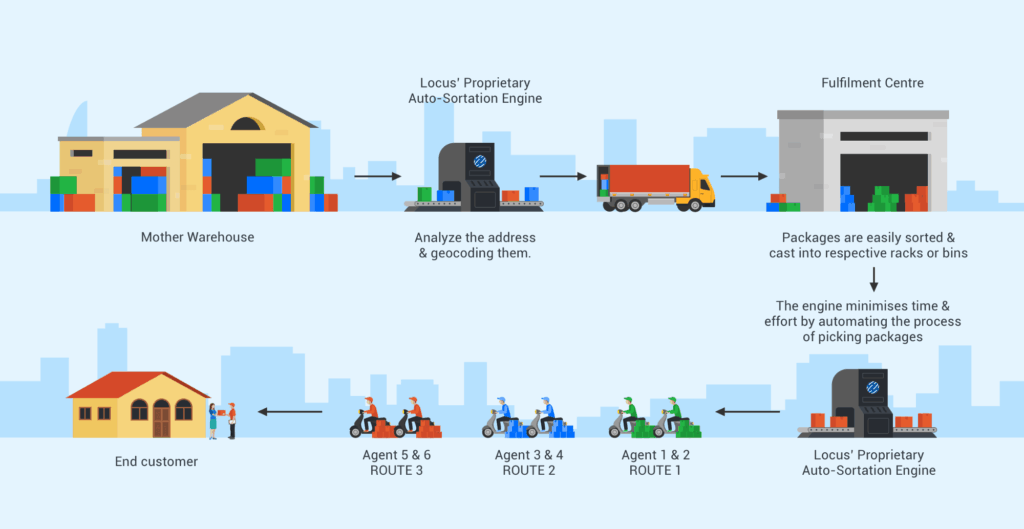
Locus’ automated parcel sortation engine resolves two critical challenges at warehouses:
- Deciphering the exact delivery destination from unstructured, multilingual addresses
- Assigning optimal routes to the right rider based on real-time conditions
The advanced geocoding technology intelligently deciphers fuzzy addresses attached to each parcel and converts them to geo-coordinates (latitude and longitude) at the packaging level itself. Every package is automatically assigned to the most optimal delivery route and the rider best suited for it. The coordinates are grouped to create the most profitable routes or clusters and assigned to the right delivery agent beforehand.
This eliminates the need for human effort and intelligence for the process of sorting and allocating routes based on PIN codes. The advanced algorithm replaces multiple manual checks involved in sorting packages, increasing rider efficiency and enabling faster delivery.
Measurable Impact from Locus Auto-Sortation
| Metric | Result | How |
|---|---|---|
| Shipment Processing Time | 65% reduction | Automated sorting via Locus’ dynamic auto-sorting engine removes human intervention and eliminates misrouting. |
| Manual Labor Hours | 50% reduction | Inbound operations are automated end-to-end, eliminating manual checks and sorting decisions. |
| Daily Shipment Deliveries | 27% increase | Riders spend more time in the field with optimized routes, higher task execution rates, minimal errors, and fewer SLA breaches. |
Locus’ intelligent algorithm solves logistics challenges by factoring in real-world fuzziness—supporting unpredictable networks, dirty location data, and hundreds of exception scenarios. The key pain points addressed are consistency (planning output is not linked to a single person), efficiency (optimal quality at every distribution center), and transparency (real-time visibility into every sortation decision).
Sortation System Integration with WMS and Route Optimization
An automated sortation system delivers maximum value when tightly integrated with a warehouse management system (WMS) and route optimization engine. Here is how the integration works:
- Order ingestion: The WMS receives incoming orders with delivery addresses, SLAs, and package specifications.
- Geocoding and classification: Locus’ AI engine converts raw addresses into precise geo-coordinates, classifying each shipment by delivery zone, priority, and rider suitability.
- Sorting instruction dispatch: The sortation system receives real-time instructions—routing each parcel to the correct physical chute, lane, or staging area.
- Route assignment: Simultaneously, the route optimization engine clusters shipments into optimal delivery sequences, assigns riders, and generates turn-by-turn navigation.
- Feedback loop: Delivery outcomes feed back into the system, continuously improving geocoding accuracy and route efficiency over time.
This closed-loop integration means that choosing the right route planning software is not a separate decision from sortation—it is part of the same automation ecosystem. When sortation and routing work together, enterprises unlock compounding efficiency gains that isolated systems cannot match.
How to Choose the Right Automated Sortation System
Choosing an automated sortation system requires more than comparing sorter speeds. The right decision depends on operational fit, parcel mix, facility design, integration maturity, scalability requirements, and the quality of the software orchestration layer connecting warehouse activity to dispatch execution.
Key evaluation areas include:
- Item compatibility: Assess parcel size, shape, weight, fragility, packaging format, and whether items move in cartons, totes, polybags, or mixed containers.
- Facility layout: Determine whether the site is better suited to linear sortation systems, loop sortation systems, or a modular configuration connected to existing conveyors and outfeeds.
- Destination complexity: Map how many lanes, chutes, sorting bins, totes, dispatch zones, carrier lanes, or route groups the system must support.
- Integration readiness: Confirm how the sorter will exchange data with WMS, WES, WCS, TMS, route optimisation, and dispatch management systems.
- Exception handling: Plan for unreadable labels, damaged parcels, late order changes, returns, overflow, and recirculation.
- Software intelligence: Ensure the system can convert order, address, capacity, SLA, and route data into real-time sorting decisions.
Throughput and Peak Volume Planning
Throughput planning should account for both average operating volume and peak-day parcel flow. The sorter comparison table above shows that different systems can range from a few thousand units per hour to high-speed configurations handling tens of thousands of units per hour. Enterprises should size systems for realistic demand patterns, including sale events, festive peaks, promotional spikes, and late cut-off waves.
Underestimating peak demand creates downstream congestion at discharge points, outfeeds, staging lanes, and dispatch docks. Overbuilding capacity, meanwhile, can lock capital into underused infrastructure. The strongest approach is to model hourly flow, not just daily volume, and align sortation throughput with labour availability, carrier cut-offs, vehicle departure times, and route planning cycles.
Budget, ROI, and Long-Term Savings
Automated sortation involves upfront investment in hardware, controls, integration, implementation, and process redesign. The business case should therefore compare initial investment against long-term savings from reduced manual labour, fewer misroutes, lower rework, higher throughput, better SLA adherence, and faster dispatch readiness.
The ROI discussion should also include the intelligence layer. A high-speed sorter still creates value leakage if parcels are assigned to the wrong route, chute, or rider because of poor address quality or static planning logic. Enterprises should evaluate how software-driven geocoding, clustering, and route optimisation improve the return from physical automation.
Sortation Within the Broader Material Handling System
Sortation is a specialised function within the broader material handling system. It sits between upstream activities such as receiving, picking, packing, induction, and identification, and downstream activities such as outfeeds, staging, loading, route dispatch, and delivery execution.
For this reason, sortation should not be evaluated in isolation. It must connect to conveyors, induction points, identification stations, discharge points, sorting bins, totes, staging lanes, WMS, WES/WCS, and route optimisation. When these systems operate as one coordinated flow, enterprises can reduce dwell time, improve dispatch accuracy, and convert warehouse automation into measurable last-mile performance.
Future Trends in Automated Sortation
Automation in warehouse sortation is evolving rapidly, driven by AI, robotics, and sustainability goals. Looking into 2026 and beyond, the next generation of systems focuses on adaptability, intelligence, and accessibility. Here are the key trends shaping the future of automated sortation.
- Integration with AI and predictive analytics: Sorters will use AI and predictive models to forecast demand, spot anomalies, and dynamically adjust paths. This means fewer delays and smarter error correction in real time—moving sortation from reactive to proactive.
- Adaptive and modular architectures: Systems will be designed so modules can be added, reconfigured, or upgraded without full rebuilds. This increases flexibility and reduces downtime during scaling—essential as the automated sortation system market grows at a CAGR of 6.3% through 2034.
- Autonomous robotics and mobile sorters: Robots and mobile systems will carry items between zones or sort directly. They will handle increasingly complex jobs independently, reducing reliance on fixed infrastructure and enabling rapid warehouse reconfiguration.
- IoT and real-time sensor feedback: Sensors will continuously monitor flow, load, and package condition, allowing sorters to slow, speed up, or reroute items to avoid congestion or damage. Innovations like Interroll’s MCP PLAY already enable up to 100% higher throughput and 30% lower energy consumption in automated conveyor systems.
- Unified software orchestration (WES / WCS / digital twin): Sortation systems will be tightly managed by execution software or digital twins that simulate operations and optimize sorting flows before real-world action—reducing trial-and-error in high-volume environments.
- Accessible automation models: Smaller operations will adopt “automation-as-a-service” models, paying for sortation capacity on demand rather than investing heavily in hardware. This democratizes enterprise-grade sortation for mid-market logistics providers.
- Sustainability and energy-efficient sorting: Future sorters will aim to reduce power use and waste, with strategies such as low-energy modes during idle periods and smarter routing to cut emissions—aligning with green logistics and sustainable supply chain goals.
- Greater handling precision and variability: Systems will evolve to more precisely divert items based on weight, size, fragility, or destination, enabling mixed-product sorting in the same line—a critical capability for enterprises handling diverse on-demand logistics challenges.
Result of an Ad-hoc warehouse sorting methods
Consider a typical scenario at an In-house logistic warehouse or a distribution centre. Manual sorters heavily rely on reading address or pin codes attached to the packages and subsequently assigning it to the agent he thinks is well versed with a locality.
While packing and route planning are essential optimization problems in logistics, often a bigger challenge precedes these considerations which include-
1. Identifying the exact delivery destination –
In countries such as India, where the address system is ‘descriptive’ rather than ‘formatted’, geocoding can get very difficult. Further, malformed addresses that contain misspellings, wrong PIN codes and vague landmarks can further complicate the matter.
2. Assigning Right Rider to the Right Route –
Sorting of deliveries into their respective routes & riders is determined by the area PIN code fed by the end customer while placing an order. With lack of uniformity in clearly defining addresses in our country, the delivery routes often get overlapped which cuts into the delivery time leading to decrease in efficiency. 7–8% of the delivery shipments are routed to the wrong destination leading to escalation in cost to re-route it to the correct drop-off location.
Auto-Sortation? – ?From Hours to Minutes
We at Locus have built advance geocoding solutions that combines Machine Learning, Natural Language Processing (NLP) and rule-based improvements to gather complete address information. Our solutions capture not only the diversity in address formats but also the diversity in language and the scripts in which addresses are provided.
Geocoding is the process of converting human written addresses to their global coordinates (latitude & longitude) which are unambiguously understandable by machines. In case of Google Geocoder, its autocorrecting feature is remarkable because of its ability to suggest you “correct” localities as you type. However, this feature becomes inept as the details get more granular because the addresses are already provided by the end users and the inability to fix the errors by prompting possible alternatives.
The following map depicts the location markup for the exact address “202, Esteem Gardenia behind swathi gardenia, Sahakara nagar, Bangalore”
The Google markup (Black pin) pinpoints to a nearby landmark ‘Swati Gardenia’, a restaurant instead of the delivery address.
Locus Geocoder (Green Pin) pinpoints the exact address on the map irrespective of any obscure landmark mentioned by the end customer in their addresses, thus capturing accurate location instead of vague landmark.

Most geocoding APIs are inefficient without the option of “suggestions” partially because of the missing “context”. Locus’ Geocoding API helps find the most accurate coordinates for the address under consideration, accurate to door number, lane and locality.
A significant reason for the success of Locus Geocoder is the access to a high volume of address data that our clients share with us along with the delivery information associated with those addresses. As the size of data increases, our geocoding accuracy leads to more profitable and optimized delivery routes.
Achieving Seamless Auto-Sortation with Locus
Why Choose Locus for Automated Sortation
Generic sortation tools handle the physical mechanics of moving packages. Locus solves the intelligence layer—the decisions that determine whether a package reaches the right person, on the right route, at the right time. Here is what sets Locus apart:
Proprietary AI Geocoding for Door-Level Accuracy
Locus’ geocoding engine resolves unstructured, multilingual addresses to precise latitude and longitude coordinates—accurate to door number, lane, and locality. Unlike generic APIs that rely on formatted inputs, Locus handles descriptive addresses, misspellings, and vague landmarks by combining machine learning, NLP, and rule-based corrections trained on real delivery data.
Real-World Data from 360+ Enterprises
Locus’ geocoding and routing accuracy improves continuously through access to high-volume address and delivery data from 360+ global enterprise clients. This data flywheel means the system gets smarter with every shipment processed—a compounding advantage no standalone geocoding API can replicate.
Scalable Automation Built for High-Volume Operations
Whether processing 5,000 or 500,000 shipments per day, Locus’ auto-sortation engine scales without proportional increases in labor or infrastructure. The system integrates seamlessly with existing WMS, TMS, and physical sortation hardware, making deployment fast and disruption-free.
End-to-End Dispatch Intelligence
Locus does not just sort—it optimizes. From geocoding to route clustering to rider assignment, the platform delivers a unified workflow that ensures consistency across every distribution center and warehouse. The result: predictable, repeatable performance regardless of who is managing the operation.
“Our mission is to make enterprise logistics effortless, accurate, and scalable.” — Nishith Rastogi, Founder & CEO, Locus
Frequently Asked Questions (FAQs)
What is the primary function of an automated sortation system?
An automated sortation system identifies, routes, and directs items to specific destinations based on barcode, RFID, or optical scanning data. It replaces manual sorting with high-speed, conveyor-based or robotic technology, handling hundreds to tens of thousands of items per hour with over 99.9% accuracy. The system follows a three-step process—induction, identification, and sorting/diverting—to ensure every parcel reaches the correct zone or chute.
What are the main types of automated sortation systems?
The primary types include sliding shoe sorters (push items via shoes at 3,000–5,000 units/hr), cross-belt sorters (individual motorized carts handling 15,000–27,000 units/hr), tilt-tray sorters (trays tilt to drop items at similar high-speed ranges), robotic sorters (AGVs/AMRs for flexible routing at 30–60 parcels/min), push-tray sorters (gentle handling for fragile goods), and pop-up wheel sorters (cost-effective medium-speed operations). Each is optimized for different throughput, item size, and accuracy requirements.
What are the key challenges in parcel sorting and last-mile delivery?
Parcel sorting and last-mile delivery face significant challenges including accurately identifying delivery destinations from unstructured or descriptive addresses, assigning the right rider to the optimal route, and minimizing misrouted shipments. Manual sorting methods that rely on reading addresses and assigning riders based on area knowledge are inefficient and error-prone at high volumes—with 7–8% of shipments routed to wrong destinations.
How does Locus’ automated sorting system work?
Locus’ automated parcel sorting engine resolves two critical challenges: deciphering exact delivery locations from fuzzy, multilingual addresses using proprietary AI geocoding, and assigning optimal routes to the right riders. Packages are automatically geocoded to precise coordinates at the packaging level, grouped into profitable route clusters, and assigned to suitable riders—eliminating manual sorting and route allocation entirely. The system achieves a 65% reduction in processing time and a 50% reduction in labor hours.
How does Locus’ geocoding technology improve address accuracy?
Locus’ geocoding API leverages machine learning, natural language processing (NLP), and rule-based improvements to accurately convert unstructured addresses into precise geographic coordinates. It accounts for diverse address formats, languages, and scripts—pinpointing locations down to door numbers and lanes rather than relying on vague landmarks. Unlike generic geocoding APIs, Locus is trained on real-world delivery data from 360+ enterprises, creating a continuously improving accuracy advantage.
How much can automated sortation improve warehouse efficiency?
Automated sortation systems reduce processing time from receiving to shipping, increase throughput by 40–60% compared to manual methods, and reduce labor requirements by 30–50%. Locus clients specifically report a 65% reduction in shipment processing time, a 50% reduction in manual labor hours, and a 27% increase in daily shipment deliveries. The global automated sorting systems segment generated USD 4,495.1 million in revenue in 2025, reflecting the strong ROI enterprises are realizing.
How do sortation systems integrate with warehouse management systems (WMS)?
Sortation systems connect to a WMS via real-time data exchange. The WMS sends sorting instructions based on order priority, inventory levels, and delivery schedules, while the sortation system provides live status updates on item movement. With Locus, this integration extends to route optimization—creating a closed-loop system where geocoding, physical sorting, route clustering, and rider assignment operate as one unified workflow.
What emerging technologies are enhancing sortation systems?
Artificial intelligence, machine learning, predictive analytics, and IoT sensor networks are increasingly integrated into sortation systems. These technologies optimize sorting paths in real time, forecast demand, predict anomalies, and handle irregularly shaped items. Digital twins and warehouse execution software (WES) simulate operations before execution, while autonomous mobile robots (AMRs) provide flexible, infrastructure-light sorting alternatives.
What is the typical ROI timeline for automated sortation?
ROI varies by operation scale and complexity, but enterprises typically see payback within 12–24 months through labor cost reductions (30–50%), error rate elimination (near 99.9% accuracy), and throughput gains (40–60% higher volumes). For Locus clients, the 65% processing time reduction and 27% delivery volume increase create compounding returns as data improves geocoding and routing accuracy over time.
How does Locus’ automated sorting solution help optimize logistics operations?
Locus’ automated sorting solution optimizes logistics operations by intelligently decoding fuzzy addresses, accurately mapping them to geographic coordinates, grouping shipments into the most profitable routes, and assigning the right riders upfront. This streamlines dispatch processes, reduces overhead costs, improves rider productivity, and enables faster, more reliable deliveries while minimizing misrouted shipments. The platform ensures consistency, efficiency, and transparency across every distribution center.
How is an automated sortation system related to material handling?
An automated sortation system is a specialised material handling function. It moves parcels, cartons, totes, or orders from induction through identification and diversion to the correct chute, tote, bin, outfeed, staging lane, dispatch route, or delivery zone. In a broader material handling setup, sortation connects conveyors, scanning systems, control software, warehouse execution, and dispatch planning so items flow accurately from warehouse processing to outbound delivery.


Dispatch Management
Gist of GST: Is India Inc. Ready?

Mar 30, 2017
Key Takeaways Finally, India seems to be taking strides forward in order to roll-out the hugely anticipated goods and services tax, or GST, by the self-set deadline of 1st July, 2017. Experts have not shied away from terming the new sales tax regime as the most significant economic reform since the economic liberalisation led by […]
Read more
Fleet Optimization
What is the Serviceability Quotient Of Your Business?

Jun 10, 2017
No more late appointments, no haggling, a pleasant service experience, and a satisfied customer! Key Takeaways “Starting all over again is not that bad, because then you get another chance to make things right”. Poignant, sure, but if the same was being said of service fulfilment, be assured that the panic siren would go out […]
Read moreInsights Worth Your Time




















Automated Sorting Systems Explained: Types, Use Cases & Benefits