


Dispatch Management
Automated Sorting Systems Explained: Types, Use Cases & Benefits
Key Takeaways
- Manual parcel sorting becomes inefficient and costly when handling thousands of packages, leading to increased errors and delivery delays in warehouse operations.
- Address inconsistencies and incorrect geocoding cause 7-8% of deliveries to be misrouted, significantly impacting delivery times and operational costs in last-mile logistics.
- Automated sorting systems can reduce shipment processing time by 65% and cut required labor hours by 50% while increasing daily delivery capacity by 27%.
- Locus’s AI-powered geocoding and auto-sortation technology accurately pinpoints exact delivery locations and optimizes route assignments, solving the dual challenges of address accuracy and efficient route planning.
Smart, well informed and less tolerant is what defines new age digital consumers.
E-commerce business has advanced towards being more consumer-centric. Today, consumers are accustomed to ‘Click & Buy’ model with an expectation of shorter delivery time along with the flexibility in delivery anywhere & anytime.
Alain Ferard from Neopost put it aptly?—?“Customers expect convenience”.These words are the defining mantra in the delivery sector today.
A significant challenge for logistics industry has been last mile delivery as it is the final touch point with the consumers.
Parcel sorting?—?Still a conventional paper based process?
Warehouses are a pandemonium.
All retail businesses prioritize safe & faster shipment delivery. Ideally, manual decision making, at warehouses or fulfillment centers bodes well for shipments that run up to a few hundred, but this is a failing formula for packages that run up to thousands and above.
Naturally, Last-Mile variations? – ?the difference in how we expect the warehouses to function and what actually happens?—?becomes a vexing issue. In order to address the problem of growing speed and volume, most businesses resort to employing more staff to handle their parcel sortation, which escalates cost incurred by the company without being sustainable on a long term.
What Is a Sortation System in Automated Warehouse
A sortation system in an automated warehouse helps move and organize items to their correct locations quickly and accurately.
It uses conveyors, sensors, and barcode or RFID scanners to identify each package and send it to the right zone based on factors like order type, delivery route, or destination. Think of it as a smart traffic system inside the warehouse, guiding every parcel smoothly to where it needs to go.
By reducing manual handling, sortation systems speed up order processing, minimise errors, and improve delivery accuracy. With AI-powered tools like Locus Auto-Sortation, this process becomes even faster and more reliable by using real-time data and machine-learning algorithms to scan, categorize, and assign parcels automatically.
The system analyzes package size, weight, delivery destination, and fleet availability to allocate each shipment to the optimal route and driver, allowing warehouses to process higher volumes with less effort.
Types of Sortation Systems
Automated warehouses use different types of sortation systems such as tilt-tray, cross-belt, shoe, push tray, and pop-up wheel sorters. Each serves a unique purpose based on product type, handling speed, and layout. The following points explain how each system works and when to use it.
| Sorter Type | How It Works | Best For |
|---|---|---|
| Tilt-Tray Sorters | Trays mounted on a moving conveyor tilt to slide items into the correct chute when they reach their destination. | Parcels and small items that need gentle handling. |
| Cross-Belt Sorters | Small belts on a continuous track move items in different directions for precise placement. | Mixed-size packages requiring high-speed, accurate sorting. |
| Shoe Sorters | Sliding shoes attached to a conveyor push items into the correct lane. | Cartons, boxes, and polybags of various sizes. |
| Push-Tray Sorters | A mechanical arm or pusher moves items off the conveyor into bins without tilting or dropping. | Delicate products such as apparel or electronics. |
| Pop-Up Wheel Sorters | Rollers or wheels pop up at specific points to divert items along different paths. | Medium-speed operations needing a simple, cost-effective setup. |
Modern AI-based tools like Locus Auto-Sortation can work with any of these systems to automate routing and reduce human intervention for higher accuracy and efficiency.
Benefits of Automated Sortation System
Automated sortation brings measurable advantages across speed, accuracy, and cost efficiency. It reduces dependency on manual work, improves real-time control, and supports higher delivery volumes smoothly.
Here’s how it helps your operations perform better.
- Speed:
Automated sortation moves and routes parcels continuously without human intervention. It reduces manual touchpoints, shortens cycle times, and boosts overall throughput, helping warehouses process thousands of orders per hour with consistent pace and precision. - Accuracy:
Using barcode scanners or RFID sensors, the system identifies each package and directs it to the correct chute or zone.
This eliminates manual sorting mistakes and ensures every parcel reaches the right destination on time. - Cost efficiency:
By automating repetitive sorting and reducing reliance on manual labor, businesses save on staffing costs and avoid costly rework.
The improved accuracy also minimizes returns, increasing profit margins and operational stability in the long run. - Scalability:
Automated sortation easily adapts to fluctuating order volumes and seasonal peaks without requiring additional manpower or space.
It lets businesses expand capacity quickly while maintaining accuracy and speed as the operation grows. - Visibility:
Integrated software provides real-time insights into package flow, equipment status, and performance metrics.
This visibility allows managers to spot delays, forecast demand, and make data-driven decisions to optimize throughput and resource allocation.
Future Trends in Auto-sortation
Automation in warehouse sortation is evolving fast, driven by AI, robotics, and sustainability goals. The next generation of systems focuses on adaptability, intelligence, and accessibility. Here are the key trends shaping the future of automated sortation.
- Integration with AI and predictive analytics: Sorters will use AI and predictive models to forecast demand, spot anomalies, and dynamically adjust paths. This means fewer delays and smarter error correction in real time.
- Adaptive and modular architectures: Systems will be designed so modules can be added, reconfigured, or upgraded without full rebuilds. This increases flexibility and reduces downtime during scaling.
- Autonomous robotics and mobile sorters: Robots and mobile systems will carry items between zones or sort directly. They’ll handle more complex jobs independently, reducing reliance on fixed infrastructures.
- IoT and real-time sensor feedback: Sensors will continuously monitor flow, load, and package condition so sorters can slow, speed up, or reroute items to avoid congestion or damage.
- Unified software orchestration (WES / WCS / digital twin): Sortation systems will be tightly managed by execution software or digital twins that simulate operations and optimize sorting flows before real-world action.
- Accessible automation models: Smaller operations will adopt “automation-as-a-service” models so they can pay for sortation capacity rather than investing heavily in hardware.
- Sustainability and energy-efficient sorting: Future sorters will aim to reduce power use and waste, with strategies such as low-energy modes during idle periods and smarter routing to cut emissions.
- Greater handling precision and variability: Systems will evolve to more precisely divert items based on weight, size, fragility, or destination, enabling mixed-product sorting in the same line.
Result of an Ad-hoc warehouse sorting methods
Consider a typical scenario at an In-house logistic warehouse or a distribution centre. Manual sorters heavily rely on reading address or pin codes attached to the packages and subsequently assigning it to the agent he thinks is well versed with a locality.
While packing and route planning are essential optimization problems in logistics, often a bigger challenge precedes these considerations which include-
1. Identifying the exact delivery destination –
In countries such as India, where the address system is ‘descriptive’ rather than ‘formatted’, geocoding can get very difficult. Further, malformed addresses that contain misspellings, wrong PIN codes and vague landmarks can further complicate the matter.
2. Assigning Right Rider to the Right Route –
Sorting of deliveries into their respective routes & riders is determined by the area PIN code fed by the end customer while placing an order. With lack of uniformity in clearly defining addresses in our country, the delivery routes often get overlapped which cuts into the delivery time leading to decrease in efficiency. 7–8% of the delivery shipments are routed to the wrong destination leading to escalation in cost to re-route it to the correct drop-off location.
Auto-Sortation? – ?From Hours to Minutes
We at Locus have built advance geocoding solutions that combines Machine Learning, Natural Language Processing (NLP) and rule-based improvements to gather complete address information. Our solutions capture not only the diversity in address formats but also the diversity in language and the scripts in which addresses are provided.
Geocoding is the process of converting human written addresses to their global coordinates (latitude & longitude) which are unambiguously understandable by machines. In case of Google Geocoder, its autocorrecting feature is remarkable because of its ability to suggest you “correct” localities as you type. However, this feature becomes inept as the details get more granular because the addresses are already provided by the end users and the inability to fix the errors by prompting possible alternatives.
The following map depicts the location markup for the exact address “202, Esteem Gardenia behind swathi gardenia, Sahakara nagar, Bangalore”
The Google markup (Black pin) pinpoints to a nearby landmark ‘Swati Gardenia’, a restaurant instead of the delivery address.
Locus Geocoder (Green Pin) pinpoints the exact address on the map irrespective of any obscure landmark mentioned by the end customer in their addresses, thus capturing accurate location instead of vague landmark.

Most geocoding APIs are inefficient without the option of “suggestions” partially because of the missing “context”. Locus’ Geocoding API helps find the most accurate coordinates for the address under consideration, accurate to door number, lane and locality.
A significant reason for the success of Locus Geocoder is the access to a high volume of address data that our clients share with us along with the delivery information associated with those addresses. As the size of data increases, our geocoding accuracy leads to more profitable and optimized delivery routes.
Achieving Seamless Auto-Sortation with Locus
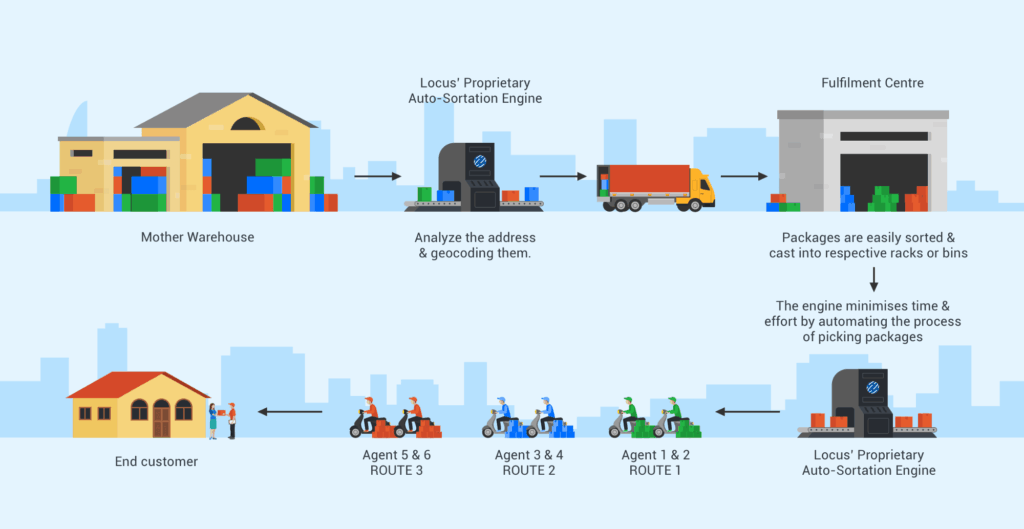
On a daily basis, a massive amount of goods are packaged and shipped from one location to another. Delivering shipments from one point to another is never quite straightforward.
Locus automated parcel sorting engine works on resolving two significant challenges at warehouses
- Deciphering exact delivery destination
- Assigning of optimal routes to the right rider
Our advanced geocoding technology intelligently deciphers fuzzy addresses attached to the parcel and converts it to its respective geo-coordinates (latitude & longitudes) at the packaging level itself. Every package is automatically assigned to the most optimal delivery route and the rider best suited for it. The coordinates are grouped to create the most profitable routes or clusters and assigned with the right delivery agent beforehand.
This eliminates the need for human effort and intelligence for the process of sorting and allocating routes based on PIN codes. Our advanced algorithm supplants multiple manual checks involved in sorting of packages and aids increased rider efficiency leading to faster delivery.
Tangible metrics we helped our clients reduce their overhead costs and increase the number of shipments delivered on a daily basis-
- 65% reduction in Shipment? ?Processing? ?Time:
Automated sorting as per defined routes via Locus dynamic auto-sorting engine to remove human intervention & reduce mis-route - 50% reduction in Man-hours? involved:
Reducing man hours by automating inbound operations and do away with manual checks - 27% Increase? ?in? ?Shipment Deliveries:
Riders are in the field for longer duration which leads to higher tasks execution rate with minimal errors, thus contributing to higher productivity by reducing cancellation rates and minimal SLA breaches.
Locus’ intelligent algorithm solves problems of the logistics industry by factoring in real world fuzziness to support unpredictable networks, dirty location points, and 100s of exception scenarios.
The key pain points addressed by the solution can be summarized as Consistency, Efficiency, and Transparency. Locus Solution, which automates the dispatch process, ensures that the planning output is not linked to a person, ensuring the most optimum quality at each distribution centre or warehouse, leading to consistent results.
To know more and understand how automated parcel sorting solutions can help enhance your business, reach out to us for a personalised demo.
Frequently Asked Questions (FAQs)
What are the key challenges in parcel sorting and last-mile delivery?
Parcel sorting and last-mile delivery face significant challenges like accurately identifying delivery destinations from unstructured addresses, assigning the right rider to the optimal route, and minimizing misrouted shipments. Manual sorting methods relying on reading addresses and assigning riders based on area knowledge are inefficient and error-prone for high volumes.
How does Locus’ automated sorting system work?
Locus’ automated parcel sorting engine resolves two key challenges: deciphering exact delivery locations from fuzzy addresses using advanced geocoding, and assigning optimal routes to the right riders. Packages are automatically geocoded to precise coordinates, grouped into profitable routes, and assigned to suitable riders, eliminating manual sorting and route allocation efforts.
What are the benefits of Locus’ automated sorting solution?
Locus’ intelligent sorting solution provides tangible benefits like 65% reduction in shipment processing time by automating sorting and route allocation, 50% reduction in manual labor hours, and 27% increase in daily shipment deliveries through optimized rider utilization. It ensures consistency, efficiency, and transparency in dispatch operations.
How does Locus’ geocoding technology improve address accuracy?
Locus’ geocoding API leverages machine learning, natural language processing, and rule-based improvements to accurately convert unstructured addresses into precise geographic coordinates (latitude and longitude). It accounts for diverse address formats, languages, and scripts, pinpointing locations down to door numbers and lanes rather than relying on vague landmarks.
How does Locus’ automated sorting solution help optimize logistics operations?
Locus’ automated sorting solution optimizes logistics operations by intelligently decoding fuzzy addresses, accurately mapping them to geographic coordinates, grouping shipments into the most profitable routes, and assigning the right riders upfront. This streamlines dispatch processes, reduces overhead costs, improves rider productivity, and enables faster, more reliable deliveries while minimizing misrouted shipments.


Dispatch Management
Gist of GST: Is India Inc. Ready?

Mar 30, 2017
Key Takeaways Finally, India seems to be taking strides forward in order to roll-out the hugely anticipated goods and services tax, or GST, by the self-set deadline of 1st July, 2017. Experts have not shied away from terming the new sales tax regime as the most significant economic reform since the economic liberalisation led by […]
Read more
Fleet Optimization
What is the Serviceability Quotient Of Your Business?

Jun 10, 2017
No more late appointments, no haggling, a pleasant service experience, and a satisfied customer! Key Takeaways “Starting all over again is not that bad, because then you get another chance to make things right”. Poignant, sure, but if the same was being said of service fulfilment, be assured that the panic siren would go out […]
Read moreInsights Worth Your Time




















Automated Sorting Systems Explained: Types, Use Cases & Benefits