


General
Why Manual Route Planning Is Holding Your Logistics Operation Back

Key Takeaways
- Manual route planning for a 50-vehicle fleet typically consumes four to six hours daily, a time that an algorithm-based system reduces to under 15 minutes.
- The real cost of manual planning extends far beyond fuel and mileage, accumulating across fleet underutilization, compliance risk, and the single-point-of-failure created by planner dependency.
- Semi-automated workarounds like Google Maps layered onto spreadsheets reduce friction without addressing the structural constraints driving inefficiency.
- AI-powered route orchestration encodes and scales the institutional knowledge senior planners have built over the years, making it organizational, auditable, and resilient.
- Automated routing typically reduces logistics costs by 10 to 20%, with ROI achieved within 12 months for fleets of 10 or more vehicles.
Many enterprise logistics operations, especially the ones still having legacy systems in place, mostly run on time because of one person.
Let’s call him Charlie. Fifteen years on the job, every shortcut and back road memorized, every carrier relationship maintained by name. The routes he builds work.
The problem is they work because Charlie builds them.
What happens when Charlie calls in sick during peak season? What happens when a second warehouse comes online, and none of his routes apply? What happens when he retires, and the institutional knowledge walks out the door with him?
Manual route planning persists across a surprising number of mid-to-large enterprises because it has worked well enough. This article examines what “well enough” costs at scale, where it fails completely, and what AI-powered orchestration replaces it with.
As an end-to-end solution for all-mile logistics, Locus orchestrates deliveries across enterprise retail, FMCG, and 3PL operations globally, providing direct visibility into exactly where manual planning breaks down.
How Manual Route Planning Works in Enterprise Logistics
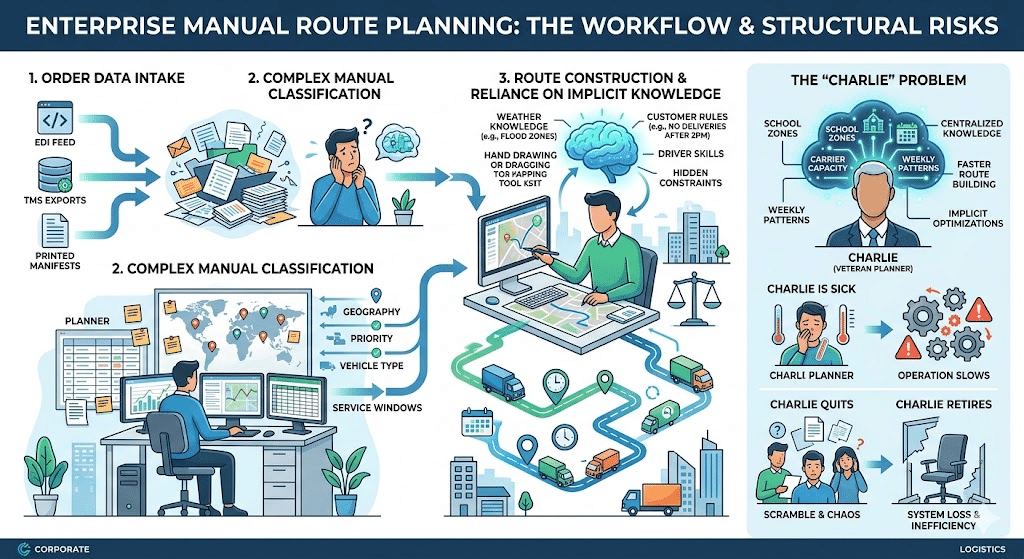
Most logistics leaders assume manual planning means one person with a spreadsheet. At lower volumes, the description is roughly accurate. At enterprise scale, it is a layered, time-intensive process held together by institutional knowledge and informal workarounds, made to look easy only by the planners experienced enough to execute it.
The operational flow at scale
Each morning in a manually planned logistics operation, the day begins with order intake. For enterprise accounts, this arrives through EDI feeds, TMS exports, printed manifests, or some combination of all three, depending on how legacy the operation is.
A planner, or a small team, sorts orders by geography, service window, vehicle type, and priority. This segregation happens in spreadsheets, on wall maps, or in the planner’s head, often all three at once.
From there, routes are constructed by hand or dragged across a mapping tool, balancing estimated delivery times against driver hours, vehicle load limits, and customer commitments. Each decision depends on the planner’s memory of which roads flood in winter, which customers refuse deliveries after 2 pm, and which drivers handle dense urban routes well. None of these lives in a system. It lives in a person.
The Charlie problem
The planner holding a decade of route knowledge is an asset and a liability simultaneously. The expertise is real. Routes get built faster than any new hire could manage, and the implicit optimizations are genuinely valuable. Avoiding the school zone at 3 pm, knowing which carrier has capacity on Thursdays.
The risk is concentration. As we noted before, when Charlie is sick, the operation slows. When he quits, the operation scrambles. When he retires, the operation loses a system that it never formally documented.
For enterprises processing hundreds of daily routes across multiple depots, this dependency is a structural issue.
The Compounding Cost of Manual Route Planning at Scale
The cost case against manual planning is typically made in terms of fuel or mileage. Those are real costs. They are also the visible fraction of a larger total. At enterprise scale, the inefficiency compounds across five distinct dimensions, and most logistics budgets account for only one or two of them.
Time, fuel, and fleet underutilization
A planner managing a 50-vehicle fleet typically spends four to six hours building the day’s routes. An algorithm-based system completes the same task in under 15 minutes. The delta extends beyond planning time. Vehicles sit idle, drivers wait for assignments, and order staging cannot begin until routes are confirmed. Across 250 working days, a 50-vehicle operation loses thousands of hours annually to planning overhead alone.
Suboptimal route sequencing compounds this. Manual planners optimize for routes they know. The full combinatorial possibility space is out of reach. Redrawing inefficient routes can eliminate 30 or more minutes of duplicated driving per vehicle per day. For a 50-vehicle fleet, that is over 400 hours of recoverable fuel and driver time per month.
Fleet underutilization adds another layer. Manual planners cannot dynamically balance loads across vehicles in real time. Orders get assigned to familiar routes and familiar drivers. Certain vehicles run over capacity while others run half-empty, generating both a cost problem and a service problem when SLA-sensitive orders sit behind routine freight.
Compliance risk and single-point failure
Hours-of-service regulations, temperature compliance windows, and SLA commitments require consistent tracking across every route. Manual planning has no automated enforcement mechanism.
A dispatcher relying on memory and a spreadsheet cannot reliably flag when a driver is approaching their hours limit across a day of dynamic changes. Violations surface not during planning, but after a customer escalates or an auditor asks.
The single-point-of-failure risk ties all of this together. Automated routing typically reduces logistics costs by 10 to 20% across fuel, driver time, and vehicle utilization. The gap between a manually planned operation and one running on AI orchestration is not primarily a routing quality gap.
Where Manual Planning Breaks Down at Enterprise Scale
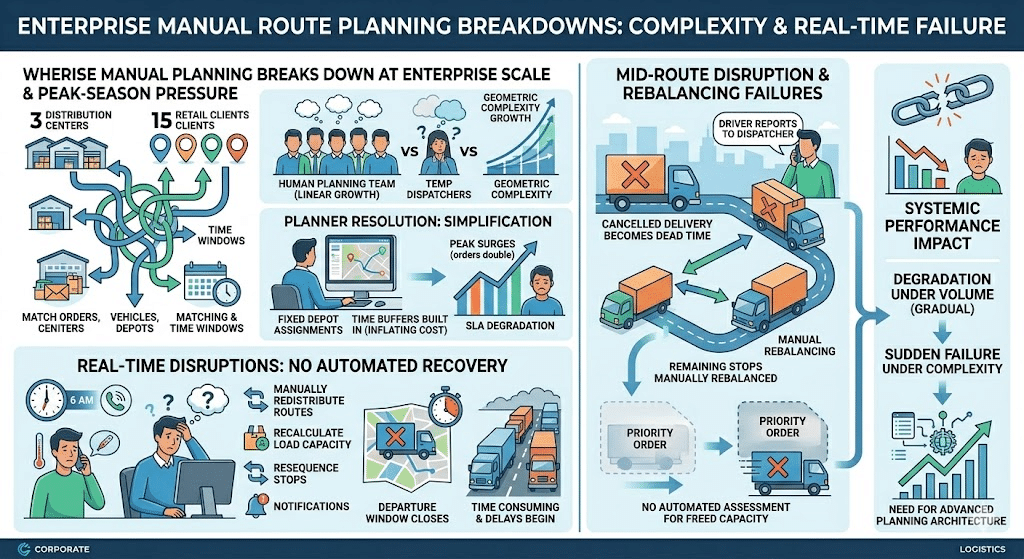
Manual planning degrades gradually under growing volume and fails suddenly under complexity. The scenarios where failure becomes acute define modern enterprise logistics rather than representing edge cases.
Multi-warehouse and peak-season pressure
A 3PL managing 15 retail clients with different delivery windows from three distribution centers cannot plan on a spreadsheet without systemic failure outcomes. The complexity of matching orders to vehicles, depots to delivery zones, and service tiers to time windows multiplies faster than any human can calculate reliably.
The planner resolves it by simplifying. Clients get assigned to fixed depots, route flexibility gets reduced, and time buffers get built in, inflating cost.
Peak-season surges make this worse. Holiday retail, FMCG promotional cycles, and e-commerce peaks can double route counts overnight. The planning team grows linearly, hiring temporary dispatchers lacking the institutional knowledge to plan efficiently, while complexity grows geometrically.
Achieving last-mile excellence under these conditions requires more than additional headcount. It requires a planning architecture capable of handling variable complexity without proportional labor input. Operations relying on manual planning during peak events typically see SLA performance degrade exactly when customer expectations are highest.
Real-time disruptions with no recovery
When a driver calls out sick at 6am, a manually planned operation faces a cascade. The absent driver’s routes must be manually redistributed across remaining vehicles, requiring recalculated load capacities, resequenced stops, and customer notifications before the departure window closes. In a 50-vehicle operation, this consumes an hour or more. By then, the departure window has closed, and delays have begun.
When a delivery is cancelled mid-route, the driver reports back. A dispatcher manually rebalances the remaining stops. There is no automated mechanism to assess whether the freed capacity could absorb a priority order from another route. The cancelled delivery becomes dead time rather than recovered capacity. Learning to manage delivery exceptions at this speed requires real-time decision support. Manual processes have no mechanism to provide it.
Why Semi-Automated Workarounds Still Fall Short
Many enterprises occupy a middle ground. They are not fully manual. They use Google Maps, basic routing add-ons, or GPS tools layered onto existing processes. These tools reduce some friction without constituting real optimization, and distinguishing between the two is critical before committing to a technology investment.
What basic tools cannot do
Google Maps provides turn-by-turn navigation and calculates the distance between two points. What it cannot do is model 50 vehicles simultaneously against customer time windows, driver hours regulations, vehicle load limits, and live traffic across a regional network. Each of those constraints requires a discrete input. The algorithm optimizing against all of them simultaneously is a logistics orchestration engine.
Basic routing add-ons extend spreadsheet capabilities slightly. They can plot multiple stops on a map and suggest an order. They produce no audit trail for compliance purposes, carry no memory of historical performance, and have no mechanism for learning which routes consistently run late or which delivery windows are routinely missed. Each planning cycle starts from zero.
Strategic route planning at enterprise scale requires constraint modeling, compliance logging, and performance feedback. Patchwork tools deliver none of these.
The false sense of optimization
The operational risk of semi-automated tools originates from the confidence they create. A planner using a routing add-on believes routes are optimized. The add-on has calculated a shorter path between stops. It has not accounted for whether the vehicle can make all deliveries within applicable service windows, whether the driver will breach hours-of-service limits at stop seven, or whether a high-priority shipment is buried behind lower-priority freight.
The structural problems of manual planning remain. The visibility into them decreases.
What AI-Powered Route Orchestration Replaces and Preserves
The transition from manual planning to AI orchestration is commonly framed as a replacement. The more accurate framing is encoding and scaling. What gets replaced is the manual process. What gets preserved, and extended, is the institutional knowledge Charlie spent 15 years building.
Encoding the planner’s knowledge
Modern AI route optimization engines ingest thousands of constraints simultaneously. Vehicle types and load capacities. Driver hours and skill sets. Customer delivery windows and service tier priorities. Road restrictions, live traffic, and weather signals. Historical delivery performance patterns by route, driver, and customer. Locus’s AI route optimization engine optimizes across 250+ variables in a single pass, producing multi-route plans for enterprise fleets in minutes.
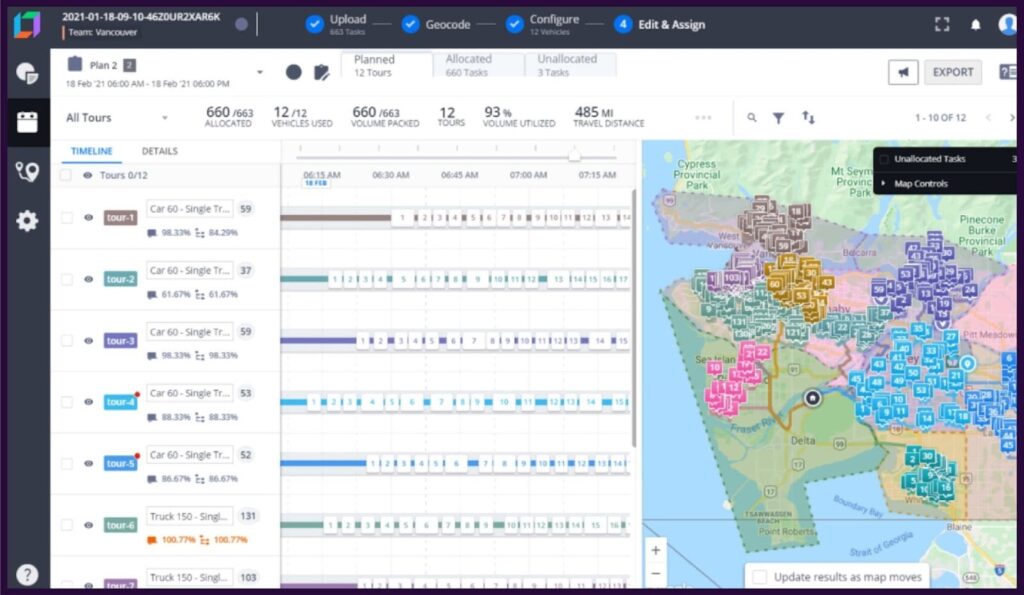
The institutional knowledge Charlie holds becomes system input rather than mental overhead. Which zones to avoid at 3 pm, which routes run long on Fridays, and which clients refuse unannounced arrivals?
Over time, Locus learns from execution patterns, incorporating actual versus planned ETAs, driver feedback, and failed delivery data into future plans. The knowledge becomes organizational. Auditable. Scalable to operations with 500 vehicles, no single planner could manually manage.
This is what automated route planning delivers at its core. Not a smarter map. A planning architecture replacing the planner’s memory with a system operating consistently regardless of who is in the dispatch chair.
Schedule a demo to see how Locus’s orchestration platform handles the planning complexity that your current process cannot.
Real-time adaptability mid-execution
When a driver goes absent, an order cancels mid-route, or a traffic incident blocks a primary corridor, manual operations return to a human bottleneck. Someone has to identify the problem, assess its impact across the full fleet, and manually reassign.
Locus’s dispatch management platform handles this without returning to a human approval loop. When a delivery is cancelled, the system identifies available capacity across nearby routes and automatically reassigns eligible orders. When a driver reports a delay, predictive ETAs update across the affected sequence and customers receive proactive notification. When a road is closed, alternative sequences are calculated and pushed to the driver app in real time.
The planner’s role shifts from constructing plans to governing them, setting parameters, reviewing exceptions, and approving deviations when they occur. The judgment stays human. The execution overhead does not.
Measuring the Shift From Manual to AI Orchestration
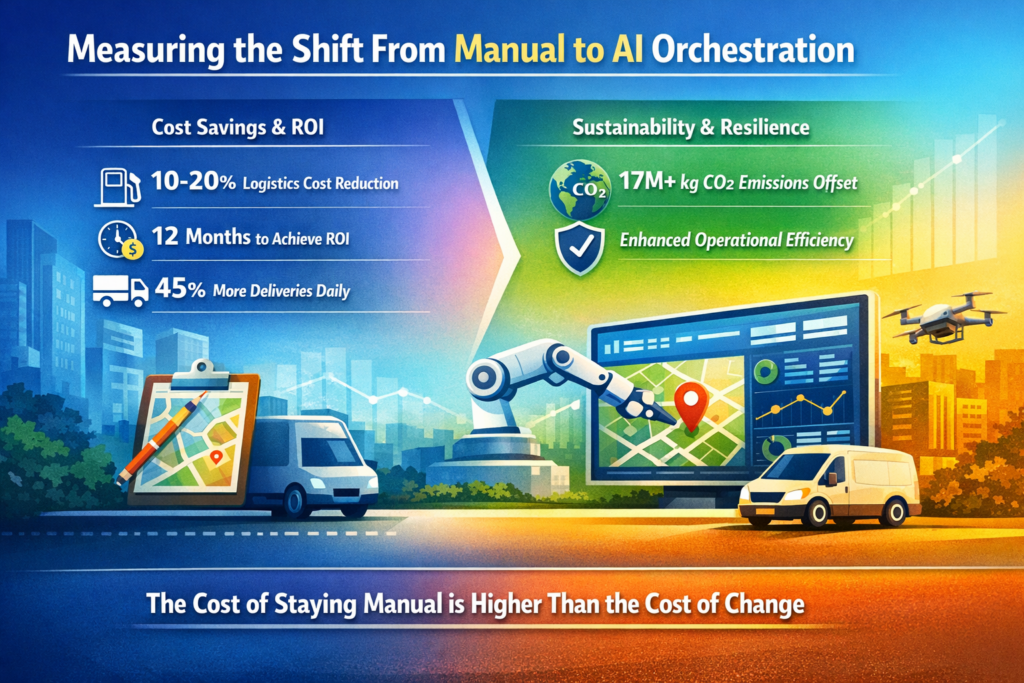
The ROI case for moving from manual to AI-powered route planning is typically measured in fuel and overtime. Those are real savings and a reasonable starting point. They are also the smallest portion of the total recovery when enterprises account for fleet utilization, compliance costs, and the compounding value of operational resilience.
Direct cost savings and ROI
Automated routing reduces logistics costs by 10 to 20% across fuel consumption, driver overtime, and vehicle utilization, a range documented across enterprise deployments at varying fleet sizes. ROI is typically achieved within 12 months for fleets of 10 or more vehicles, with larger enterprise operations reaching it faster because the volume of recoverable inefficiency is proportionally greater.
Locus has reduced ground resource costs by 20% while enabling fleets to complete 45% more deliveries per day without additional vehicles. Across 360+ enterprise deployments, it has recovered $320M+ in transit cost savings and reduced driven distance by 800M+ miles.
These figures are outcomes from the same operational profiles most enterprise logistics leaders are managing today. The routing efficiency gains in each case share a common source. Replacing planner intuition with algorithmic precision across variables no human can simultaneously optimize.
Sustainability and resilience
Fewer miles driven translates directly into measurable carbon reduction. For enterprises facing ESG reporting requirements, now standard across most enterprise supplier agreements and increasingly mandated by institutional investors, logistics is one of the largest controllable emissions categories. Locus has offset 17M+ kg of CO2 across its deployments, a figure traceable to specific route optimizations rather than a blanket carbon credit purchase. That traceability matters for board-level ESG disclosure.
The resilience argument is harder to quantify and more consequential. An operation running on algorithmic planning does not degrade when a senior planner leaves. It does not slow down during peak season because the planning system scales with order volume rather than with headcount.
The automated tracking system connecting route execution data back into Locus’s visibility layer creates a continuous improvement loop, with each delivery cycle improving the inputs to the next.
The question is not whether to move away from manual planning. At an enterprise scale, the cost of staying is higher than the cost of change.
Stop Paying the Manual Planning Tax
Manual route planning persists in enterprise logistics for the same reason most operational legacies persist. It works well enough to avoid a crisis until it does not.
The costs it generates are real, compounding, and largely invisible until a peak event or a resignation makes them undeniable. Planning overhead, suboptimal routing, fleet underutilization, compliance exposure, and Charlie dependency all accumulate quietly.
Locus’s orchestration platform eliminates each of these failure modes. It encodes institutional knowledge into a scalable system, adapts mid-execution without returning to a human bottleneck, and delivers measurable ROI within 12 months across fleets of all sizes. The operational resilience it provides does not depend on who shows up for the planning shift.
To learn more, schedule a Locus demo.
Frequently Asked Questions (FAQs)
1. How long does manual route planning typically take compared to AI-optimized planning for a fleet of 50+ vehicles?
Manual planning for a 50-vehicle fleet typically consumes four to six hours per day. Algorithm-based planning completes the same task in under 15 minutes. The gap extends beyond planning time. Vehicles idle, and order staging cannot begin until routes are confirmed. At 250 working days per year, the time delta compounds into thousands of hours of recoverable operational capacity annually.
2. What are the biggest compliance risks associated with manual route planning in regulated logistics environments?
Manual planning has no automated enforcement mechanism for hours-of-service regulations, temperature compliance windows, or SLA commitments. Violations surface after a customer escalation or an audit. By then, the failure has already happened. Operations running on spreadsheets and planner memory have no systemic way to flag approaching compliance thresholds across a dynamic daily route set before a breach occurs.
3. Can manual route planning handle dynamic disruptions like driver absences or weather delays in real time?
Manual planning has no real-time recovery mechanism. When a driver calls out, routes must be manually redistributed, a process consuming an hour or more, during which the departure window closes. When a delivery cancels mid-route, freed capacity typically goes unused. There is no automated system to identify reallocation opportunities and act within the available window.
4. What is the typical ROI timeline when transitioning from manual route planning to an automated dispatch platform?
Automated route optimization typically delivers ROI within 12 months for fleets of 10 or more vehicles. Larger enterprise operations tend to recover their investment faster because the volume of inefficiency being eliminated is proportionally greater. The primary ROI drivers are fuel savings, reduced driver overtime, and improved fleet utilization, each measurable from the first weeks of deployment.
5. How does AI route optimization preserve institutional planner knowledge instead of replacing it?
AI route optimization encodes the planner’s knowledge rather than erasing it. Route preferences, customer quirks, and operational patterns a senior planner has built over the years become system inputs rather than mental overhead. The system learns from execution data over time, incorporating actual versus planned performance into future plans and making institutional knowledge organizational rather than individual.


General
AI Agents in Logistics Are Only as Smart as the Platform Underneath

Apr 1, 2026
Every logistics vendor is launching AI agents. But an agent's output is only as good as the platform underneath it. Here's what to evaluate.
Read more
General
Easter Logistics: How Retail & Grocery Operations Handle the Spring Surge

Apr 2, 2026
Easter grocery surge isn't just a volume problem. It's a time-window precision problem, a cold-chain compliance problem, and a customer-expectation problem, all at once.
Read moreInsights Worth Your Time




















Why Manual Route Planning Is Holding Your Logistics Operation Back