


General
Top 10 Fleet Routing Software for Enterprise Logistics Teams in 2026
Key Takeaways
- Most fleet routing software was built for small fleets. Enterprise operations running multi-depot networks require a fundamentally different level of platform capability.
- Routing is one layer of the logistics execution stack. Disconnected dispatch, carrier management, and visibility tools create manual gaps that grow more expensive as volumes scale.
- Enterprise buyers should evaluate constraint depth, dispatch automation, and integration depth before shortlisting vendors, not just ease of use or starting price.
- For enterprises running 500+ daily shipments across mixed fleets and carrier networks, Locus delivers the only Agentic TMS purpose-built for that scope.
Three depots. Forty drivers. Six 3PL partners.
Your routing tool builds tomorrow’s plan the same way it built last Tuesday’s, without accounting for the fact that Hub 2 is operating at 60% capacity, a driver has called in sick, and your largest retail client has moved their delivery window forward by two hours.
By 6 AM, these changes become visible. Your dispatcher reworks the plan within the hour, but the SLA breach still lands in your inbox by noon.
Many logistics operations still function this way because most routing software was designed for a different planning model entirely. The stop sequencing for a single fleet operating from one depot cannot be applied to constraint-based planning across mixed fleets, carrier networks, and operational exceptions that evolve before execution even begins.
Most routing software comparisons overlook this distinction because they are built around simpler use cases, like a courier managing a limited number of stops from a single vehicle.
This evaluation takes a different approach. Ten platforms were assessed on optimization depth, dispatch automation, carrier orchestration, and integration with existing TMS and ERP systems, so you know exactly what each platform supports before you commit to a demo.
What to Look for in Fleet Routing Software
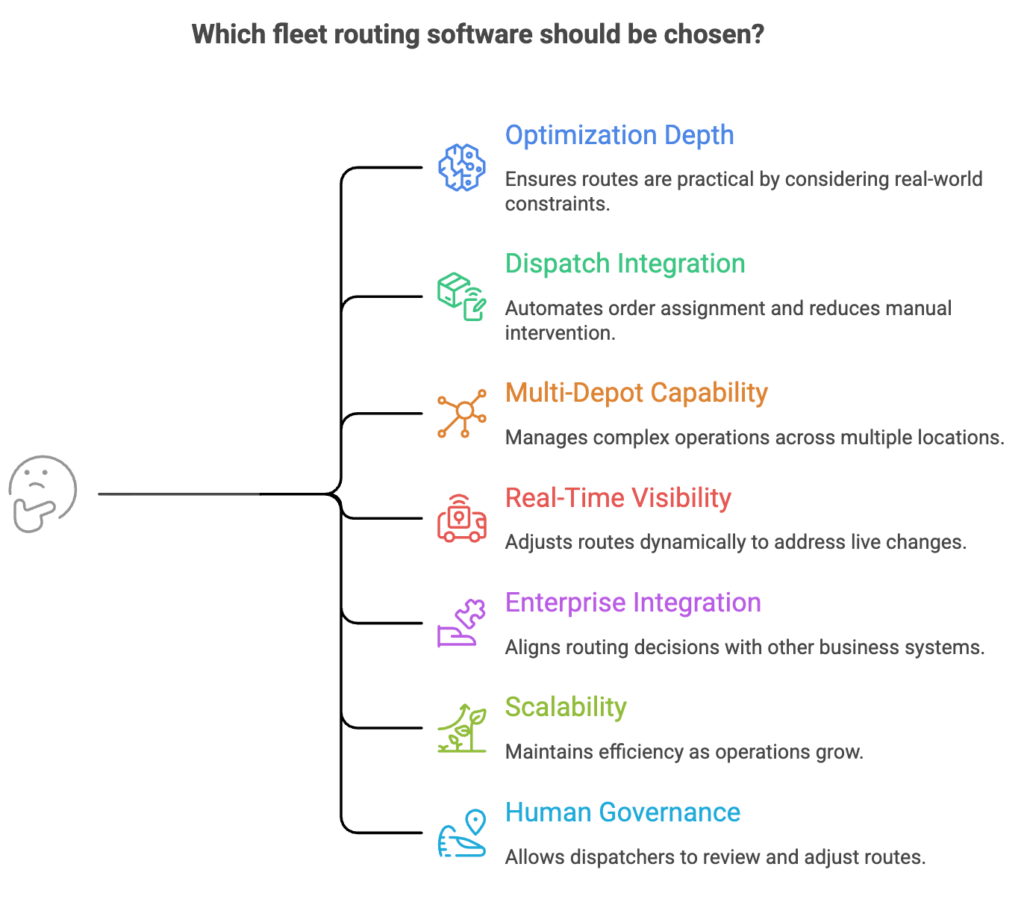
Before we get into the tools, it helps to understand how each platform is evaluated in this list, since what works for a 50-stop courier operation is very different from what is needed to manage 10,000 orders a day across multiple depots.
Optimization Depth
The basic expectation from any routing software is to find an efficient path between stops. However, the more important question is how well the system handles real-world constraints.
Factors such as delivery time windows, vehicle capacity limits, driver shift hours, hub capacity, road restrictions, vehicle routing, and live traffic all influence whether a route is actually workable.
Platforms that consider these constraints properly create routes that can be followed without issues during actual delivery. If these factors are not considered, the routes often do not work in practice, and dispatchers have to fix them manually.
Dispatch Integration
Route planning software that stops at building routes and hands off execution to a separate dispatch process creates a point of failure where missed assignments and delayed responses to real-time changes tend to accumulate.
The key question is whether the platform can automatically assign each order to the right driver, vehicle, or carrier based on cost, delivery commitments, and capacity, without requiring manual intervention at scale.
Multi-Depot and Multi-Fleet Capability
Automated route planning within a single depot is widely established. Planning becomes more complex when operations span multiple depots at the same time, with each location operating under different inventory availability, hub capacity, and outbound volume conditions that continue to shift throughout the day.
The complexity increases further when planning must account for a combination of owned fleets, contracted drivers, and 3PL partners, each working within their own service agreements and cost structures.
If a platform cannot manage this natively, teams are forced to plan for each depot and carrier relationship separately, which reduces coordination and limits the value of a centralized routing system.
Real-Time Visibility and Dynamic Rerouting
A route plan created overnight can become outdated before operations begin. Changes such as driver availability, hub delays, or last-minute customer updates can affect execution even before vehicles leave the depot.
The platform should be able to detect these changes in real time and adjust the affected routes without requiring a dispatcher to rebuild the plan from scratch. When this capability is missing, teams spend a significant part of the day responding to issues that could have been identified and resolved automatically with better visibility.
Enterprise Integration Depth
When a route is optimized, that decision must carry through to the order management system, align with warehouse dispatch processes, and stay consistent with carrier contracts and TMS data.
If a platform does not integrate effectively with existing ERP, OMS, WMS, and TMS systems, teams are required to handle these connections manually. This often leads to data inconsistencies and additional effort to keep systems aligned.
Scalability
When order density increases, depot complexity grows. Similarly, when seasonal peaks push demand higher, some platforms begin to lose efficiency in how routes are planned.
This makes it important to evaluate not only how the platform performs under current conditions, but also whether it has been proven at the scale you are aiming to reach. Plan quality should remain consistent even when the system is operating under a higher load.
Human Governance and Override Capability
When a platform reassigns a high-priority order or adjusts a depot’s plan in response to a live change, dispatchers need visibility into why that decision was made and whether it aligns with operational priorities.
They also need the ability to review and adjust these decisions before they are executed. Without this level of control, teams lose oversight of routing outcomes, which can affect reliability during execution.
Top 10 Fleet Routing Software at a Glance
The fleet routing software market in 2026 supports a wide range of use cases, from enterprise logistics orchestration to lightweight route planning for smaller delivery teams. Some platforms are designed for high-volume, multi-depot operations, while others focus on field service workflows or basic last-mile delivery needs.
1. Locus
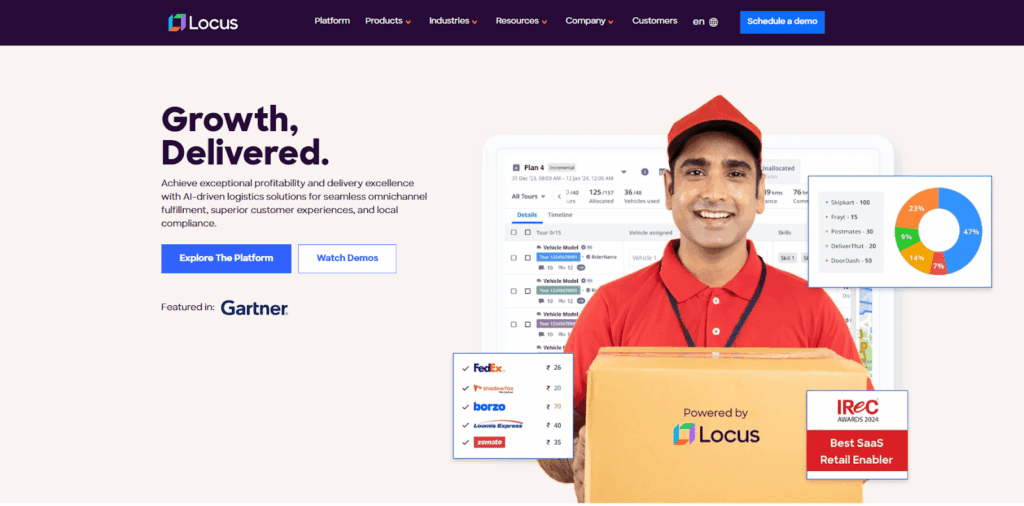
Locus is an agentic TMS that uses AI-powered route optimization as one component of a full logistics orchestration platform, connecting routing decisions with dispatch processes while maintaining visibility across carriers and execution in one system.
Fireworks routing engine plans against 250+ real-world constraints, including delivery time windows, vehicle capacity, driver shift hours, hub throughput, road restrictions, and live traffic conditions.This approach uses constraint-based planning to generate routes that remain practical during real-world execution.
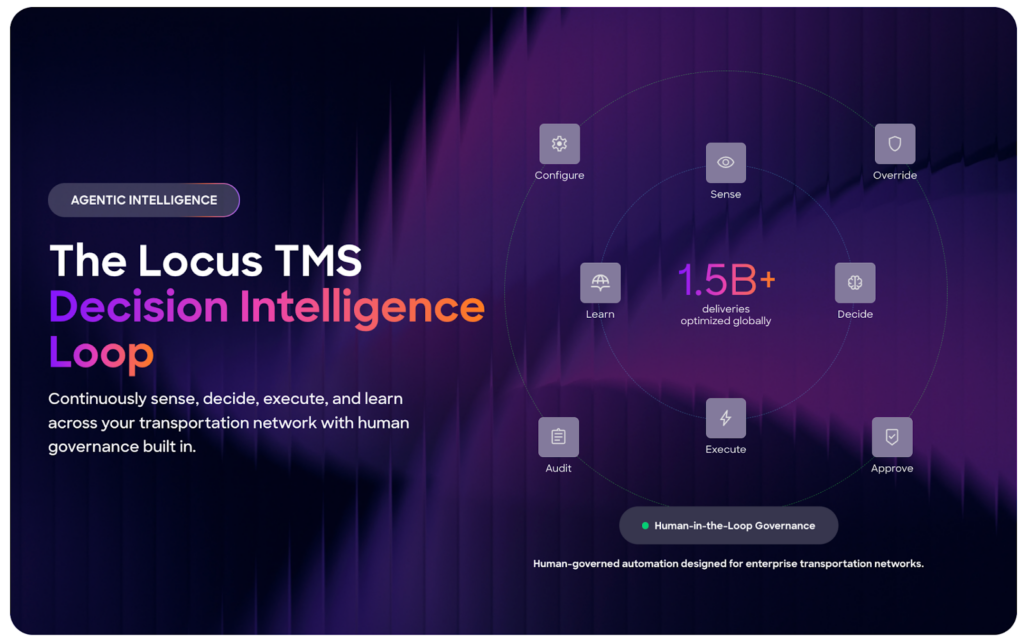
What separates Locus from every other platform in this list is the decision intelligence loop, where the system continuously senses operational conditions, makes decisions, executes, and learns from outcomes, while keeping your dispatchers in control at every step. They can override, approve, or reconfigure any AI-generated decision with full audit visibility into why it was made.
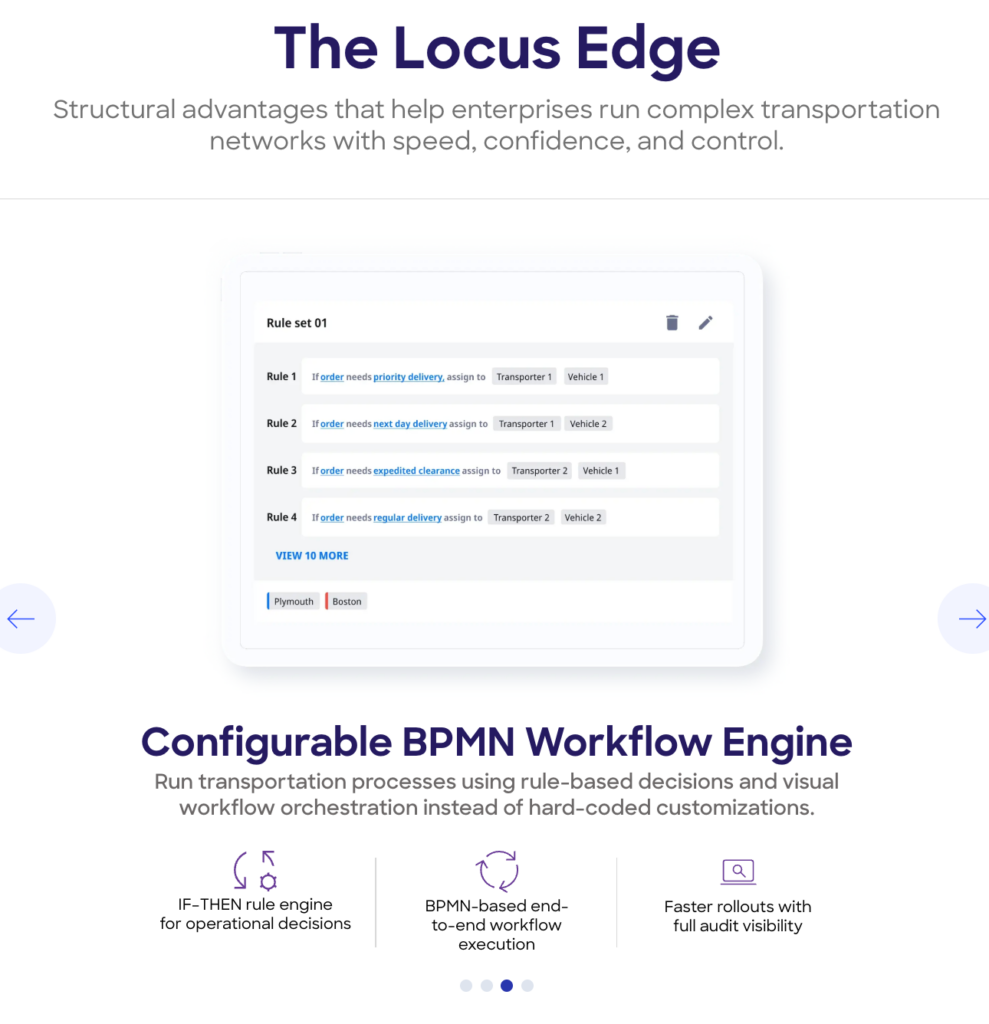
Along with this, Locus’s configurable BPMN Workflow Engine allows operators to set automated route planning rules and operational workflows without hard-coded customization, which means faster rollouts and fewer dependencies on engineering teams every time your business rules change.
On the carrier side, Locus manages rate and carrier selection across 1,000+ pre-integrated carriers, enabling automated tendering, contract compliance, and self-serve carrier onboarding within the same platform. For operations with significant in-house and outsourced fleet complexity, this removes the manual layer that typically sits between a routing decision and actual carrier assignment.
The platform has optimized 1.5 billion deliveries across 30+ countries for 350+ enterprise customers, delivering $320M+ in logistics cost savings at a platform average of 20% cost reduction.
Unilever achieved 99.5% on-time deliveries across Southeast Asia, Floranow improved on-time delivery from 70% to 99%, and BigBasket achieved 99.5% SLA adherence alongside a 34% reduction in distance traveled.
Locus also addresses one of the most persistent challenges in emerging market logistics, which is address accuracy. Its proprietary geocoding engine converts incomplete or ambiguous addresses into precise coordinates, directly reducing failed deliveries and improving SLA adherence in markets where standardized addressing does not exist.
Key Features of Locus
- Fireworks routing engine optimizing against 250+ real-world constraints
- Decision Intelligence Loop with full dispatcher override and audit capability
- Configurable BPMN Workflow Engine for rule-setting without hard-coded customization
- Automated carrier selection and tendering across 1,000+ pre-integrated carriers
- Proprietary geocoding engine for accurate addressing in emerging markets
- Real-time control tower with exception management and live visibility
- Mycroft AI Co-Pilot for next-best-action recommendations across dispatch decisions
- End-to-end coverage across fulfillment automation, dispatch planning, delivery orchestration, and track and trace
Locus Is Best For
Large retail, e-commerce, FMCG, CPG, and 3PL enterprises running 500+ daily shipments across multi-depot, multi-carrier networks who need a single orchestration layer connecting routing, dispatch, carrier management, and visibility rather than a standalone routing tool.
Locus’s Cons
Locus is built for complexity, and that depth requires structured onboarding. For operations running low volumes out of a single depot with straightforward routing needs, the platform is likely more comprehensive than the use case justifies. The configuration effort involved in setup is better suited to enterprises where the scale of operations creates a clear return on that investment.
Locus’s Pricing
Locus operates on a custom pricing model. There is no publicly listed starting price, free plan, or free trial. Pricing is scoped based on order volumes, operational complexity, and the specific modules required. You can get a scoped estimate by scheduling a demo directly with the Locus team.
2. FarEye
FarEye is a delivery management platform built around the post-dispatch experience. Its strengths sit in last-mile visibility, branded customer communication, and delivery experience management, which makes it a relevant option for retail and e-commerce brands where the customer-facing side of the delivery journey is a primary concern.
The platform covers route planning and real-time tracking, and it has established positioning in the Gartner last-mile technology landscape. For brands that need to manage delivery notifications, branded tracking pages, and customer communication at scale, FarEye handles that layer well.
Its route optimization engine does not operate at the same constraint depth as purpose-built optimization platforms. While FarEye manages the experience after a route goes to a driver effectively, the intelligence that determines how that route gets built in the first place is less sophisticated. For an enterprise operation where the quality of the plan before execution directly determines SLA outcomes, that gap matters.
Dispatch automation is also less autonomous compared to platforms built around decision intelligence. FarEye requires more manual oversight in the assignment and dispatch workflow, which adds operational effort at the exact point where high-volume operations need the system to work independently.
Key Features of FarEye
- Last-mile delivery visibility and real-time tracking
- Branded customer tracking pages and delivery notifications
- Route planning with basic optimization capabilities
- Proof of delivery and driver mobile application
- Delivery experience management for retail and e-commerce workflows
- Gartner-recognized positioning in last-mile delivery technology
FarEye Is Best For
Mid-to-large retail and e-commerce brands where the customer delivery experience is the primary focus and post-dispatch communication, visibility, and branded tracking are the core requirements.
FarEye’s Cons
FarEye’s route optimization engine lacks the constraint depth needed for complex enterprise planning. Dispatch automation requires more manual intervention than platforms built around automated order assignment. For operations where pre-dispatch intelligence and carrier orchestration are critical, FarEye covers the delivery experience layer but does not replace a full orchestration platform.
FarEye’s Pricing
FarEye operates on a custom pricing model with no publicly listed starting price. Pricing is determined based on operational scope and requirements. Contact FarEye directly for a quote.
3. LogiNext

LogiNext is a logistics automation platform offering route optimization, fleet tracking, and delivery management across multiple operational modules. It has built meaningful enterprise presence particularly across MEA and Asia, and its breadth of coverage spanning first mile, middle mile, and last mile makes it a consideration for enterprises looking for a broad logistics suite under one roof.
The platform covers haul, mile, and reverse logistics within a single system, which gives it an advantage in markets where operators need visibility across multiple legs of the supply chain without stitching together separate tools. Its real-time tracking and delivery management capabilities are established, and it has demonstrated traction with large enterprises across its core geographies.
Where LogiNext faces challenges is in integration flexibility and user experience at scale. Enterprises with complex existing technology stacks have reported difficulty in getting LogiNext to connect cleanly with their ERP and WMS systems without significant custom engineering. At high operational volumes, the platform’s UX complexity can slow down dispatcher workflows rather than accelerating them, which is the opposite of what an enterprise deployment needs to achieve.
The route optimization engine handles standard constraint-based planning but does not reach the variable depth of purpose-built optimization platforms. For enterprises running operations in SEA, India, or MEA where LogiNext has strong regional presence, it is a workable option. For operations that require deep carrier orchestration, automated dispatch, and optimization across 250+ real-world constraints, the platform has meaningful gaps.
Key Features of LogiNext
- Route optimization across first mile, middle mile, and last mile
- Real-time fleet tracking and delivery management
- Reverse logistics and returns management module
- Driver mobile application with proof of delivery
- Multi-module coverage across haul, mile, and reverse operations
- Regional strength in MEA and Asia markets
LogiNext Is Best For
Enterprises in Asia and MEA seeking broad logistics suite coverage across multiple supply chain legs, particularly where regional market familiarity and multi-module deployment matter more than optimization depth.
LogiNext’s Cons
Integration flexibility is a recurring challenge for enterprises with complex existing technology stacks. UX complexity at scale can slow dispatcher workflows rather than simplifying them. Route optimization does not match the constraint depth of purpose-built platforms, and carrier orchestration capabilities are limited compared to full orchestration layers like Locus.
LogiNext’s Pricing
LogiNext operates on a custom pricing model. No publicly listed starting price is available. Contact LogiNext directly for a scoped quote based on your operational requirements.
4. Shipsy
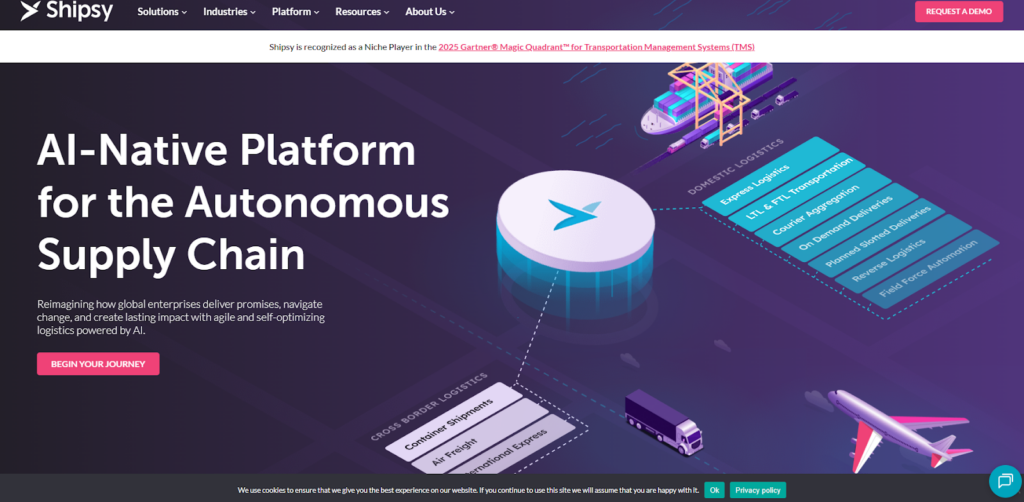
Shipsy is a logistics management platform with route planning, carrier management, and freight visibility capabilities. It has built its core positioning around freight and cross-border logistics, and for enterprises where international shipments and carrier management across borders represent a significant share of operational complexity, it covers that ground reasonably well.
The platform handles carrier selection, freight tracking, and cross-border documentation workflows, which makes it relevant for operations where the movement of goods across geographies and customs boundaries is a primary challenge. Its carrier management layer gives operations teams visibility into freight partners and shipment status across international lanes.
Where Shipsy’s positioning becomes less certain is in last-mile orchestration. Compared to more established platforms in this space, Shipsy’s last-mile capabilities are relatively newer and less proven at the scale that large retail, FMCG, or 3PL operations require. Enterprises evaluating Shipsy for complex domestic last-mile delivery across multi-depot networks will find the platform less mature in that specific area than its freight and cross-border strengths suggest.
Dispatch automation and constraint-based route optimization also do not operate at the depth that high-volume last-mile operations need. For enterprises whose primary challenge is domestic delivery orchestration rather than cross-border freight management, Shipsy covers a different part of the logistics problem than the one they are trying to solve.
Key Features of Shipsy
- Route planning with carrier management capabilities
- Cross-border freight visibility and documentation workflows
- Carrier selection and performance tracking across international lanes
- Real-time shipment tracking for freight operations
- Last-mile delivery management for domestic operations
- Analytics and reporting across freight and carrier performance
Shipsy Is Best For
Enterprises with significant cross-border freight and international shipping needs where carrier management across borders, customs documentation, and freight visibility are the primary operational challenges.
Shipsy’s Cons
Shipsy’s last-mile capabilities are newer and less proven at enterprise scale compared to platforms purpose-built for high-volume domestic delivery orchestration. Constraint-based route optimization and automated dispatch do not match the depth required for complex multi-depot, multi-carrier last-mile operations. Enterprises evaluating Shipsy primarily for domestic last-mile delivery will find more capable options elsewhere in this list.
Shipsy’s Pricing
Shipsy operates on a custom pricing model with no publicly listed starting price. Contact Shipsy directly for a quote based on your freight volume and operational scope.
5. Route4Me
Route4Me is one of the most widely recognised names in route planning software, and its scale reflects that. The platform has processed over 30 million optimised routes, analysed more than 3 billion miles of delivery data, and its customers report cost reductions in the range of 20 to 30 percent, according to Route4Me’s published marketing materials. For the use case it was built for, those numbers are credible.
That use case is multi-stop route planning for small-to-mid-sized delivery and field service fleets. Route4Me does this well. The interface is approachable, the mobile driver app is functional, and the setup time is short compared to enterprise platforms that require structured onboarding. If your operation runs a manageable number of stops out of a single location and your primary need is stop sequencing, Route4Me gets the job done.
The challenge surfaces when enterprise buyers evaluate it against the criteria that actually matter at scale. Route4Me does not offer automated dispatch orchestration. Order assignment remains a manual process, which creates the exact kind of operational gap that high-volume operations cannot afford. Its integration ecosystem is shallow relative to what enterprises running complex ERP, WMS, and TMS stacks require, and connecting Route4Me cleanly into an existing enterprise technology stack typically involves significant custom work.
The platform was designed for a different buyer entirely. Field service teams, small courier operations, and local delivery fleets are where Route4Me performs at its best. At 5,000 daily shipments across multiple depots and carrier networks, the platform’s limitations become the operation’s problem.
Key Features of Route4Me
- Multi-stop route planning and optimisation
- Mobile driver app with turn-by-turn navigation
- GPS tracking and real-time driver location visibility
- Proof of delivery and customer notification capabilities
- Route history and basic delivery analytics
- Optimisation dataset built on 30 million routes and 3 billion miles of delivery data
Route4Me Is Best For
Small-to-mid-sized delivery and field service fleets where the primary need is multi-stop route sequencing, driver navigation, and basic delivery tracking without the complexity of enterprise dispatch orchestration or carrier management.
Route4Me’s Cons
Route4Me does not support automated dispatch orchestration, which means order assignment at scale remains a manual process. Its integration depth with enterprise ERP, WMS, and TMS systems is limited, and the platform’s feature set is not designed for multi-depot, multi-carrier operations running high daily volumes. Enterprise logistics teams will outgrow it quickly.
Route4Me’s Pricing
Route4Me offers subscription-based pricing starting from $60 per vehicle per month. Enterprise pricing is available on request. A free trial is available for teams that want to evaluate the platform before committing.
6. OptimoRoute
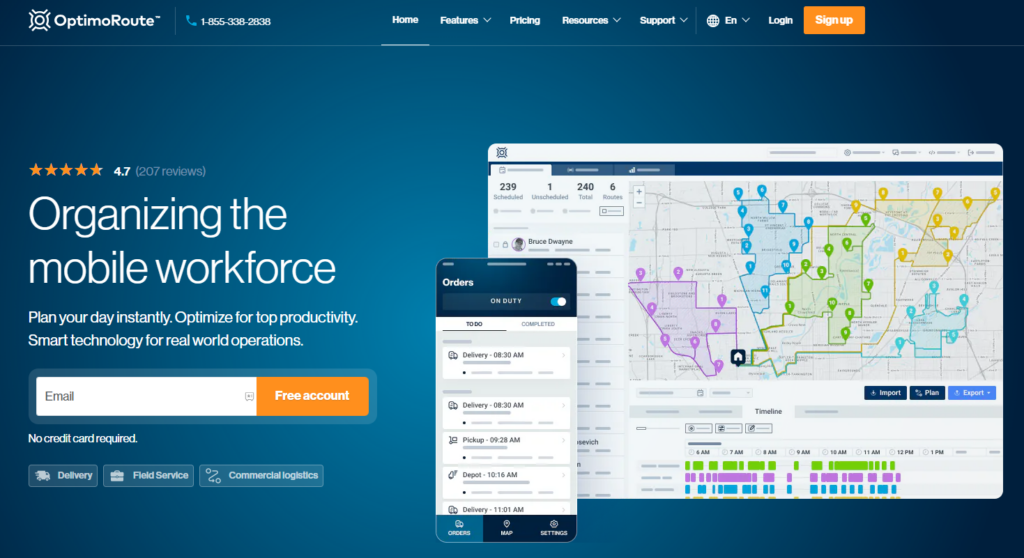
OptimoRoute is a route optimization and scheduling platform used primarily by delivery and field service teams. It has built a solid reputation in the mid-market for multi-stop planning, and its optimization engine is reliable for operations that need clean, well-sequenced routes without the complexity of enterprise dispatch orchestration.
Where OptimoRoute stands out is in multi-day planning and workload balancing. For service businesses that need to schedule jobs across multiple days, balance driver workloads evenly, and manage recurring delivery schedules, the platform handles that planning layer well. The interface is straightforward, setup is relatively quick, and the mobile driver app gives field teams a functional tool for executing their daily task list.
The limits become visible when the operation grows beyond mid-market complexity. OptimoRoute does not offer AI-driven dispatch automation. Route plans are built and pushed to drivers, but the intelligence that should sit between a routing decision and actual order assignment, including carrier selection, capacity balancing across depots, and real-time exception management, is not part of what the platform does. For a 3PL or FMCG enterprise managing thousands of daily shipments across mixed fleets and carrier partners, that gap is significant.
Real-time rerouting is also limited compared to platforms built around live operational intelligence. When exceptions occur mid-route, OptimoRoute requires more manual intervention to adjust plans than enterprise operations can accommodate without adding dispatcher headcount to absorb the workload.
Key Features of OptimoRoute
- Multi-stop route optimization and scheduling
- Multi-day planning and workload balancing across drivers
- Real-time driver tracking and live order status visibility
- Proof of delivery with photo and signature capture
- Mobile driver app with turn-by-turn navigation
- Weekly planning and recurring delivery schedule management
OptimoRoute Is Best For
Mid-sized delivery and field service companies that need reliable multi-stop route optimization, multi-day scheduling, and workload balancing without the complexity requirements of enterprise dispatch orchestration or carrier management.
OptimoRoute’s Cons
OptimoRoute does not offer automated dispatch orchestration or AI-driven carrier assignment. Real-time rerouting requires manual intervention, which adds operational overhead when exceptions occur at scale. The platform lacks the supply chain visibility layer and integration depth that enterprise 3PL and FMCG operations require, making it a capable mid-market tool that reaches its ceiling quickly in high-volume, multi-depot environments.
OptimoRoute’s Pricing
OptimoRoute offers subscription-based pricing starting from $35 per user per month, with a higher tier available at $44 per user per month. A free trial is available for teams evaluating the platform before committing.
7. WorkWave
WorkWave is a route planning and fleet management platform built specifically for field service businesses. Its core verticals are pest control, lawn care, HVAC, and similar service industries where the primary planning challenge is technician routing and job scheduling rather than parcel delivery or supply chain orchestration. Within that context, WorkWave is a well-established tool with a functional feature set that matches the needs of its intended audience.
The platform covers GPS tracking, route optimization for service technicians, scheduling, and a driver application that gives field teams their daily job list. For a pest control company managing 20 technicians across a city, or a lawn care business scheduling recurring service visits, WorkWave delivers what those operations need without unnecessary complexity.
The challenge arises when WorkWave appears on enterprise logistics shortlists, which it frequently does because of its search visibility and brand recognition. WorkWave was not designed for high-volume parcel delivery, multi-depot retail logistics, or 3PL carrier orchestration. It does not offer constraint-based optimization at the depth that enterprise delivery operations require, and its integration ecosystem is oriented toward field service management systems rather than the ERP, WMS, and TMS stacks that logistics enterprises run on.
If your operation manages technician routing for a service business, WorkWave is worth evaluating. If your operation manages thousands of daily shipments across multiple depots and carrier partners, WorkWave is solving a different problem entirely. For logistics leaders reading this list who found WorkWave through a competitor search, the tools above this entry operate in a fundamentally different category.
Key Features of WorkWave
- Route optimization and scheduling for field service teams
- GPS tracking and real-time technician location visibility
- Job scheduling and recurring service visit management
- Mobile driver and technician application
- Customer notification and appointment management
- Fleet management and basic reporting capabilities
WorkWave Is Best For
Field service businesses managing technician routing across industries such as pest control, lawn care, and HVAC, where job scheduling, recurring visits, and technician dispatch are the primary operational challenges.
WorkWave’s Cons
WorkWave is purpose-built for field service and is not designed for high-volume parcel delivery or complex retail logistics. It lacks the constraint-based optimization depth, automated dispatch orchestration, and carrier management capabilities that enterprise delivery operations require. Its integration ecosystem is oriented toward field service management rather than enterprise logistics stacks, which limits its applicability outside its intended use case.
WorkWave’s Pricing
WorkWave offers pricing starting from $54 per vehicle per month. Enterprise pricing is available on request. Contact WorkWave directly for a quote based on your fleet size and operational requirements.
8. Onfleet
Onfleet is a last-mile delivery management platform with a strong reputation among small-to-mid-sized delivery operations and D2C brands. It carries a 4.8 out of 5 rating across more than 4,500 reviews on G2, which reflects genuine satisfaction from the audience it was built for. For operations running local delivery, same-day fulfillment, or direct-to-consumer shipments at manageable volumes, Onfleet is a polished and well-regarded tool.
The platform covers route optimization, real-time driver tracking, proof of delivery, and customer notifications within a clean interface that requires minimal onboarding time. Its mobile driver app is intuitive, and the dispatcher dashboard gives small operations teams a clear view of what is happening on the ground without overwhelming them with complexity they do not need.
The limitations become apparent when Onfleet is evaluated against enterprise requirements. The platform does not offer AI-powered dispatch automation or carrier orchestration, which means order assignment and carrier selection remain manual processes. For a D2C brand shipping 200 orders a day out of a single location, that is manageable. For a retail enterprise running thousands of daily shipments across multiple depots and 3PL partners, it creates an operational ceiling that Onfleet was not designed to break through.
Analytics depth is also limited compared to what enterprise logistics teams require for performance reporting, SLA tracking, and network-level decision making. Onfleet provides delivery data and basic reporting, but it does not offer the kind of operational intelligence layer that connects routing performance to broader supply chain outcomes.
Key Features of Onfleet
- Route optimization and multi-stop delivery planning
- Real-time driver tracking and live delivery status visibility
- Proof of delivery with photo and signature capture
- Customer notifications and live tracking page
- Dispatcher dashboard with task management and driver communication
- Analytics and basic delivery performance reporting
Onfleet Is Best For
Small-to-mid-sized last-mile delivery operations and D2C brands running manageable daily volumes from a single location, where ease of use, driver tracking, and customer communication are the primary requirements.
Onfleet’s Cons
Onfleet does not support AI-powered dispatch automation or carrier orchestration, which limits its applicability for high-volume enterprise operations. Analytics depth is insufficient for enterprise-level SLA tracking and network performance reporting. The platform was built for simplicity, and that design choice creates a ceiling that operations scaling beyond mid-market volumes will reach relatively quickly.
Onfleet’s Pricing
Onfleet offers subscription-based pricing with plans available on their website. Enterprise pricing is available on request for larger operations requiring custom configuration. Contact Onfleet directly for a scoped quote based on your delivery volumes and team size.
9. Sygic
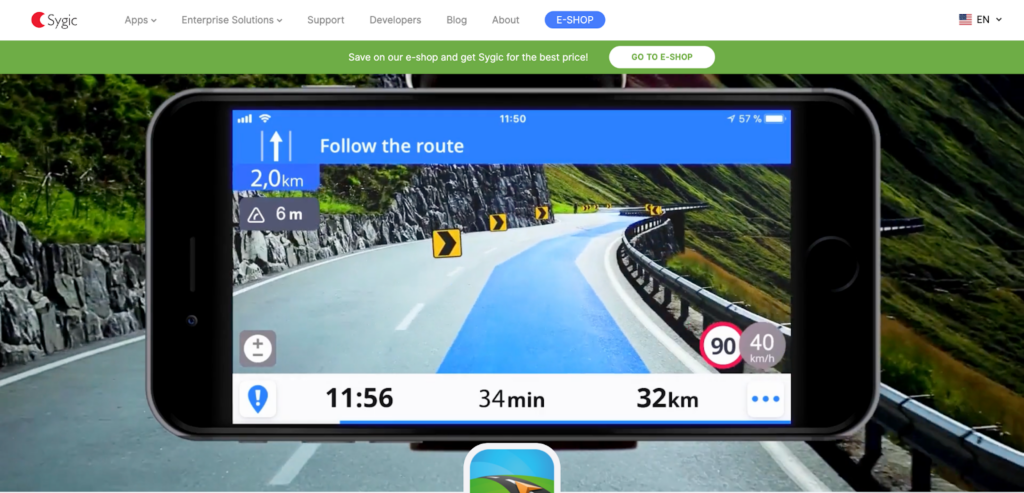
Sygic is a fleet navigation and routing tool trusted by more than 3,000 fleets and 4 million drivers globally. Its core strength is truck-legal turn-by-turn navigation, and within that specific capability, it is one of the most reliable options available. Drivers using Sygic get routes that account for vehicle dimensions, weight restrictions, bridge heights, and road access limitations that standard navigation tools ignore entirely, which matters considerably for commercial vehicle operators managing compliance across different road networks.
The platform supports offline navigation, which is a meaningful advantage for fleets operating in areas with unreliable connectivity. Its compliance tools help fleet managers stay on the right side of regional road regulations, and the familiarity of the interface means driver adoption is typically straightforward without extensive training.
Where Sygic’s scope ends is exactly where enterprise logistics planning begins. Sygic is a navigation layer, not a route optimization or dispatch platform. It does not build delivery plans, assign orders to vehicles, manage carrier relationships, or provide the operational visibility that logistics teams need to manage a network of shipments in real time. Drivers use it to follow a route that has already been planned elsewhere. It does not replace the system that does the planning.
For enterprise logistics buyers evaluating fleet routing software, Sygic is worth understanding as a component of a broader technology stack rather than a standalone solution. It answers the question of how a driver navigates a route. It does not answer the question of how that route gets built, optimized, and dispatched in the first place.
Key Features of Sygic
- Truck-legal turn-by-turn navigation with vehicle dimension and weight restrictions
- Offline navigation for areas with limited connectivity
- Real-time traffic updates and route recalculation
- Compliance tools for regional road regulations
- Fleet management integration capabilities
- Driver-facing mobile application with professional navigation interface
Sygic Is Best For
Fleets that need reliable truck-legal navigation with compliance tools and offline capability, particularly where driver-facing navigation accuracy and road restriction adherence are the primary requirements.
Sygic’s Pros
- Provides truck-legal navigation based on vehicle dimensions and road restrictions, helping drivers follow compliant routes across different regions
- Supports offline navigation, allowing drivers to operate in areas with limited or unreliable connectivity
- Delivers real-time traffic updates and route recalculations, helping drivers adjust navigation during execution
- Offers a driver-focused mobile interface, enabling easy adoption and consistent navigation across fleet operations
Sygic’s Cons
Sygic is a navigation tool, not a route optimization or dispatch platform. It does not build delivery plans, assign orders, manage carriers, or provide operational visibility across a logistics network. Enterprise logistics teams evaluating platforms for route optimization and dispatch orchestration will find that Sygic addresses only the final execution layer of navigation and does not replace the planning and orchestration capabilities they require.
Sygic’s Pricing
Sygic offers fleet pricing on a quote basis. Contact Sygic directly for pricing based on your fleet size and navigation requirements.
10. Routific
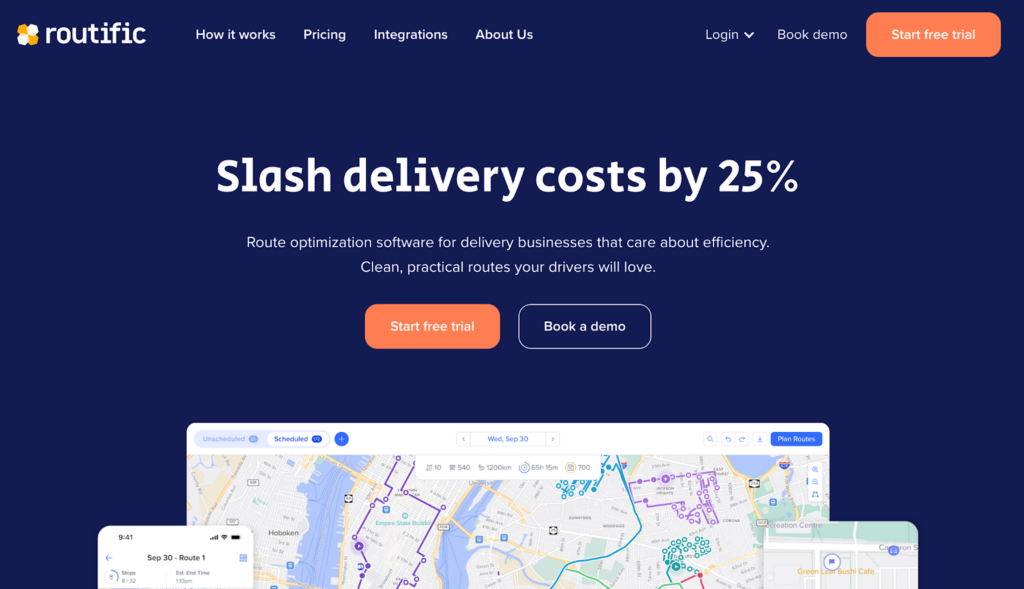
Routific is a lightweight route optimization tool designed around simplicity. Its drag-and-drop interface and quick setup make it accessible for small local delivery operations that need basic multi-stop planning without the onboarding overhead of more complex platforms. For a small business running a handful of drivers across a limited delivery area, Routific gets routes built quickly and without friction.
The platform covers the fundamentals of stop sequencing, driver scheduling, and basic delivery notifications. Its interface is clean and approachable, and teams with no prior experience using route planning software can typically get up and running without significant support. That simplicity is genuinely valuable for the audience Routific was designed for.
The challenge is that Routific’s capabilities stop at a point that enterprise buyers reach very early in their evaluation. The platform does not offer real-time rerouting, automated dispatch, or carrier management. There is no AI-driven decision layer, no integration depth with enterprise ERP or WMS systems, and no operational visibility beyond basic delivery tracking. Routific has limited published case studies or documented deployments from operations above 500 daily deliveries, which makes it difficult to assess how the platform performs under the conditions that enterprise logistics teams operate in every day.
For enterprise buyers who encounter Routific on broader comparison lists, it belongs in a different category entirely. It is a tool for small local delivery operations with straightforward needs, not a platform for logistics teams managing complexity at scale.
Key Features of Routific
- Drag-and-drop route planning and stop sequencing
- Driver scheduling and shift management
- Basic delivery notifications and customer communication
- Driver mobile application with route guidance
- Delivery tracking and basic reporting
- Quick setup with minimal onboarding requirement
Routific Is Best For
Small local delivery operations with basic multi-stop planning needs, where simplicity of setup and ease of use matter more than optimization depth, dispatch automation, or enterprise integration capability.
Routific’s Cons
Routific does not support real-time rerouting, automated dispatch, or carrier management. Integration with enterprise ERP, WMS, and TMS systems is not a capability the platform was built for. There is limited evidence of successful deployments at volumes above 500 daily deliveries, which makes it difficult to evaluate its performance under enterprise operating conditions. Operations with any meaningful scale will outgrow it quickly.
Routific’s Pricing
Routific offers subscription-based pricing with plans listed on their website. Contact Routific directly for details on enterprise pricing if applicable to your requirements.
Choosing the right fleet routing software comes down to understanding which category of platform your operation actually needs. The tools in this list fall into three distinct tiers based on their capability depth, the complexity they were built to handle, and the scale at which they perform reliably.
Use the breakdowns below to identify where each platform fits before committing to a shortlist or a demo.
Enterprise Tier
| Tool | Best For | Constraint Depth | Dispatch Management | Real-Time Visibility | Multi-Depot/Multi-Fleet Support | Enterprise Scalability | Starting Price |
|---|---|---|---|---|---|---|---|
| Locus | Large enterprise retail, FMCG, 3PL, e-commerce | 250+ real-world constraints | Yes | Yes | Yes | High | Contact Sales |
| FarEye | Mid-to-large retail and e-commerce brands | Standard constraints | Partial | Yes | Partial | Medium | Contact Sales |
| LogiNext | Enterprises in Asia and MEA | Standard constraints | Partial | Yes | Yes | Medium | Contact Sales |
| Shipsy | Enterprises with cross-border freight needs | Standard constraints | Partial | Yes | Partial | Medium | Contact Sales |
Key Takeaway: Among enterprise-tier platforms, Locus is the only one offering full dispatch automation, 250+ constraint-based optimization, and carrier orchestration within a single system. FarEye, LogiNext, and Shipsy cover parts of the enterprise problem well but require additional tools or manual effort to close the gaps Locus handles natively.
Mid-Market
| Tool | Best For | Constraint Depth | Dispatch Management | Real-Time Visibility | Multi-Depot/Multi-Fleet Support | Enterprise Scalability | Starting Price |
|---|---|---|---|---|---|---|---|
| Route4Me | Small-to-mid delivery and field service fleets | Limited constraints | No | Yes | No | Low | From $60/vehicle |
| OptimoRoute | Mid-sized delivery and service companies | Limited constraints | No | Yes | Partial | Low | From $35/user |
| Onfleet | Small-to-mid last-mile and D2C operations | Limited constraints | No | Yes | No | Low | Contact Sales |
Key Takeaway: Mid-market tools in this tier are built for simplicity and ease of use. They handle stop sequencing and basic delivery tracking well, but none of them offer automated dispatch or multi-depot support. Operations growing beyond a few hundred daily shipments will reach the ceiling of these platforms relatively quickly.
SMB and Niche
| Tool | Best For | Constraint Depth | Dispatch Management | Real-Time Visibility | Multi-Depot/Multi-Fleet Support | Enterprise Scalability | Starting Price |
|---|---|---|---|---|---|---|---|
| WorkWave | Field service businesses | Limited constraints | No | Yes | No | Low | From $54/vehicle |
| Sygic | Fleets needing truck-legal navigation | Navigation only | No | Partial | No | Low | Contact Sales |
| Routific | Small local delivery operations | Limited constraints | No | No | No | Low | Contact Sales |
Key Takeaway: These tools serve specific, narrow use cases and do them well within those boundaries. WorkWave is purpose-built for field service, Sygic is a navigation layer rather than a planning platform, and Routific is designed for small local delivery operations. None of them were built for the complexity that enterprise logistics teams operate in, and evaluating them on those criteria would be the wrong comparison to make.
How to Choose the Right Fleet Routing Software for Enterprise Operations
The contents above enunciate feature parity at a surface level, but enterprise routing decisions rarely fail on features. They fail on integration gaps, manual handoffs between systems, and the absence of a single layer that connects what the route optimizer decides to what actually happens during execution.
Routing is one component of the logistics execution stack. On its own, even a strong optimization engine creates a problem if it hands off to a separate dispatch process, a different carrier management tool, and another system for tracking. Each handoff point is a place where data gets lost, decisions get delayed, and SLA risk accumulates. At 500 daily shipments that friction is manageable. At 5,000 it becomes a structural problem that no amount of manual dispatcher effort can fully absorb.
The enterprises achieving last-mile excellence at scale are not doing it with better routing alone. They are doing it by connecting routing decisions to dispatch intelligence, carrier orchestration, real-time visibility, and operational analytics within a single system. That connection is what turns a routing tool into an execution layer, and it is what separates the first four platforms in this list from the remaining six.
For logistics leaders thinking beyond individual tools, the routing decision also connects upward into broader supply chain network design. How depots are positioned, how carrier relationships are structured, and how inventory is distributed across nodes all shape what routing software can actually achieve. Getting the execution layer right is the starting point, not the finish line.
From Complexity to Control in Fleet Routing
At scale, many logistics operations reach a point where routing plans are created, dispatch processes are in place, and yet execution continues to require increasing effort to stay on track. The challenge emerges in how these systems connect and operate together during execution.
When routing, dispatch, carrier management, and visibility are handled across separate tools, teams take on the responsibility of keeping these systems aligned. This often results in manual coordination and continuous intervention during daily operations.
Locus is designed to address this by functioning as an agentic TMS, where decisions made during routing carry through to dispatch and execution within a connected system. This allows teams to operate with shared visibility and coordinated workflows across planning and execution.
As a result, dispatch teams can focus on handling exceptions that require human judgment, rather than spending time maintaining alignment between systems.
If your operation is still absorbing that gap manually, it is worth understanding what changes when it is not. Schedule a demo with Locus and see the full platform against your operation’s actual constraints.
Frequently Asked Questions (FAQs)
1. Is fleet routing software suitable for pharmaceutical or cold-chain logistics?
Yes. Platforms built for regulated industries support cold-chain continuity, temperature-sensitive delivery constraints, and audit-ready documentation. This makes them viable for pharmaceutical last-mile and direct-to-patient delivery where compliance and chain of custody are non-negotiable.
2. How long does it typically take to implement fleet routing software at enterprise scale?
Implementation timelines vary based on integration complexity and operational scope. Lightweight tools can go live within days. Enterprise platforms require structured onboarding, typically ranging from a few weeks to a few months depending on the number of depots and systems involved.
3. Can fleet routing software support reverse logistics and returns management?
Some platforms handle reverse logistics natively within the same dispatch workflow. Locus, for instance, manages cancellations, reattempts, and returns optimization within the same platform, reducing the cost and coordination overhead that typically comes with managing reverse flows separately.
4. Does fleet routing software work for businesses operating across multiple countries?
It depends on the platform. Enterprise-grade solutions support multi-country operations with localized road restrictions, address formats, and carrier networks. Platforms with strong emerging market coverage also handle non-standardized addressing, which is a common challenge in cross-border last-mile operations.
5. What is the difference between a TMS and fleet routing software?
A TMS manages the broader transportation operation including carrier contracts, freight audit, and shipment planning. Fleet routing software focuses specifically on route optimization and delivery execution. Some platforms, like Agentic TMS solutions, now combine both capabilities within a single system.


General
Blue Yonder Alternatives for Transportation Management: The Enterprise TMS Comparison for 2026

Mar 26, 2026
Evaluating Blue Yonder's TMS module? Compare the top enterprise transportation management platforms on features, pricing, and real-world performance.
Read more
General
Why Enterprise Logistics Teams Are Rethinking Dispatch Routing Software
Mar 27, 2026
Most dispatch routing software was built for simple fleets. This article covers what enterprise logistics operations need from a dispatch platform in 2026.
Read moreInsights Worth Your Time




















Top 10 Fleet Routing Software for Enterprise Logistics Teams in 2026