


Supply Chain Optimization
E-commerce Supply Chain Management: A Complete Guide
Key Takeaways
- Optimize your e-commerce supply chain with AI-powered tools like Locus to reduce operational costs by up to 20%.
- Streamline order fulfillment processes by outsourcing to 3PL providers, enhancing delivery speeds by 30% for small businesses.
- Leverage data analytics to improve demand forecasting, reducing stockouts and overstocks by 15% for large enterprises.
- Integrate multi-channel fulfillment systems to ensure smooth order processing across platforms, reducing errors and boosting efficiency.
- Automate inventory management to save up to 10 hours per week, improving overall supply chain accuracy.
Global e-commerce sales are projected to surpass $6.86 trillion in 2025, driving the demand for more efficient supply chains. As businesses scale, managing the complexity of sourcing, inventory, and fulfillment becomes critical to maintaining competitiveness.
Inefficient supply chain processes lead to delays, higher costs, and dissatisfied customers. Optimizing e-commerce supply chain management (SCM) is essential for businesses looking to enhance operational efficiency and meet customer expectations.
This guide breaks down the key components of e-commerce SCM, explores its strategic benefits, and outlines how leveraging AI-powered solutions can drive cost savings and improve performance. We’ll also discuss how Locus helps businesses streamline their supply chains for smarter, more efficient operations.
What Is the E-Commerce Supply Chain?
The e-commerce supply chain is the system that manages the journey of a product from its source to the customer. It starts with sourcing materials or finished products, moves through storage in warehouses, and ends when the product is delivered to the consumer.
Unlike traditional supply chains, which often focus on physical stores, the e-commerce supply chain must handle online orders, often involving multiple steps and the need to fulfill customer demands quickly and accurately.
Origin of E-commerce Supply Chain: As online shopping grew in the late 1990s, businesses began to adapt their supply chain processes to support e-commerce, leading to the development of more efficient systems for handling digital orders.
Did you know? The first-ever online transaction took place in 1994 when a man sold a Sting CD to his friend, marking the start of e-commerce.
Key Components of the E-commerce Supply Chain
The e-commerce supply chain consists of several key components. Each plays a critical role in ensuring the smooth movement of goods from suppliers to customers. Without these components, businesses risk delays, increased costs, and a poor customer experience.
Below is an overview of each component, its role, and the consequences of its absence:
| Component | What It Does | If Not Present: What Happens | Where It’s Used |
| Suppliers & Manufacturers | Provide the raw materials or finished goods needed to fulfill orders. | Without suppliers, there are no products to sell, leading to stockouts and production delays. | Sourcing materials, production of goods. |
| Warehouses & Distribution Centers | Store and organize inventory, ensuring timely order fulfillment. | Inefficient storage leads to stock imbalances, delayed orders, and higher operational costs. | Inventory storage, order packing. |
| Fulfillment & Shipping | Manages order processing, packaging, and delivery to customers. | Delays or errors in fulfillment can result in dissatisfied customers and lost sales. | Order processing, packaging, delivery. |
| Customers | The final link, where products are delivered, driving repeat business. | Poor delivery or product issues lead to returns, negative reviews, and lost loyalty. | Delivery satisfaction, customer loyalty. |
The result is faster order processing, enhanced customer experience, and better overall supply chain performance.
What Is E-Commerce Supply Chain Management?
E-commerce supply chain management (SCM) is the process of overseeing and optimizing the movement of goods, services, and information in an online retail operation. It involves coordinating suppliers, manufacturers, warehouses, order fulfillment, and delivery networks to ensure timely, cost-effective product delivery.
Did You Know?
The concept of drop shipping, where a retailer doesn’t hold stock but instead fulfills orders directly from the supplier, was first popularized by mail-order catalog businesses long before the internet. It’s now an integral aspect of e-commerce, allowing businesses to scale rapidly without significant upfront investment.
Unlike traditional supply chains, e-commerce SCM relies heavily on digital tools and automation to track orders in real-time. The main goal is to meet customer expectations for fast, reliable deliveries while keeping costs under control and maintaining operational efficiency.
What Is E-Commerce Logistics?
E-commerce logistics is the execution layer of ecommerce supply chain management: the practical movement, storage, handling, delivery, and return of products after a customer order is created or inventory is positioned for sale.
It typically covers:
- First mile — the movement of products from suppliers or manufacturers into warehouses, distribution centres, dark stores, or fulfilment networks.
- Warehousing and inventory handling — receiving, storing, counting, replenishing, and locating stock accurately.
- Fulfilment operations — picking, packing, labelling, staging, and preparing orders for dispatch.
- Shipping and carrier management — selecting the right service level, carrier, cost model, and handoff process.
- Last mile delivery — moving the order from the final fulfilment or distribution point to the customer’s address.
- Returns and reverse logistics — collecting returned products, inspecting them, restocking saleable items, and routing unsaleable items for repair, disposal, or vendor return.
In other words, the supply chain defines how goods and information flow across the network, while ecommerce logistics determines how those flows are executed every day. For enterprise retailers and high-volume ecommerce brands, the quality of logistics execution directly affects delivery promise accuracy, cost per shipment, customer experience, and the ability to scale during demand peaks.
How Does the E-Commerce Supply Chain Work?
The e-commerce supply chain is a series of interconnected stages that work together to deliver products to customers seamlessly. Each step relies on real-time management and precise coordination to ensure inventory is available, orders are fulfilled on time, and customers receive their products as expected.
Customer-Centric Breakdown of the E-commerce Supply Chain
1. Sourcing and Manufacturing

The journey begins when customers select products. Behind the scenes, suppliers and manufacturers ensure the availability of high-quality goods. Efficient sourcing and manufacturing processes help maintain stock availability and fulfill customer demand.
2. Warehousing & Inventory Management
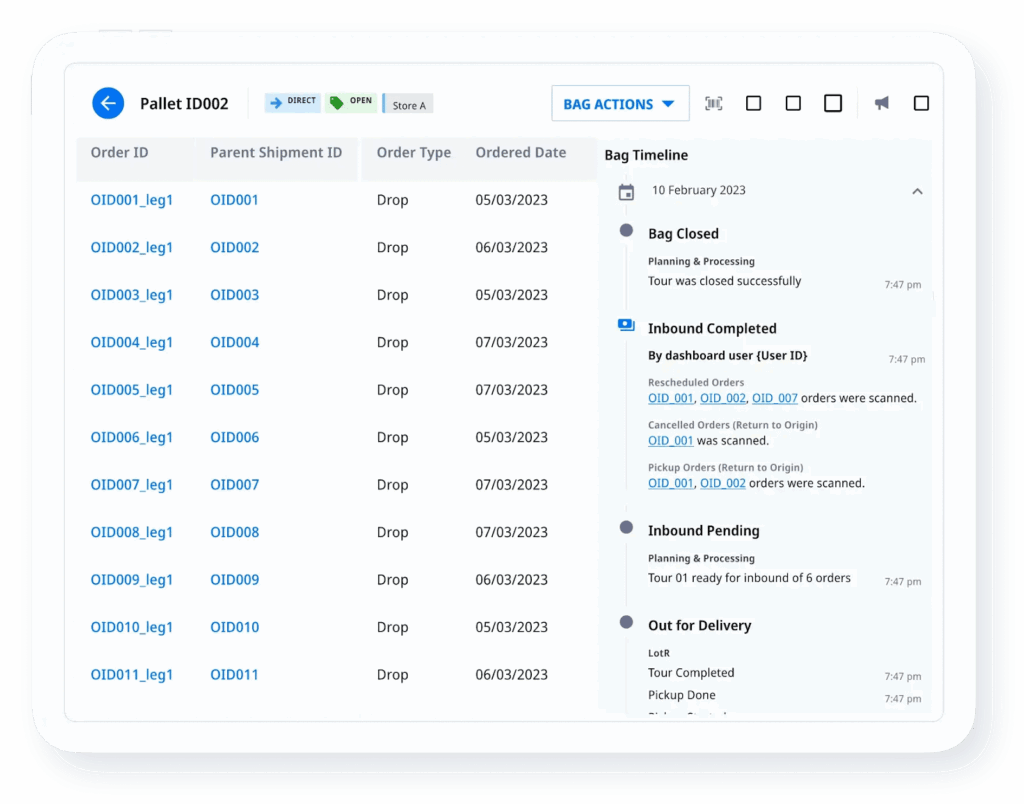
After sourcing, products are stored in warehouses or distribution centers. Effective inventory management ensures the right products are always available, reducing the likelihood of stockouts and preventing delays that could disrupt the customer experience.
3. Order Processing

When a customer places an order, the product is picked, packed, and labeled for delivery. Automation plays a crucial role in speeding up the process, minimizing errors, and ensuring accurate order fulfillment, which directly impacts the speed and reliability of delivery.
4. Shipping and Delivery
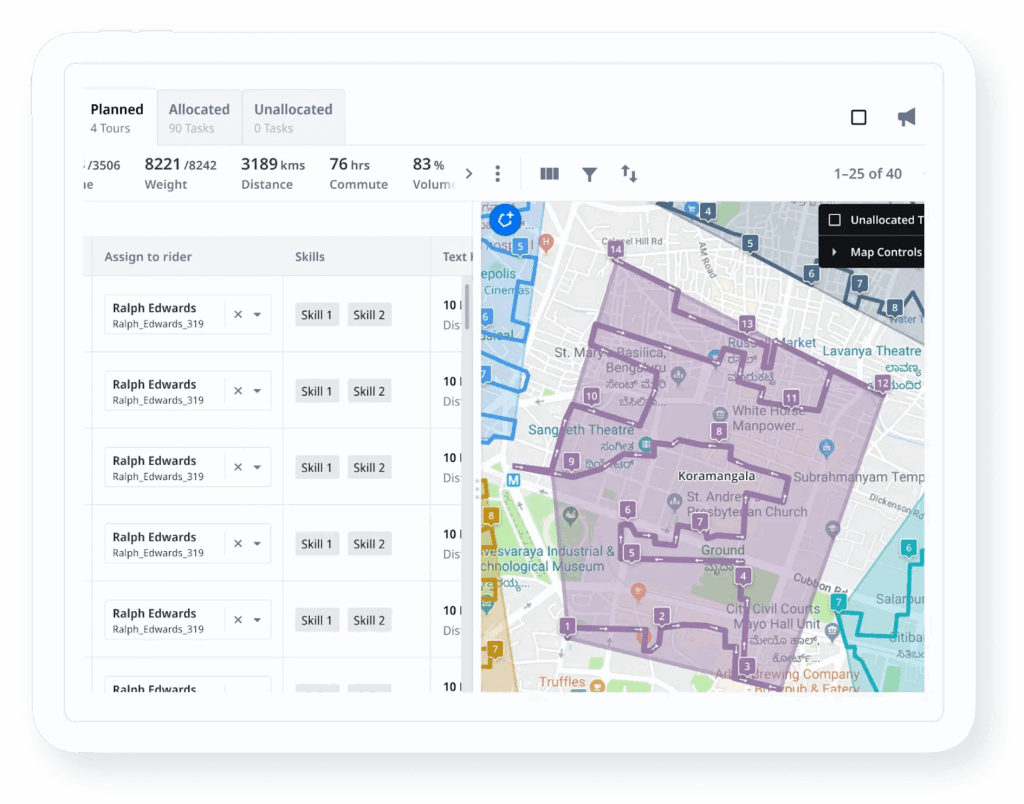
The packaged product is handed over to a delivery provider for the final leg of the journey. Advanced technologies help optimize delivery routes, ensuring that products reach customers quickly and cost-effectively. This is a critical phase for maintaining high levels of customer satisfaction. This stage typically involves two connected steps: dispatch planning, where orders are assigned to the right vehicle or carrier, and route optimization, where the sequence of stops is planned to minimize distance and time. Together, they determine how reliably the delivery promise made at checkout is kept.
5. Returns and Reverse Logistics

Returns are an inevitable aspect of e-commerce. Efficient reverse logistics processes enable businesses to manage returns smoothly, enhancing customer satisfaction and fostering trust. An optimized returns process ensures a positive post-purchase experience.
The Role of Technology in Optimizing E-commerce Supply Chain
To keep pace with customer demand and market shifts, e-commerce businesses are turning to technology for better efficiency. AI-driven platforms, like Locus, optimize real-time decision-making, reduce costs, and provide full supply chain visibility. Automation tools for warehousing, order fulfillment, and shipping are enhancing accuracy and speed, providing a competitive edge in the fast-evolving e-commerce landscape. These platforms typically work alongside a few core systems: a warehouse management system (WMS) to track inventory and coordinate picking within the warehouse, an order management system (OMS) to route and consolidate orders across channels, and often an enterprise resource planning (ERP) system to tie supply chain data into broader financial and business operations. Where a business also needs to plan and execute deliveries across a fleet or carrier network, a transportation management system (TMS) or logistics orchestration layer connects that execution back to the same order and inventory data.
A robust technology stack also depends on accurate item-level and location-level data capture. Inventory management software maintains live stock positions across warehouses, stores, fulfilment centres, and marketplaces, helping teams avoid selling stock that is not actually available.
At the warehouse floor level, barcode scanners are commonly used to confirm picking, packing, stock counts, receiving, and shipment handoffs. Barcode labels connect physical products, bins, cartons, pallets, and shipments to the digital inventory and order records inside WMS, OMS, ERP, and logistics systems. This reduces manual entry, improves traceability, and gives teams a clearer audit trail when exceptions occur.
For higher-volume or higher-velocity operations, RFID can extend this visibility further. RFID tags and readers support faster, non-line-of-sight tracking of inventory and assets, making them useful where businesses need to scan multiple items quickly, verify movement between zones, or improve control across dense fulfilment environments.
Supply chain collaboration — shared visibility between suppliers, warehouses, and delivery partners, so a delay at one stage is visible to every team relying on it
Supply chain visibility — real-time status of inventory, orders, and shipments across every stage named in the “How Does the E-Commerce Supply Chain Work?” section above
Carrier and 3PL coordination — keeping outsourced fulfillment, like the 3PL strategy covered later in this guide, connected to the same order and inventory systems rather than operating in a silo
Key E-Commerce Supply Chain Metrics and Common Challenges
Before looking at the benefits of an optimized supply chain, it helps to know what to measure and where things typically go wrong.
Metrics to Track
Ecommerce supply chain teams use key performance indicators (KPIs) to monitor fulfilment speed, inventory accuracy, delivery reliability, cost efficiency, and customer experience. The right KPI set should combine operational measurements that reveal what is happening today with forward-looking indicators that help teams prevent tomorrow’s exceptions.
- Fulfillment speed — how quickly orders move from placement to delivery, tied to the expectation (noted below) that most online shoppers want their order within 2 to 3 days
- Inventory accuracy — how closely stock records match what’s actually on hand; poor accuracy is part of why U.S. retailers were sitting on an estimated $740 billion in unsold goods in 2023, as noted later in this guide
- Order fill rate — the percentage of customer orders fulfilled completely from available stock. A low order fill rate can indicate poor inventory allocation, slow replenishment, or inaccurate stock records.
- On-time delivery / SLA adherence — the share of orders delivered within the promised window, which this guide already ties to customer retention below
- Order fulfillment cost — the cost to pick, pack, and ship a single order, which the “Reduced Operational Costs” benefit further down depends on tracking
- Cost per order (CPO) — the total fulfilment, handling, packaging, and shipping cost divided by total orders. Tracking CPO helps leaders understand whether scale is improving efficiency or simply adding more cost.
- Stockout and overstock rate — how often demand and inventory fail to match, which the Key Takeaways above already flag as a target for improvement
- Inventory turnover — how often stock is sold and replaced over a defined period. It helps identify slow-moving items that tie up working capital, as well as fast-moving products that may need stronger replenishment controls.
Types of Supply Chain Analytics: Diagnostic, Predictive, and Prescriptive
Once KPIs are in place, analytics helps supply chain teams move from measurement to action. In ecommerce supply chain management, three categories are especially useful:
- Diagnostic metrics — measurements that explain why issues happened. For example, a team may analyse late deliveries by warehouse cut-off time, carrier handoff delay, route density, or failed first-attempt delivery to identify the root cause.
- Predictive metrics — forward-looking signals used to forecast demand, stock risk, capacity requirements, and delivery delays. These can help teams anticipate which SKUs may run out, which regions may face capacity pressure, or which orders are likely to miss their SLA.
- Prescriptive metrics — decision-oriented recommendations that indicate the best next action. In practice, this could mean reallocating stock to a different fulfilment node, switching carriers, reprioritising orders, adjusting delivery routes, or changing cut-off times during peak demand.
Common Challenges
- Demand forecasting gaps — leading to the stockouts and overstocks the Key Takeaways box already flags
- Fragmented systems across sourcing, warehousing, and fulfillment — the same fragmentation the “Key Components” table above warns about when any one component is missing
- Multi-channel order coordination — keeping stock and order status consistent across a business’s own site and third-party marketplaces, as covered later in this guide’s “Optimizing Multi-Channel Fulfillment” section
- Returns handling — the “Returns and Reverse Logistics” stage above already notes this is inevitable and needs a smooth process to protect customer trust
- Inventory imbalance — excess stock in one location and shortages in another can increase transfer costs, delay fulfilment, and reduce delivery promise accuracy.
- High shipping costs — fuel, labour, carrier rates, failed deliveries, packaging choices, and low route density can all increase cost-to-serve.
- Free shipping pressure — free shipping can improve conversion, but it shifts cost pressure onto fulfilment efficiency, carrier selection, packaging optimisation, and route planning.
- Overselling — when sales channels are not synchronised with live inventory, businesses risk accepting orders they cannot fulfil on time.
- Operational bottlenecks — delays can appear at supplier handoff, receiving, putaway, picking, packing, dispatch, carrier allocation, or last-mile delivery.
- Global-scale shipping complexity — cross-border ecommerce introduces additional pressure from customs requirements, duties, longer lead times, regional carrier performance, and variable customer expectations.
- Returns policy alignment — a returns policy shapes reverse logistics volume, customer expectations, inspection workflows, restocking speed, and total cost. If policy, operations, and technology are not aligned, returns can quickly erode margin and customer trust.
How to Audit Your Current E-Commerce Supply Chain
Before investing in new capacity or technology, businesses should reevaluate their current supply chain to identify where delays, cost leakage, and service failures are actually occurring.
A practical audit should cover:
- Map the end-to-end flow — document suppliers, manufacturers, inbound lanes, warehouses, fulfilment partners, carriers, delivery zones, return points, and customer-facing channels.
- Review vendor performance — compare suppliers, 3PLs, carriers, and fulfilment partners against agreed lead times, service levels, exception rates, communication quality, and cost.
- Identify bottlenecks — look for recurring delays in receiving, inventory updates, picking, packing, carrier handoffs, dispatch planning, delivery attempts, or returns inspection.
- Trace product delays back to source — determine whether late orders are caused by vendor lead-time variation, warehouse capacity, carrier unreliability, inaccurate inventory, or poor order prioritisation.
- Prioritise fixes by business impact — focus first on bottlenecks that affect high-volume SKUs, strategic customers, expensive delivery lanes, or SLA-critical regions.
- Create a measurable improvement plan — assign owners, track KPIs, and review improvements regularly rather than treating the audit as a one-off exercise.
Benefits of E-Commerce Supply Chain
Effective e-commerce supply chain management (SCM) is vital for online success. Companies that optimize their supply chains experience improved efficiency, lower costs, and enhanced customer satisfaction. Research shows that 79% of companies with high-performing supply chains outperform their competitors in revenue growth, while optimized supply chains can reduce costs by 15%.
Below are the six key benefits of an optimized e-commerce SCM:
1. Faster Shipping Times
Customer expectations have shifted toward faster delivery. According to McKinsey & Company, 90% of online shoppers expect their orders within 2 to 3 days, and delays can prompt customers to abandon their purchase or choose competitors.
With efficient SCM strategies, businesses minimize the risk of delays caused by vendors, manufacturing bottlenecks, or stockouts. As a result, faster shipping times become achievable, improving customer satisfaction and driving repeat business.
2. Improved Inventory Accuracy
Inaccurate inventory management leads to significant losses. In 2023, retailers in the United States were holding approximately $740 billion in unsold goods, reflecting a 12% increase from the previous year. This excess inventory indicates challenges in demand forecasting and supply chain agility.
Effective SCM integrates tools that forecast demand, track inventory, and prevent stock imbalances. By aligning inventory with actual demand, businesses avoid stockouts and minimize waste, ultimately improving cash flow and operational efficiency.
3. Higher Customer Satisfaction
Timely delivery is a critical factor for customer loyalty. Research from Oracle indicates that 13% of customers will never return to a store if their orders are not delivered on time.
Streamlined SCM processes ensure that products are shipped promptly and arrive intact. Real-time tracking and efficient returns management also contribute to a better customer experience, which can drive repeat business and improve overall customer retention rates.
4. Reduced Operational Costs
Inefficiencies in supply chain processes lead to higher operational expenses, whether from overstocked inventory, labor-intensive operations, or frequent shipping errors.
By optimizing tasks like inventory management, order fulfillment, and shipping, SCM reduces unnecessary costs. Automation tools help streamline these processes, leading to lower labor costs and reduced storage expenses, all while improving overall supply chain performance.
5. Scalability and Flexibility
As businesses grow, their supply chains must adapt to handle fluctuating demand. Without a scalable system, companies struggle to manage surges in orders during peak times, leading to stockouts or delays.
Optimized SCM offers scalable solutions through third-party logistics (3PL) and cloud-based tools, allowing businesses to expand their capacity without significant infrastructure investment. This flexibility ensures that companies can handle seasonal demand or market changes efficiently.
6. End-to-End Visibility
A lack of visibility across the supply chain can lead to inefficiencies and poor decision-making. Real-time tracking and data analytics provide businesses with comprehensive oversight of product movements and inventory levels.
With AI-powered platforms and advanced tracking systems, e-commerce companies gain full visibility of every stage in the supply chain. This transparency helps identify potential issues early, enabling quicker resolutions and more informed decision-making.
E-Commerce Supply Chain Strategies for Small or Large Shops
Whether you’re running a small e-commerce business or managing a large enterprise, having the right supply chain strategy is essential for success. The scale of your business impacts the complexity of your supply chain, but the core principles of efficiency, cost-effectiveness, and customer satisfaction remain the same.
Supply Chain Strategies for Small E-commerce Businesses
1. Focus on Agility
Small businesses must be able to pivot quickly in response to shifts in customer demand, inventory levels, and market changes. An agile supply chain allows for fast decision-making without incurring additional costs.
| Agility Factors | Impact on Business |
| Flexible inventory systems | Quickly address stockouts or increased demand. |
| Rapid supplier and order adjustments | Maintain seamless operations even during unpredictable market changes. |
| Real-time monitoring and decision-making | Prevent delays and keep fulfillment on track with minimal disruption. |
2. Use Cloud-Based Solutions
Cloud platforms offer small businesses scalable, affordable tools for managing their supply chain. These systems evolve with the business, eliminating the need for expensive, on-premise solutions.
Key Benefits of 3PL Outsourcing:
- Scalable: Easily adapts to growing business needs without significant upfront costs.
- Cost-effective: Reduces the need for expensive on-premise infrastructure.
- Real-time data: Provides accurate, up-to-date information for better decision-making.
- Automation: Streamlines processes like inventory management and order fulfillment.
- Accessible: Offers 24/7 access from anywhere for increased flexibility.
3. Outsource Fulfillment to 3PL Providers
Third-party logistics (3PL) providers offer an efficient way to manage warehousing, shipping, and returns without burdening internal resources. This outsourcing strategy reduces operational overhead and ensures products are delivered reliably.
How Locus Optimized FMCG Retail Distribution
One of Indonesia’s leading FMCG distributors faced inefficiencies due to manual sales beat planning and lack of visibility across their distribution network. The company partnered with Locus to automate its sales beat planning process, providing real-time tracking and intelligent optimization.
The solution, FieldIQ, integrated dynamic route planning, real-time alerts, and on-ground tracking, resulting in:
- 30% reduction in planning time
- 12% increase in serviceability ratio
- 20% reduction in distribution costs
By automating these processes and leveraging Locus’ Control Tower Application, the business achieved more efficient resource utilization and faster delivery times, showing the significant advantages of partnering with 3PL providers for end-to-end fulfillment.
4. Adopt Automation
Automating key supply chain functions such as inventory management, order processing, and shipping enhances operational efficiency and accuracy.
Examples of Automation:
- Inventory tracking: Automation ensures real-time updates on stock levels, preventing stockouts and overstocking.
- Order processing: Automated systems speed up picking, packing, and shipping, reducing human error and increasing fulfillment speed.
- Shipping optimization: Automated tools calculate the most cost-effective shipping routes, improving delivery speed and reducing costs.
Supply Chain Strategies for Large E-commerce Businesses
Large e-commerce businesses face more complex supply chain challenges due to their scale and multi-channel operations. To stay competitive, they need strategies that can handle growth, improve efficiency, and optimize customer experience.
1. Optimizing Multi-Channel Fulfillment
Large e-commerce businesses typically operate across various platforms, including their own websites, Amazon, and other third-party marketplaces. Managing seamless fulfillment across these diverse channels requires a sophisticated, integrated supply chain management system.
| What It Does | Key Impact | Why It Matters |
| Manages orders from multiple platforms | Streamlines the fulfillment process across different channels | Ensures consistent delivery times and stock availability across platforms, enhancing customer satisfaction. |
| Centralized order management | Reduces risk of stockouts and overselling | Keeps inventory levels balanced, ensuring efficient order fulfillment. |
Why Omnichannel Fulfillment Also Means Omnichannel Communication
Keeping stock and order status consistent across channels, as covered above, only solves half the experience. Customers also expect consistent shipment status updates and communication regardless of where they ordered — a tracking link that works the same way whether the order came from a company’s own site or a third-party marketplace. Coordinating this alongside the centralized order management already described here closes the loop between fulfillment accuracy and the customer experience.
2. Investing in Advanced Technology
AI, machine learning, and data analytics are transformative technologies that allow businesses to predict demand more accurately, optimize inventory, and improve forecasting. These technologies enable better decision-making and more precise resource allocation.
Optimizing FMCG Supply Chain with AI
A leading frozen dessert manufacturer in India partnered with Locus to optimize their FMCG supply chain. By integrating AI-powered solutions, they moved from traditional ad-hoc distribution planning to scheduling-based optimization, significantly improving efficiency.
Locus implemented tools like Dispatch management for route optimization and NetOpt for network optimization, helping the company reduce logistics costs by 8% and save 2-3 hours in daily planning. The company also gained 100% visibility of its resources, leading to more reliable deliveries and cost savings. This integration of AI-based solutions improved the entire supply chain from sourcing to last-mile delivery.
3. Global Sourcing & Supply Chain Integration
Businesses with a global reach must manage suppliers, manufacturers, and fulfillment centers across multiple regions. Effective integration and coordination of these processes are essential to handle complexities such as tariffs, shipping regulations, and currency fluctuations.
Key Considerations for Global Sourcing:
- Customs and Regulations: Navigating international trade laws and customs can lead to delays if not managed properly.
- Supplier Coordination: Managing suppliers across different time zones and regions can lead to inefficiencies without a unified system.
- Logistics Optimization: Efficient management of international shipping routes, including selecting the most cost-effective carriers.
4. Building Strategic Partnerships
Long-term relationships with suppliers, logistics providers, and technology vendors are crucial for creating a resilient and efficient supply chain. These partnerships ensure scalability during high-demand periods and foster collaboration in solving complex logistical challenges.
Benefits of Strong Strategic Partnerships:
- Consistency: Reliable relationships with partners help maintain consistent delivery times, even during peak seasons.
- Flexibility: Partnerships offer flexibility to adapt to unforeseen challenges, such as supply chain disruptions or sudden demand spikes.
- Innovation: Collaborating with technology vendors often leads to innovations that streamline operations and improve efficiency.
E-Commerce Supply Chain Management Best Practices
Strong ecommerce supply chain management is not a one-time redesign. It requires continuous operational discipline across process, technology, partners, and performance management.
- Streamline core processes — standardise receiving, putaway, picking, packing, dispatch, carrier handoff, delivery exception handling, and returns workflows so teams can scale without adding avoidable complexity.
- Monitor KPIs consistently — track fulfilment speed, inventory accuracy, order fill rate, cost per order, on-time delivery, stockout rate, and returns performance at a regular operating cadence.
- Maintain flexible fulfilment capacity — use a mix of warehouses, stores, fulfilment centres, 3PL partners, and carrier options where appropriate to absorb peak demand and regional volume shifts.
- Build contingency plans — prepare for supplier delays, carrier failures, weather disruption, labour shortages, customs delays, and sudden demand spikes before they affect customers.
- Use multiple suppliers where appropriate — dual sourcing or regional supplier diversification can reduce dependency risk, particularly for high-volume, high-margin, or business-critical SKUs.
- Connect systems instead of creating silos — ensure WMS, OMS, ERP, inventory management software, carrier systems, and logistics orchestration tools share timely data.
- Review network design periodically — reassess warehouse locations, delivery zones, service levels, and carrier allocation as order density and customer expectations change.
Delivering Seamless Order Fulfillment and Cost Savings with Locus
The success of any e-commerce business depends on how well its supply chain runs. Customers expect fast deliveries, businesses want to keep costs low, and growth requires everything to scale without breaking. Meeting all three at once is not easy.
That is where Locus comes in. The platform uses AI to take the guesswork out of logistics. Routes are planned in seconds, inventory and orders are tracked in real time, and routine tasks are automated so teams can focus on customers instead of spreadsheets.
For a retailer, this means fewer late deliveries and lower shipping costs. For a growing e-commerce brand, it means scaling operations without adding extra overhead. And for every business, it means a supply chain that is reliable, predictable, and ready for tomorrow’s demand.
As e-commerce becomes more competitive, those who optimize their supply chains now will stay ahead. Locus makes that possible. Book a demo today to see how.
Frequently Asked Questions (FAQs)
1. What are the most common challenges in e-commerce supply chain management?
The most common challenges include inventory management, order fulfillment delays, and maintaining visibility across multiple platforms. Technology solutions, like those offered by Locus, can address these by automating and streamlining processes.
2. How can I reduce shipping costs in my e-commerce supply chain?
Optimize delivery routes using AI-powered solutions, consolidate shipments, and negotiate better rates with carriers. Tools like Locus provide route optimization to reduce shipping costs and enhance efficiency.
3. What technologies are transforming e-commerce supply chain management?
AI, machine learning, real-time tracking, and automation are revolutionizing e-commerce SCM by improving forecasting, inventory management, and fulfillment speeds. These technologies offer increased accuracy and reduced costs.
4. How do I scale my e-commerce supply chain as my business grows?
Leverage automation, partner with third-party logistics providers, and implement cloud-based management systems. Locus helps businesses scale efficiently with AI-driven solutions that enhance visibility and optimize supply chain processes.
5. What role does customer service play in e-commerce supply chain management?
Customer service ensures timely communication and handles issues like returns, refunds, or shipping delays. A streamlined supply chain helps improve customer satisfaction by ensuring quick resolutions and smooth operations.


General
What is Logistics Automation? A Complete Guide in 2025

Oct 6, 2025
Explore the world of logistics automation in 2025. Understand its types, benefits, and future trends while discovering how Locus is leading the change with AI.
Read more
News
Our First Steps to Perpetuity

Oct 7, 2025
A Short Story About Symbols There is a small service road in Nagasandra, on the outskirts of Bengaluru, where Locus took its first steps, working out of a rented apartment. In those first months, there was just a quiet stretch of road, a rented flat, and a handful of people learning how to make hard […]
Read moreInsights Worth Your Time




















E-commerce Supply Chain Management: A Complete Guide