


General
What Is a Carrier Operation Management Platform? Dispatch, Visibility, Exception Handling, and Analytics
Key Takeaways
- A carrier operation management platform centralizes dispatch, real-time visibility, exception handling, and carrier analytics in one place, replacing the spreadsheets, phone calls, and carrier portals that fragment day-to-day operations.
- The four pillars work together: dispatch decisions feed visibility requirements, visibility surfaces exceptions early, and exceptions generate the performance data that drives analytics.
- Modern platforms embed carrier operation management inside a broader TMS rather than running it as a standalone module, which means dispatch, tracking, and contract data all share the same system of record.
- Organizations managing fragmented carrier networks, rising SLA penalties, or high manual coordination overhead are the clearest candidates for this category.
- The right platform choice depends on dispatch automation depth, carrier onboarding speed, integration with ERP and WMS systems, and the ability to scale under peak load without performance degradation.
A carrier misses its pickup window. Your dispatcher only learns about it when the warehouse calls asking where the truck is. Forty minutes is enough time for the rest of the route to unravel, for delivery windows to slip, and for customer commitments to turn into fire drills.
This is rarely just a carrier issue. It starts as a visibility gap, turns into a dispatch scramble, and ends as a customer experience problem. It happens when dispatch, tracking, and exception workflows live in different tools, with different data, and no single place to act fast.
A carrier operation management platform is designed to close that gap. It brings dispatch control, real-time shipment visibility, exception handling workflows, and carrier performance analytics into one operational layer, so teams can see issues early and resolve them before they become misses.
In this guide, we break down what these platforms do, how they differ from a basic TMS or spreadsheet-driven coordination, and what to look for when your carrier network is getting harder to run with manual processes.
What Is a Carrier Operation Management Platform?

A carrier operation management platform is software that centralizes the day-to-day work of running a carrier network. It helps teams assign loads, track shipments, catch exceptions before they become service failures, and measure carrier performance over time.
The point is simple: replace the patchwork most teams inherit (carrier portals, email threads, spreadsheets, and tribal knowledge) with one operational layer that runs the workflow end to end.
The category has matured a lot over the past decade. Early tools were essentially digital dispatch boards with tracking added on as an afterthought. What people mean by a carrier operation management platform today is more complete, and the difference shows up in two places.
- First, the execution layer is built to act, not just inform. Instead of simply showing where loads are, the platform can apply dispatch rules automatically, evaluate carriers dynamically using real-time capacity and performance signals, and route exceptions into resolution workflows instead of dropping alerts into someone’s inbox.
- Second, carrier operation management no longer exists as a standalone category. It is now embedded within modern transportation and logistics management platforms, where dispatch, tracking, contract data, and analytics share the same system of record.
The operational benefit is significant. When a carrier misses an SLA, the platform does not just log it as an event. It ties that miss to the carrier’s contract terms, updates the performance scorecard, and surfaces it in the next dispatch cycle’s allocation logic. That feedback loop does not exist when the tools are separate.
How carrier operation management platform differs from a basic TMS or spreadsheets
A traditional TMS handles transportation planning: load tendering, freight procurement, and carrier rate management. It is built around the planning event, not the execution event. Once a load is assigned, most traditional TMS platforms hand off to manual processes for tracking, exception handling, and performance measurement.
A carrier operation management platform is where execution lives. It manages what happens after the load is assigned: tracking the shipment in real time, routing exceptions to resolution, and feeding performance data back into carrier governance.
For operations running 15 or more carriers across multiple regions, the gap between a planning tool and an execution tool is where most of the operational cost accumulates.
Spreadsheets are not a comparable alternative at this scale. A logistics director managing carrier performance data manually described the problem precisely: the spreadsheet needed its own spreadsheet to explain it.
Manual reconciliation works until it does not, and at carrier network complexity, it stops working well before most teams realize it.
Carrier operation management platform: Who it is for
The clearest candidates are shippers, 3PLs, and operations teams managing multiple carriers simultaneously, where manual coordination has become a bottleneck.
Specific signals: dispatch decisions taking too long because capacity data is not centralized, exceptions discovered by customers rather than by the platform, carrier invoices requiring manual reconciliation because there is no system of record for contract terms, and performance decisions being made on intuition rather than data.
For smaller operations running two or three carriers on predictable routes, the governance layer is overkill. The threshold arrives when carrier count, exception volume, or SLA exposure exceeds what a dispatcher can manage manually without dropping operational quality.
Why Your Business Needs a Carrier Operation Management Platform

The business case for this category is not theoretical. It sits inside cost lines that most logistics teams can already measure: redelivery costs, SLA penalty payments, manual coordination hours, and the margin difference between the contracted carrier rate and what actually gets invoiced.
Fragmented carrier networks and coordination cost
Enterprise logistics operations now routinely manage 15 to 40 carriers across geographies, shipment types, and service tiers.
Every carrier added to a fragmented stack multiplies the coordination overhead: separate portals for tracking, separate contacts for exception resolution, separate invoice formats for reconciliation. The cost is not just time. It is decision latency. When a dispatcher has to log into four systems to understand the current state of the network, they are always working from incomplete information.
A carrier operation management platform consolidates that network view. Dispatch, tracking, and exception data for all carriers run through one interface. The coordination overhead does not scale with carrier count because the platform handles it rather than passing it to a human.
Rising SLA penalties
Enterprise retail and marketplace contracts have tightened their delivery accuracy requirements substantially over the past three years. A carrier that misses a delivery window by 30 minutes may now trigger a contractual penalty that wipes the margin on that shipment entirely. For high-volume operations, the financial exposure from SLA failures is no longer a rounding error.
The problem with reactive exception management is that by the time a failure is confirmed, the penalty is already accrued. A platform that monitors carrier-level SLA commitments in real time and alerts before a breach, rather than after, changes the financial exposure. Earlier intervention means more resolution options. More resolution options mean fewer confirmed misses.
3PL fragmentation
Regional fulfillment increasingly runs through sub-contracted networks where a single shipment may touch two or three logistics partners before reaching the end customer. Each handoff creates a visibility gap. Each gap is a potential exception that no one catches until the customer calls.
Carrier operation management platforms handle multi-leg visibility by aggregating tracking data across all partners in the chain. The operations team sees one continuous shipment journey rather than three separate carrier events that they have to stitch together manually.
Peak-season capacity volatility
During peak periods, carrier capacity commitments made in advance do not always hold. A carrier that confirmed 200 slots for November may come back in October with 140.
Without a platform that shows available capacity in real time and can dynamically reallocate to alternate carriers, the gap between committed capacity and actual capacity lands in a dispatcher’s lap as a manual problem to solve under time pressure.
Dynamic carrier selection, covered in the next section, is the mechanism that prevents that gap from becoming a service failure.
Dispatch: Centralized Control and Execution
Dispatch in a carrier operation management platform means more than assigning a load to a carrier. It means managing the full execution sequence: capacity checking, assignment, driver or carrier communication, real-time adjustment, and exception escalation. All of it from one place, across every carrier in the network.
Automated assignment and capacity management
Manual dispatch at scale is a coordination tax. A dispatcher managing 30 carriers across parcel, LTL, and last-mile routes cannot hold all of that capacity data in working memory. Assignment decisions get made on habit and availability rather than on cost, performance, and geographic fit.
Automated dispatch rules codify the criteria that a skilled dispatcher would use and run them consistently at every assignment event. Load characteristics (weight, volume, service level, destination zone) are matched against carrier capacity and availability in real time. The assignment happens without a dispatcher having to build it manually, which means faster dispatch, fewer errors, and a consistent decision framework across the network.
Dynamic carrier selection
Static rate cards are a planning tool. They reflect what carriers agreed to charge under specific conditions. They do not reflect what a carrier can actually deliver on a given day, at a given volume, at the tail end of peak season.
Dynamic carrier selection changes the evaluation from a static table lookup to a live comparison. When an order is ready for dispatch, the platform pulls real-time capacity signals and current performance data from each eligible carrier, scores them against the order’s requirements, and makes the assignment. A carrier running at 95% on-time delivery gets prioritized over a cheaper carrier running at 78%. The decision is made by data, not by whoever answered the phone fastest.
The business impact compounds over time. Carriers with consistently weak performance get less volume in the next cycle. Carriers that perform well get more. The network improves because the selection logic applies performance data rather than ignoring it.
Real-time adjustment
Dispatch decisions made at 6 AM are rarely still optimal by noon. A driver running late after a difficult delivery, a carrier at capacity for the afternoon window, a store that moved its ready time: each of these events requires a dispatch adjustment. Without a platform, those adjustments are manual. With one, the platform detects the constraint, evaluates alternatives, and either makes the reassignment automatically or surfaces it to the dispatcher with a recommended action.
For high-volume order fulfillment operations, the reduction in manual dispatch intervention is where the analyst hours come back.
Visibility: Real-Time Tracking and Status
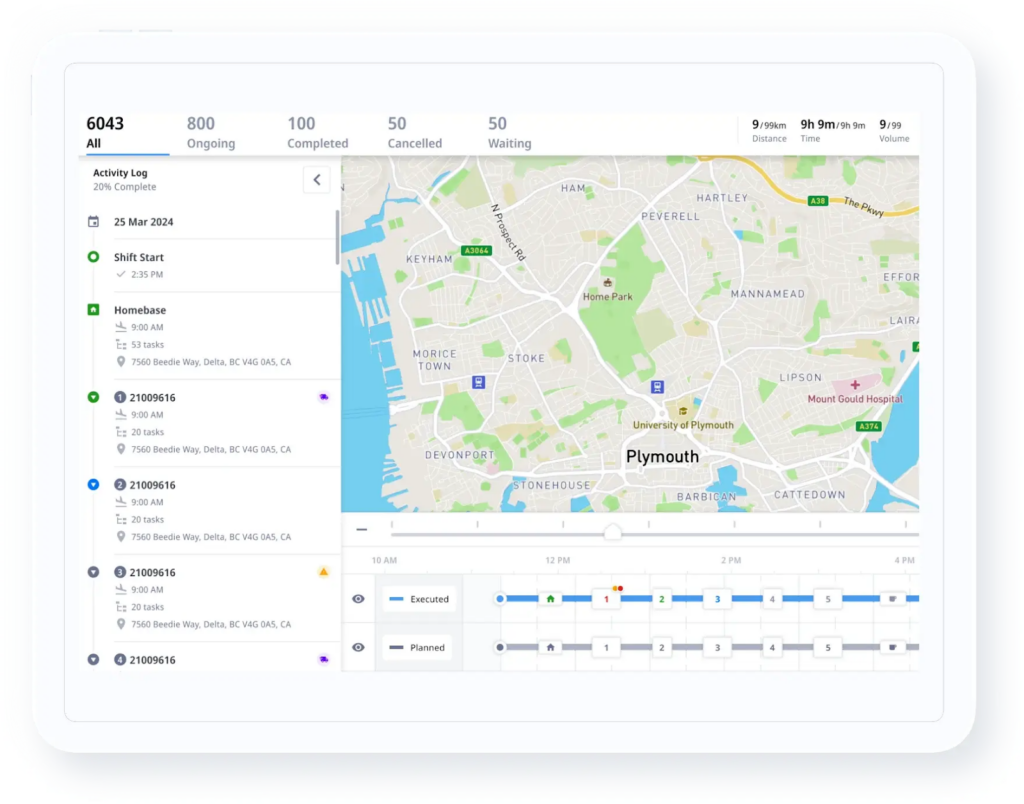
Visibility in logistics means knowing where every shipment is, what its current status is, and when it will arrive, without logging into a carrier portal or waiting for a check-in call. At the carrier network level, it means having that information for all carriers simultaneously, in one interface.
Unified, carrier-agnostic tracking
The baseline problem is that every carrier has its own tracking system. A logistics team managing 20 carriers is, by default, managing 20 separate data sources. Consolidated visibility requires either manual aggregation (which is slow and incomplete) or a platform that connects to all carrier data feeds and normalizes them into a single view.
Carrier operation management platforms handle the integration layer. Tracking events from different carriers, using different data formats and update frequencies, are translated into a consistent status model. The operations team sees one network, not 20 separate ones.
Proactive alerts and predictive ETAs
Real-time visibility is only operationally useful if it triggers action before a problem becomes a failure. A map showing a shipment’s current location is informative. An alert that fires 20 minutes before a predicted SLA breach, with enough lead time to activate an alternative carrier or notify the customer, is operationally valuable.
Predictive ETAs account for traffic patterns, carrier history, and current operational conditions rather than just calculating the remaining distance. When a shipment is at risk, the platform knows it before the dispatcher does, and the alert can reach whoever needs to act on it in time to make a difference.
How visibility feeds the rest of the platform
Visibility is not a standalone function. It is the data source that makes the other three pillars work. Exception handling depends on visibility to detect deviations early. Analytics depends on visibility to build the performance record that drives carrier scorecards. Dispatch depends on visibility to understand the current network capacity before making the next assignment.
A platform where visibility is a separate module, rather than a shared data layer, creates the same coordination problem it was meant to solve. The delivery management software that handles this well integrates tracking data directly into dispatch and exception workflows rather than surfacing it on a separate dashboard.
Exception Handling: Managing Delays, Failures, and Changes
Exceptions are unavoidable in carrier operations. Late pickups, failed delivery attempts, route deviations, address errors, damaged goods, customer reschedule requests: the question is not whether they will happen but how quickly the operation can detect and resolve them.
The cost of reactive exception management
Most logistics teams discover exceptions in one of two ways: the carrier calls to report it, or the customer calls to complain. Both of these are late. By the time a carrier reports a late pickup, the downstream slot may already be lost. Additionally, when a customer calls about a missed delivery, the redelivery cost is already accrued, and the damage to the customer experience is already done.
The financial cost of a single unmanaged exception is measurable: redelivery costs typically run 1.5 to 2 times the original delivery cost, SLA penalties from missed windows add on top of that, and the dispatch team time spent resolving the exception is overhead that scales with exception volume.
How a platform changes the exception workflow
A carrier operation management platform detects exceptions through continuous monitoring rather than waiting for a report.
As a case in point, a driver deviating from the planned route, a shipment that has not updated status within its expected window, a carrier that has not confirmed pickup for a time-sensitive load: each of these triggers an alert routed to the right person with enough context to act.
Resolution workflows mean the alert does not sit in an inbox. The platform can trigger automatic reassignment to an alternate carrier when a primary carrier rejects capacity, initiate a customer notification when a delay is confirmed, or escalate to a supervisor if an exception has not been resolved within a set time window. The decision logic is configured by the operations team and runs without dispatcher intervention on standard scenarios.
Reducing customer impact
For operations running last mile delivery at scale, the customer impact of a poorly managed exception is the most visible cost. A proactive notification that a delivery is running 30 minutes late, sent before the customer has to call to ask, is qualitatively different from discovering the miss after the fact.
Customer satisfaction scores on deliveries with proactive exception communication consistently outperform those where the customer finds out last.
Analytics: Performance, Cost, and Carrier Scorecards
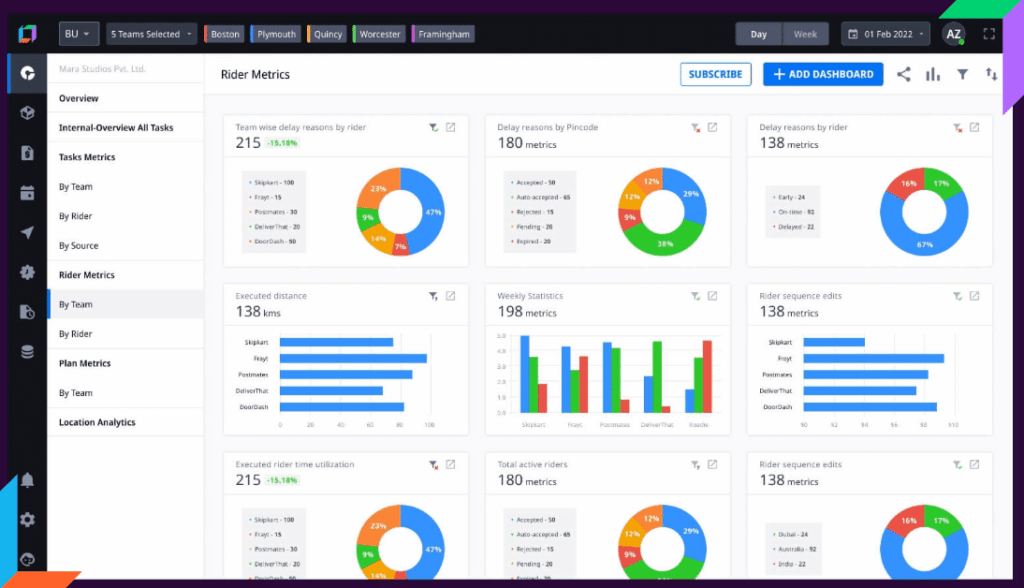
Carrier analytics is where operational data from dispatch, visibility, and exception handling converts into the information that drives better decisions: which carriers to award more volume, which contracts to renegotiate, and where the network has structural gaps in coverage or reliability.
Carrier scorecards
A carrier scorecard is a performance record built from actual execution data. On-time pickup rate, on-time delivery rate, exception frequency, exception resolution time, and cost per shipment are the standard dimensions. Over time, the scorecard gives operations leaders a factual basis for carrier allocation decisions rather than relying on the relationship or the last conversation.
The practical implication is significant for contract negotiations. Arriving at a renegotiation with 12 months of data showing a carrier’s actual on-time rate against contracted SLAs is a different conversation than arriving with a general sense that performance has been inconsistent.
Data-driven renegotiation typically recovers meaningful cost or commitment improvement that gut-feel conversations do not.
Cost per shipment and trend analysis
Carrier performance is not just about the delivery success rate. Cost efficiency per shipment, by carrier and by lane, shows where the rate card is working and where it is not. A carrier that performs well on on-time metrics but runs 18% above the network average on cost per shipment in a specific region may still be worth examining.
Trend analysis shows whether carrier performance is stable, improving, or degrading over time. A carrier whose on-time rate dropped 6 points in the last 90 days while volume held constant is a risk that shows up in the data before it shows up in a customer complaint.
Reporting for operations and leadership
Analytics in a carrier operation management platform needs to serve two audiences. Operations teams need granular, actionable data: exception rates by carrier, on-time performance by route, cost per shipment by mode. Leadership needs aggregated performance against targets: network-wide SLA compliance, total carrier spend versus budget, and trend direction.
Platforms that require significant manual export and reformatting to produce either view add a reporting overhead that reduces the frequency of data-driven decisions. Built-in dashboards and configurable KPI views mean the data is available when the decision needs to be made, not after someone has spent three hours building a pivot table. For retail logistics operations where carrier performance directly affects customer satisfaction metrics, reporting speed matters operationally.
7 Key Features of an Effective Carrier Operation Management Platform
The features below reflect the operational capabilities that separate platforms that can govern a carrier network from platforms that can only connect to one.
- Unified dispatch and capacity management: A single interface for assigning loads across all carriers, with real-time capacity visibility and automated assignment rules that apply configurable criteria consistently without manual intervention at each event
- Dynamic carrier selection: Real-time scoring of available carriers against order requirements using live capacity, current performance data, and cost, rather than static rate tables
- Carrier-agnostic tracking and visibility: Normalized tracking data across all carriers in one view, with predictive ETAs and proactive breach alerts that fire before failures are confirmed
- Exception management workflows: Automated detection, alert routing, and resolution workflows for standard exception types, with escalation logic and audit trails for every exception event
- Carrier scorecards and performance analytics: Execution-data-driven scorecards covering on-time rates, exception frequency, cost per shipment, and trend direction, accessible for both operational and leadership reporting
- Integration with OMS, WMS, TMS, and carrier systems: Native API and prebuilt connector support for enterprise stack components, including EDI and API carrier formats, without custom middleware for standard environments
- Scalability for multi-carrier and multi-mode operations: Performance that holds at peak load across parcel, LTL, and last-mile shipment types without degradation, and support for adding new carriers without engineering-led integration builds
How to Choose the Right Carrier Operation Management Platform
The evaluation criteria for this category map directly to the operational gaps that make a carrier operation management platform necessary in the first place.
Dispatch automation depth
Ask vendors to demonstrate what happens when a carrier rejects a tender. Does the platform automatically identify the next best carrier based on current capacity and performance data and reassign without manual intervention? Or does it surface a notification and wait for a dispatcher to act? The difference between those two answers is the difference between automation and alerting.
Integration depth with ERP, WMS, and OMS
Carrier dispatch does not run in isolation. Rate selection needs order data from the OMS. Label generation needs package dimensions from the WMS. Invoice reconciliation runs against contract data in the ERP. Platforms with native prebuilt connectors for major enterprise stack components avoid the middleware debt that accumulates in custom integration projects.
Ask specifically: which ERP and WMS systems does the platform have certified integrations for? What does the integration maintenance commitment look like post-go-live? Who owns it when a system update breaks a connection?
Carrier onboarding time
A platform’s pre-integrated carrier network size determines how quickly new regional carriers can go live. Platforms with self-serve carrier onboarding portals and large pre-integrated carrier libraries can activate a known carrier in days.
Custom integrations for carriers without standard API documentation typically take four to eight weeks and require engineering involvement.
If your expansion plans include adding regional carriers for new markets, carrier activation speed is a constraint on how fast the operation can grow. Verify pre-integration coverage for your target markets before committing to a platform.
Scalability under peak load
Pilot-environment performance is not the same as peak-season performance. A platform that handles 5,000 shipments per day smoothly in June may behave differently at 25,000 in November.
Ask vendors for specific data on performance at peak load: processing time for dispatch decisions, tracking data refresh rate, and exception alert latency. References from customers who have run peak seasons on the platform are more informative than benchmark claims. Platforms that cannot demonstrate stable performance at peak volume from existing customers should be treated as a risk.
Exception handling configurability
A late pickup on a non-critical shipment is of a different severity than a failed delivery on a same-day order with an SLA penalty attached. The platform’s exception management logic should be configurable to reflect those distinctions, with different alert routing, escalation timelines, and resolution workflows by exception type.
Carrier Operation Management Platform vs. Traditional Freight Management
The comparison between a carrier operation management platform and traditional freight management methods is worth being direct about, because the gap is not just a feature gap. It is a structural one.
| Dimension | Traditional freight management | Carrier operation management platform |
|---|---|---|
| Dispatch | Manual assignment via phone or email | Automated rules with dynamic carrier selection |
| Visibility | Carrier portal logins, periodic check-in calls | Unified real-time tracking across all carriers |
| Exception handling | Reactive, discovered by a customer or carrier report | Proactive detection with automated resolution workflows |
| Analytics | Manual spreadsheet reconciliation | Built-in scorecards and dashboards from execution data |
| Carrier onboarding | Custom build per carrier, weeks to months | Self-serve portal for pre-integrated carriers, days |
| Contract management | Manual rate file maintenance | Digitized contract parameters with invoice reconciliation |
Traditional methods are not a viable comparison at a multi-carrier scale. The coordination cost compounds faster than headcount can absorb it.
An operations team that is spending meaningful time on carrier billing disputes, manual exception resolution, or performance decisions based on incomplete data is already past the threshold where a platform pays for itself.
The investment threshold is not purely about shipment volume. It is about carrier count, exception frequency, and SLA financial exposure. An operation running 10 carriers with strict delivery accuracy requirements and contractual penalties may hit that threshold at lower volume than an operation running 30 carriers with looser SLA terms.
Streamline Your Logistics With a Carrier Operation Management Platform
To sum it up, carrier billing disputes, manual exception resolution, performance decisions made without reliable data, and carrier onboarding timelines that delay market expansion: these are the symptoms.
The carrier operation management platform is the structural fix. Not because it adds features, but because it shifts the operational model from reactive coordination to automated governance.
For logistics and supply chain management teams evaluating this category, the buying decision starts with the specific breakdown points in your current carrier network.
- Where is the most analyst time disappearing?
- Where are SLA failures originating?
- Which carriers are underperforming and why?
A platform worth deploying should be able to answer all three of those questions from execution data within the first 90 days.
Locus operates this carrier management layer as part of its broader delivery management software and TMS architecture, covering dispatch, visibility, exception handling, and analytics across 1,000+ pre-integrated carrier and 3PL partners in 30+ countries.
If your carrier network has reached the complexity where manual coordination is the binding constraint, see how the execution layer works in practice. Get a demo.
Frequently Asked Questions (FAQs)
1. What is a carrier operation management platform?
A carrier operation management platform is software that centralizes carrier dispatch, real-time shipment tracking, exception handling, and performance analytics in one place. It replaces the combination of carrier portals, emails, and spreadsheets that fragment day-to-day carrier operations, giving logistics teams a single operational layer to manage their entire carrier network.
2. How does a carrier operation management platform improve dispatch?
It replaces manual assignment decisions with automated rules that run against real-time capacity data and carrier performance scores. Dynamic carrier selection means every assignment evaluates which available carrier best fits the load’s requirements at that moment rather than defaulting to a static rate card. Dispatch decisions happen faster, more consistently, and with less manual overhead.
3. Why is visibility important in carrier operations?
Visibility is the data layer that makes the other functions work. Without real-time tracking across all carriers, exceptions are discovered late, dispatch adjustments are reactive, and performance analytics are incomplete. A platform where visibility feeds directly into exception detection and dispatch decision logic creates a feedback loop that static tracking tools do not.
4. What is exception handling in carrier management and how does a platform help?
Exception handling is the process of detecting, routing, and resolving events that deviate from the planned delivery sequence: late pickups, failed delivery attempts, route deviations, address errors, and capacity rejections. A platform improves exception handling by detecting deviations through continuous monitoring rather than waiting for a report, routing alerts to the right person with resolution context, and automating standard resolution workflows.
5. How do analytics and carrier scorecards work in a carrier operation management platform?
The platform builds carrier scorecards from execution data collected during dispatch and tracking: on-time pickup and delivery rates, exception frequency, exception resolution time, and cost per shipment by lane. Scorecards are updated continuously from live data rather than built manually from carrier-reported metrics. Operations teams use scorecard data to inform carrier allocation, renegotiate contracts with factual performance records, and identify carriers whose performance trend warrants a volume reduction before it becomes a service failure.
6. How is a carrier operation management platform different from a TMS?
A traditional TMS is built around transportation planning: load tendering, freight procurement, and carrier rate management. Its primary function is the planning event. A carrier operation management platform handles what comes after the plan: tracking, exception resolution, and performance measurement during execution.
Modern enterprise platforms, including Locus, embed carrier operation management within a broader TMS architecture so that planning and execution share the same system of record rather than handing off between separate tools.

General
7 Best Carrier Integration Software Platforms for Enterprise Logistics (2026)

Mar 10, 2026
Compare 7 carrier integration software platforms built for enterprise logistics. Covers API vs EDI, multi-carrier governance, SLA monitoring, and onboarding speed.
Read more
General
7 Best Enterprise Multicarrier Parcel Management Solutions in 2026
Mar 10, 2026
Compare enterprise multicarrier parcel platforms for retail and 3PL operations. Assess carrier rate shopping, real-time tracking, and integration depth.
Read moreInsights Worth Your Time




















What Is a Carrier Operation Management Platform? Dispatch, Visibility, Exception Handling, and Analytics