


General
Blue Yonder Pricing, Plans, and Features: Is It Worth the Investment in 2026?

Key Takeaways
- Blue Yonder publishes no pricing, and all cost data requires a direct sales engagement, with total cost of ownership routinely exceeding the license fee once implementation, professional services, and customization are included.
- The suite spans seven separately priced modules, including supply chain planning, TMS, WMS, order management, retail planning, workforce management, and the Luminate Platform.
- Enterprise deployments typically run 12 to 24 months, with professional services costs that can match or exceed the annual license fee in year one.
- Blue Yonder earns its price for large enterprises running multi-module supply chains on a common data layer across planning, warehouse, and transportation.
- Locus is the faster alternative for execution-layer logistics, with lower TCO, weeks-to-months deployment, and a closed loop from dispatch through AI-validated ePOD.

When evaluating Blue Yonder, prospects look for a detailed pricing breakdown. However, there are no publicly-available pricing details. You need to schedule a meeting and reach out to their sales team first.
Blue Yonder targets enterprises with complex supply chain needs and quotes prices according to the use cases. The deal closes through a configured sales relationship.
Procurement teams building a business case need cost benchmarks before comparing the vendors. This guide covers what Blue Yonder actually costs, how its pricing model works, what each module delivers, where TCO accumulates beyond the license, and when the investment makes sense.
Quick Comparison: Blue Yonder vs. Top TMS Alternatives in 2026
Six platforms dominate the enterprise TMS shortlist in 2026. They differ less in what they claim to do and more in where their architecture is strongest, how long they take to deploy, and what their pricing model hinders at scale.
The table below cuts through the positioning language and maps each vendor to its actual fit:
| Vendor | Pricing model | Core strength | Primary limitation | Deployment speed |
|---|---|---|---|---|
| Blue Yonder | Custom enterprise, contact sales | Multi-module supply chain suite for a large enterprise | High TCO, 12-24 month implementation, planning-native | Slow (12-24 months) |
| SAP Transportation Management | Module-based enterprise license, multi-year | Native fit for SAP S/4HANA ecosystem | Steep IT overhead outside SAP | Slow (9-18 months) |
| Oracle Transportation Management | FUM-based (per $1M freight managed), 3-year term | Multimodal freight at scale, 18-year Gartner TMS Leader | Costs grow with freight spend; high for non-Oracle orgs | Moderate (6-12 months) |
| Manhattan Active TMS | Custom enterprise, contact sales | Cloud-native microservices; only cloud-native TMS in the Gartner Leader quadrant | Requires configuration for constraint-heavy last-mile dispatch | Moderate (6-9 months) |
| MercuryGate / Infios TMS | Subscription-based, user or transaction volume | Multi-modal across parcel, LTL, TL, air, ocean, rail in one system | Enterprise support quality flagged in reviews; custom development is costly | Moderate (3-6 months) |
| Locus | Modular: delivery volume + regions + fleet + modules | Execution-native closed loop from dispatch through AI-validated ePOD | Purpose-built for execution, it does not fit supply chain planning or demand forecasting | Fast (weeks to months) |
If your primary use case is multimodal freight planning or you are already deep in the Blue Yonder or SAP ecosystem, Blue Yonder and SAP TM belong at the top of your evaluation.
If deployment speed and execution-layer depth matter more than planning integration, Locus or Manhattan Active TMS are worth comparing. Oracle OTM and MercuryGate sit in the middle, each with specific strengths, Oracle for FUM-scaled freight operations and MercuryGate for multi-modal breadth at mid-market price points.
How Did We Research Blue Yonder Pricing?
As noted above, Blue Yonder publishes nothing on pricing. The figures and ranges in this guide are drawn from three places:
- Blue Yonder’s official product and solution pages at blueyonder.com cover module and feature descriptions.
- Gartner Peer Insights and Gartner Magic Quadrant reports supply analyst assessments and verified user patterns.
- Third-party analyst platforms, including SelectHub and Capterra, contribute user-reported cost and implementation data.
Where a specific number cannot be verified from an authoritative source, this guide says so and describes the pricing mechanism instead. Implementation cost ranges come from aggregated user-reported data across multiple analyst platforms and should be treated as directional rather than precise.
How Much Does Blue Yonder Cost in 2026?
Procurement teams often underestimate the hidden cost of Blue Yonder’s engagement cycle. Moving from initial contact to a signed contract takes months. This lengthy sales process overlaps with standard budget forecasting. As a result, companies struggle to lock in funding during annual planning before they finalize their vendor decision.
Across analyst platforms and user reviews, four components consistently make up Blue Yonder’s total cost of ownership, such as:
License fees
Third-party analyst sources, including SelectHub, report that individual module pricing starts at approximately $100,000 annually, with enterprise multi-module deployments running considerably higher.
These figures come from user-reported data on analyst platforms. Blue Yonder itself publishes nothing, and these numbers should be validated directly with Blue Yonder for any specific deployment.
Professional services
This is often equal to or exceeds the license in year one. Blue Yonder deployments require extensive configuration work delivered through Blue Yonder’s own professional services team or certified implementation partners. Users on Gartner Peer Insights consistently flag implementation costs as underestimated at the contract stage.
Integration development
It sits as a separate cost line. Blue Yonder connects with ERP, WMS, and OMS systems, but those integrations require custom development work for systems outside the Blue Yonder ecosystem. Buyers running SAP, Oracle, or non-standard ERP configurations budget this separately from the license.
Ongoing maintenance and upgrade costs
These accumulate over the contract term. Legacy on-premise Blue Yonder deployments carry substantial IT infrastructure overhead. Migrating to the cloud adds a one-time transition cost, and users report that software upgrades can require configuration re-testing that pulls internal IT resources or external consulting time.
What drives the price up
The number of modules activated is the largest driver. A single-module deployment costs materially less than a multi-module implementation, connecting supply chain planning, transportation, and warehouse management into one integrated deployment.
The deployment model also matters. Cloud carries lower infrastructure overhead than on-premises. Migrating from an on-premise Blue Yonder installation, common in enterprise accounts that have run the suite for five to ten years, adds a transition cost sitting outside the ongoing subscription.
Next comes customization depth, which directly affects professional services cost. Buyers with unique workflows, custom reporting requirements, or integration dependencies beyond standard connectors pay more in both implementation and long-term maintenance.
Blue Yonder: Key Solutions and Modules

Blue Yonder sells as a suite of modules that buyers purchase separately or together. Most enterprise buyers run two or more, and the primary value argument is that connecting them produces a common data layer across planning, warehouse, and transportation.
Supply Chain Planning
Blue Yonder’s original product and its deepest capability area. This module covers demand sensing, inventory optimization, replenishment planning, and network design.
Machine learning detects demand signals and recommends actions before stockouts or excess inventory conditions develop. Large consumer goods companies and retailers use it for SKU-level forecasting across multi-region distribution networks.
Transportation Management System
The TMS module covers freight planning, carrier procurement, execution, visibility, and settlement. Blue Yonder positions it as end-to-end transportation management across road, rail, ocean, and air. Its architecture is planning-native. The design strength sits in strategic freight optimization and multi-leg carrier coordination rather than in last-mile dispatch and execution-layer constraint management.
Warehouse Management System
The WMS module handles receiving, put-away, picking, and shipping workflows. Blue Yonder WMS is built for high-complexity warehouse environments, covering labor management, yard management, and robotics integration. It appeared as a Gartner Magic Quadrant WMS Leader in 2024 and is one of Blue Yonder’s most widely deployed modules.
Order Management
This module handles omnichannel order capture, fulfillment, and returns across physical and digital channels. It integrates with the TMS and WMS modules to coordinate fulfillment promises with available transportation capacity.
Retail Planning
Blue Yonder’s retail planning suite includes assortment optimization, space planning, and markdown management. The Lifecycle Pricing product sits here. It is an AI-powered retail markdown optimization tool that adjusts product prices dynamically across the product lifecycle to reduce excess inventory and recover margin. This is a retail merchandise pricing tool, separate from Blue Yonder’s software licensing model.
Workforce Management
This module covers labor scheduling, task management, and compliance for warehouse and store operations. It integrates with the WMS to coordinate labor allocation against inbound and outbound fulfillment demand.
Luminate Platform
The Luminate Platform is Blue Yonder’s underlying data and AI layer. It runs across all modules, providing a common data model, machine learning, and the cognitive AI features Blue Yonder markets under its SADA (See, Analyze, Decide, Act) framework. Modules purchased separately still require Luminate as the underlying infrastructure.
Blue Yonder Features: Breakdown by Category
| Capability | Blue Yonder coverage | Notes |
|---|---|---|
| AI and machine learning | Strong across planning, inventory, and pricing modules | ML-based demand sensing and scenario modeling; SADA framework for agentic AI |
| Supply chain planning and forecasting | Deep, original core strength | Best in class for large enterprise demand and inventory optimization |
| Transportation planning and execution | Available; planning-native architecture | Strongest in strategic freight and multimodal; last-mile execution requires validation |
| Last-mile dispatch and route optimization | Limited native depth | Built for freight planning at the lane and mode level, not ideal for constraint-dense last-mile dispatch |
| Multi-carrier management | Via Blue Yonder Network | Strongest with network-connected carriers; custom carrier integrations require development |
| Real-time visibility and tracking | Via Blue Yonder Network and the integration layer | Depends on carrier and partner connectivity |
| Warehouse management | Deep; Gartner WMS Magic Quadrant Leader 2024 | Level 3-5 complexity operations |
| Order management | Available; omnichannel fulfillment focus | Strong for retail and D2C order orchestration |
| Analytics and reporting | Transportation Intelligence module; Luminate analytics | SAP BW integration for advanced reporting; native dashboards available |
| Mobile and driver workflows | Limited | No native last-mile driver app at the depth of execution-native tools |
| ePOD and freight settlement | Available; freight settlement in the TMS module | ePOD requires integration with the execution layer |
| ERP and WMS integrations | SAP, Oracle, and select others | Deep integration with Blue Yonder WMS; third-party ERP requires middleware |
| Security and compliance | SOC 2, GDPR, Azure infrastructure | Role-based access, data residency options; verify HIPAA directly with Blue Yonder |
| API and developer access | REST APIs; Blue Yonder Network connectivity | Integration strongest within the Blue Yonder product suite |
As the data suggests, Blue Yonder’s strongest sectors are supply chain planning, WMS, and warehouse-level AI. Its weakest areas are last-mile dispatch, mobile driver workflows, and ePOD, precisely the features that matter most to operations running 100+ driver routes per day.
If your evaluation centers on freight procurement and warehouse automation, the feature coverage here justifies the cost. If day-of-dispatch execution and driver-level visibility are the binding constraint, the table tells you Blue Yonder was built for a different problem.
Blue Yonder: Hidden Costs and Total Cost of Ownership
The license fee is the number that appears in a budget presentation. Total cost of ownership is the number that appears in a post-implementation review. For Blue Yonder, the gap between those two figures is consistently wider than buyers anticipate at the contract stage.
Implementation and professional services
Blue Yonder deployments typically require 12 to 24 months from contract to full production. That timeline reflects the legitimate complexity of deploying a multi-module supply chain suite across a large enterprise.
The timeline is extensive, and the spending during it is substantial. Users across Gartner Peer Insights and Capterra consistently flag that implementation costs ran higher than projected and that professional services involvement extended beyond the original scope.
Single-module deployments run shorter and cheaper. Multi-module implementations, particularly those connecting supply chain planning, TMS, and WMS, require coordinated data model alignment across functions, which is where implementation complexity and spend accumulate.
Data migration and integration
Migrating from a legacy TMS or existing supply chain planning tool means extracting, cleaning, and re-mapping years of carrier rates, freight contracts, order history, and configuration rules. This work sits outside the license fee and is rarely scoped at the precision needed to budget it accurately in the initial contract.
Integrating with third-party ERP, OMS, or WMS systems beyond the Blue Yonder native suite requires custom development. Buyers running SAP S/4HANA alongside Blue Yonder TMS, for example, are connecting two large enterprise systems with distinct data models and release cadences. That alignment has a cost.
Customization and upgrades
Blue Yonder’s configurability is part of its appeal for large enterprise environments. The cost that comes with it is predictable. Customizations require re-testing during software upgrades.
On-premise deployments face this most acutely. An upgrade that modifies underlying logic can break configured workflows, requiring additional consulting time to diagnose and resolve. Cloud deployments carry lower upgrade friction but still require the IT team’s involvement for major platform releases.
Training and change management
A suite of Blue Yonder’s depth requires structured training for supply chain planners, transportation managers, IT administrators, and warehouse operations teams. Training is available through Blue Yonder’s partner network, but is a separate cost line. Buyers who underestimate the change management effort see slower adoption and a longer payback period on the overall investment.
Is Blue Yonder Right for You?
Blue Yonder fits a specific type of enterprise buyer. Getting that assessment wrong in either direction is expensive. Purchasing a suite you cannot fully deploy is as wasteful as ruling out one that would have solved a real problem.
Where Blue Yonder performs best
Large enterprises managing supply chain operations across planning, transportation, and warehouse from a common data layer are where Blue Yonder earns its cost. When a company runs Blue Yonder supply chain planning alongside Blue Yonder WMS and TMS, the integration advantage is real. Demand signals from the planning module influence transportation capacity commitments, which feed warehouse labor scheduling, all from one system. That coherence is hard to replicate across separate point solutions.
Global manufacturers and retailers with complex, multi-modal freight networks, seasonal demand variability, and large-scale replenishment operations are the strongest fit. Enterprises already running Blue Yonder for one module and evaluating adjacent modules are also natural buyers. The switching cost of leaving the ecosystem is real, and extending within it often makes financial sense.
Where it falls short
Blue Yonder’s TMS was built for freight planning and extended to execution from there. Operations where the primary challenge is dispatching 200+ drivers per day across constraint-dense routes, managing real-time exceptions at the stop level, and closing the loop at ePOD will find that the TMS module requires validation before it can serve those use cases reliably.
Mid-market buyers should model TCO carefully before proceeding. The license, professional services, and implementation timeline make the investment difficult to justify below a certain scale. Analyst platforms consistently place Blue Yonder in the large enterprise market.
Buyers who need a production-ready TMS within three to six months should look elsewhere. Blue Yonder’s implementation timeline is not negotiable for complex deployments. It reflects the actual work required to configure and integrate the suite.
What Gartner Peer Insights reviewers say
Verified reviewers on Gartner Peer Insights consistently praise Blue Yonder’s depth in supply chain planning and its ability to handle complex, multi-variable demand scenarios at enterprise scale.
However, there are several recurring concerns like implementation timeline, support responsiveness on escalations, and the difficulty of managing customized configurations through upgrade cycles.
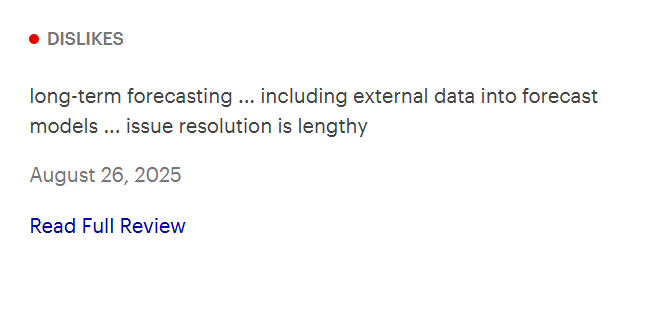
Ease of deployment and quality of support score lower than overall functionality in the distribution of ratings.
Consider Locus for a Faster TMS
Buyers searching for Blue Yonder pricing are often at a specific decision point. They have seen the suite, they understand its depth, and they are asking whether the investment is justified for what their operation actually needs.
For a meaningful share of those buyers, the comparison includes a tool built from a fundamentally different starting point.
Locus was built at the execution layer. The suite covers dispatch planning, constraint-based route optimization, carrier orchestration, real-time tracking, driver workflow management, and freight settlement in a single operational layer. A retail operation running 400 deliveries per day across a mixed fleet plans and executes in the same system. There is no handoff.
The operational difference shows up most clearly in three areas.
Constraint depth at dispatch
Locus optimizes routes across 250+ constraints in a single pass, covering vehicle weight, cubic capacity, time windows, crew pairing requirements, equipment type per stop, and real-time road conditions.
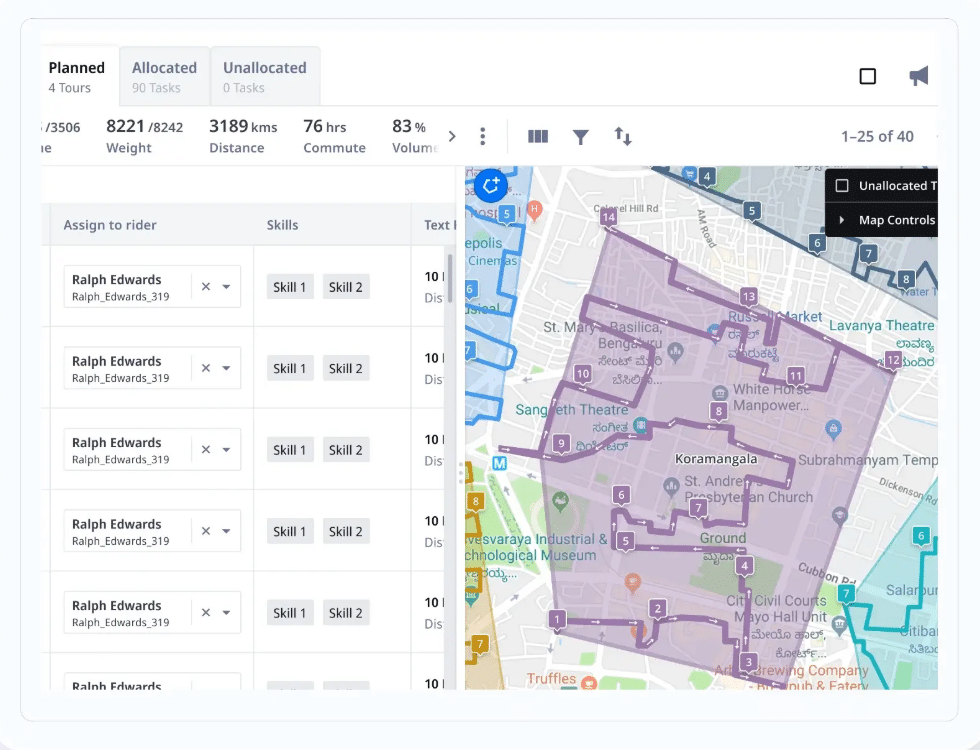
Blue Yonder’s TMS handles transportation planning at the lane and mode level. Constraint-dense last-mile dispatch, where a driver’s fourth stop depends on what happened at stop three, operates at a different granularity than Blue Yonder’s TMS was designed for.
Closed-loop execution
A route plan disconnected from what actually happens during delivery is an estimate. Locus connects the dispatch decision to AI-validated ePOD, freight audit, and settlement in one workflow. The evidence chain from route assignment to delivery confirmation to invoicing stays in one system.
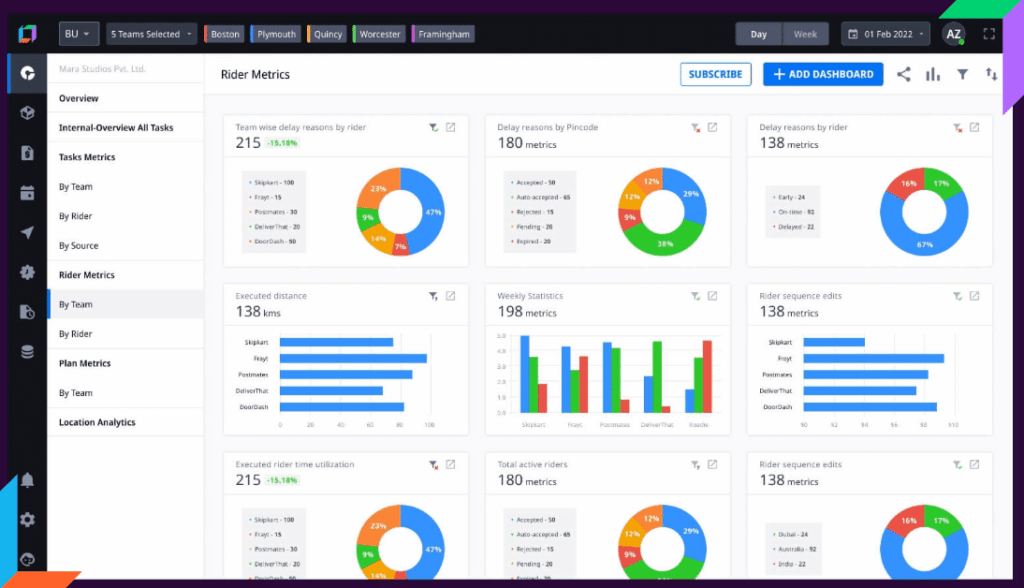
Blue Yonder’s TMS covers freight settlement, but the closed-loop execution at the driver and stop level requires integration with execution tools that Locus provides natively.
Time to value
Blue Yonder implementations run 12 to 24 months. Locus deployments run in weeks to months, depending on integration scope and fleet configuration. Pre-built connectors for SAP S/4HANA, Oracle NetSuite, and Microsoft Dynamics 365 reduce the integration phase significantly.
Buyers who cannot absorb a two-year implementation cycle before the system reaches production capacity have a structural problem with Blue Yonder’s deployment model that no ROI model resolves.
Locus has processed 650M+ orders across 30+ countries, maintains a 99.5% on-time delivery rate, and has delivered $320M+ in documented cost savings across its customer base.
Blue Yonder vs. Locus: Detailed Comparison
| Capability | Blue Yonder | Locus |
|---|---|---|
| Route optimization | Multi-leg freight optimization; planning-native; last-mile constraint depth requires validation | Real-time optimization across 250+ constraints per route, including vehicle capacity, time windows, crew pairing, and equipment requirements |
| Dispatch management | Available in the TMS module; built for freight planning | Native dispatch orchestration with event-triggered re-optimization; fires on individual events, no batch intervals |
| Carrier management | Via Blue Yonder Network; strongest with connected carriers | 1,000+ pre-integrated carriers via ShipFlex; self-serve carrier onboarding; automated tendering |
| Real-time tracking | Via Blue Yonder Network and integration, carrier-dependent | Live shipment lifecycle visibility; predictive ETAs; auto-escalation on exception |
| Last-mile execution | Limited native depth | Core capability. Driver workflows, offline-first LOTR app, exception handling at the stop level |
| ePOD and settlement | Freight settlement in TMS; ePOD requires integration | AI-validated ePOD; digital freight invoicing and audit in one workflow |
| Mobile and driver app | Limited | LOTR offline-first driver app; turn-by-turn navigation; direct dispatcher communication |
| Analytics and BI | Transportation Intelligence module; Luminate analytics layer | Plan-versus-actual dashboards; natural language search; AI optimization recommendations |
| API architecture | REST; Blue Yonder Network ecosystem | API-first; pre-built connectors for SAP, Oracle NetSuite, Microsoft Dynamics 365 |
| ERP and WMS integrations | Native Blue Yonder WMS, SAP, and Oracle via connectors | SAP S/4HANA, SAP Business One, Oracle NetSuite, Microsoft Dynamics 365, and major WMS tools |
| Supply chain planning | Deep, original core strength in demand sensing, inventory, and replenishment | Purpose-built TMS execution, it is not a supply chain planning tool |
| Deployment speed | 12-24 months is typical for an enterprise multi-module | Weeks to months, depending on integration complexity |
| Pricing model | Custom enterprise, contact sales | Modular: delivery volume + regions + fleet + modules activated |
| Industries | Retail, manufacturing, CPG, logistics, 3PL | Retail, FMCG/CPG, e-commerce, 3PL, CEP, manufacturing |
The clearest dividing line in this table is deployment speed versus planning depth.
Choose Blue Yonder if supply chain planning, WMS, and multimodal freight are the core requirements and your organization can absorb a 12 to 24-month implementation.
Go with Locus if the job is dispatching drivers at scale, managing carrier allocations across hundreds of partners, and closing the loop on ePOD and freight settlement inside a single system within months of signing.
User Reviews: Blue Yonder vs. Locus
Now let’s go over what users are saying about these two platforms on Gartner:
Blue Yonder on Gartner Peer Insights
Blue Yonder’s Gartner Peer Insights reviews are concentrated in the Supply Chain Planning market. The pattern across them is consistent.
Users who get full value from the platform tend to be running Blue Yonder for demand forecasting and inventory optimization at an enterprise scale. One reviewer from late 2025 credited the tool with a nearly 5% improvement in forecast accuracy, a meaningful result for a large-scale replenishment operation. Another flagged the “single source of truth” that Blue Yonder creates across functions as its core operational value.
The friction shows up most in the areas that matter to operations. Configuration overhead is the most frequently cited challenge. One reviewer put it plainly: getting full value out of the platform requires extensive configuration, and the batch-processing architecture slows down time-sensitive workflows.
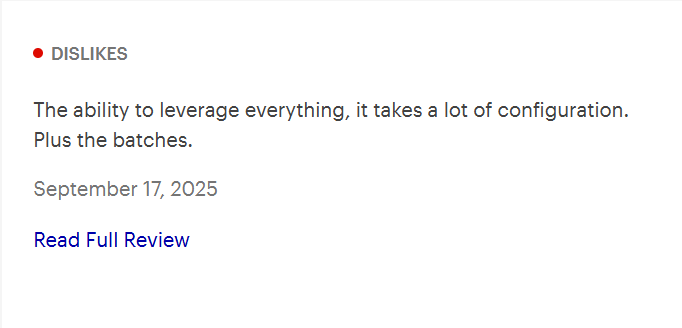
Implementation pain comes up repeatedly, with multiple reviewers noting that the process ran longer and costlier than initially scoped. Support escalations draw consistent criticism, too.
Plus, issue resolution is flagged as slow in more than one review, and deployment of enhancements and fixes is described as taking significant time.
What Locus users say
Locus’s Gartner Peer Insights reviews sit in the Last-Mile Delivery Technology Solutions market. Three themes repeat across the verified ratings.
Deployment speed is the most distinctive signal. One reviewer described the experience as “fast, easy to understand, short implementation lead times.” That is not a common thing to read in enterprise software reviews, where go-live timelines are typically measured in months, and it maps directly to what buyers frustrated with Blue Yonder’s 12 to 24 month window are looking for.
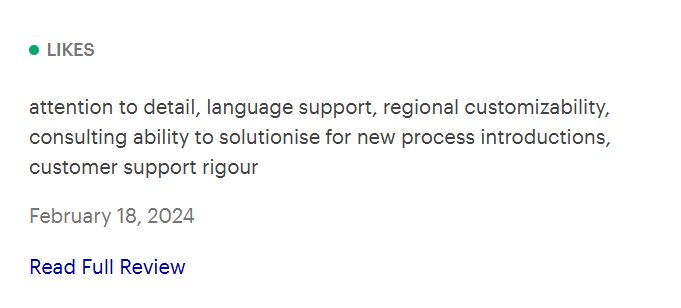
Support responsiveness is the second theme. Reviewers cite 24/7 customer support and dedicated project manager access as consistent positives, with specific mentions of structured onboarding and responsive account management during new deployments.
The contrast with the escalation friction in Blue Yonder’s reviews is meaningful, though the two platforms serve different operational layers.
The third pattern is regional and operational flexibility. Multiple reviewers mention language support, regional customizability, and integration capability as strengths, which matter for operations running across multiple geographies.
The weaknesses in Locus’s reviews are also worth stating accurately. Dashboard filtering and reporting depth come up as limitations across several reviews. One reviewer cited UI gaps in the driver app.
Blue Yonder vs Locus: Head-to-head by review dimension
| Dimension | Blue Yonder | Locus |
|---|---|---|
| Gartner category | Supply Chain Planning Solutions | Last-Mile Delivery Technology Solutions |
| Overall rating | 4.6 / 5 (275 reviews) | 4.3 / 5 (27 reviews) |
| What reviewers praise | Demand forecasting depth; single source of truth across functions; ML that picks up on trends faster than manual review; responsive onshore support team | Fast deployment and short go-live timelines; 24/7 support with dedicated project manager access; regional and language flexibility; real-time data across integrated systems |
| What reviewers flag | Heavy configuration required before value is realized; implementation runs longer and costlier than scoped; issue resolution is slow; enhancements and fixes take time to deploy | Dashboard filtering and reporting depth are limited; driver app UI needs improvement; internal support capacity under strain as the platform scales into new markets |
| Core fit per reviews | Large enterprise running a multi-module supply chain planning where configuration time is acceptable | Operations prioritizing fast go-live, execution-layer control, and responsive support during deployment |
Pay particular attention to the ease of deployment and quality of support rows when comparing these scores. Overall ratings on Gartner Peer Insights tend to reflect long-term satisfaction among committed users, which skews positive for complex platforms once the implementation pain fades. Deployment ease and support quality capture the experience during the period when most deals break down operationally.
Evaluating Your Blue Yonder Contract
If you are already in a Blue Yonder commercial conversation or renewing an existing contract, these questions are worth raising before signature.
What is the full implementation cost, beyond the license fee?
Get a scope-of-work estimate from Blue Yonder’s professional services team that covers configuration, data migration, integration development, and training. Get this in writing before signing the license agreement.
What is the upgrade process for customized configurations?
If the deployment requires custom workflows or integrations, ask explicitly how those are handled during major releases. Understanding the re-testing and re-development cost of future upgrades is part of the long-term TCO calculation.
What support tier is included, and who is the escalation contact?
Blue Yonder’s standard support model has received consistent criticism in enterprise reviews for slow response on critical issues. Ask specifically what the committed response time is for severity-one production issues, and who the named escalation contact is if that SLA is missed.
What is the off-ramp?
Enterprise TMS contracts typically include data portability terms and exit provisions. Understanding what it costs and how long a migration takes is relevant information before signing a multi-year agreement.
Is this module the right fit for your actual use case?
Blue Yonder’s TMS is strong for freight planning and multimodal operations. If the primary use case is dispatch execution, last-mile orchestration, or carrier management at the integration level, validate that the TMS module covers those workflows to the depth your operation requires before the deal closes.
Steps to evaluate migration to Locus
For operations considering Locus as an alternative or replacement for Blue Yonder TMS, specifically:
- Request a network impact assessment from Locus scoped to your actual delivery volume, carrier count, and regional footprint. This gives you a cost and outcome estimate tied to your actual operation rather than an industry benchmark.
- Run a parallel evaluation during any remaining Blue Yonder pilot window. Locus’s implementation team can configure a sandbox against your data before you commit.
- Map your current Blue Yonder TMS configuration, covering carrier integrations, custom workflows, and reporting outputs, against Locus’s pre-built connector set. Most standard configurations transfer through Locus’s ERP and carrier integration layer without custom development.
- Scope the migration timeline. Locus’s phased migration approach keeps the existing system live during validation, which removes the hard cutover risk.
When to Choose Blue Yonder vs. Locus
Blue Yonder is a well-established, deeply capable supply chain suite. Its strength is genuine, and for the right enterprise buyer, the investment is justifiable. Large enterprises running supply chain planning alongside transportation and warehouse operations, where connecting those functions through a common data layer reduces operational and financial waste, are where Blue Yonder operates at its best.
Realizing that value requires the right scale, the right integration footprint, and the capacity to absorb a 12 to 24-month implementation. Buyers who fall outside that profile are making the wrong purchase.
For enterprises where the primary challenge is executing the delivery plan rather than building it, covering dispatch at scale, carrier allocations across 1,000+ partners, and closing the loop on ePOD and freight settlement, Locus operates closer to the actual operational problem. It deploys faster, costs less to maintain, and produces measurable execution outcomes without a multi-year runway to production.
The decision hinges on the fit to use case, at the actual scale, within the actual timeline your operation can absorb. Schedule a Locus demo to learn more.
Frequently Asked Questions (FAQs)
1. How much does Blue Yonder cost per year?
Blue Yonder keeps pricing on its website. Third-party analyst platforms report that individual module pricing starts at approximately $100,000 annually, with enterprise multi-module deployments running significantly higher. These figures come from user-reported data on analyst platforms. Blue Yonder publishes nothing directly. Total cost of ownership, including professional services, integration, and ongoing support, typically exceeds the license fee in year one.
2. Does Blue Yonder offer a free trial or demo?
Blue Yonder offers no self-serve free trial. Prospective buyers can request a demo through the sales team. The demo process is typically accompanied by a discovery conversation to scope the configuration before pricing is provided.
3. What is Blue Yonder’s pricing model: per user, per transaction, or per module?
Blue Yonder’s pricing structure varies by module and is kept off its public-facing materials. Based on analyst and user-reported data, it combines elements of per-user licensing and module-based fees depending on the specific product being purchased. The exact structure for a given deployment is confirmed during the sales engagement.
4. How long does Blue Yonder take to implement?
Enterprise deployments typically run 12 to 24 months from contract signature to full production. Single-module implementations run shorter. Multi-module deployments connecting supply chain planning, TMS, and WMS require coordinated data model work across functions, which drives the timeline. This is one of the most frequently cited post-implementation findings in Gartner Peer Insights reviews. Buyers who projected 6 to 9 months often reached production closer to 18.
5. Is Blue Yonder suitable for mid-market companies?
Blue Yonder’s pricing structure, implementation timeline, and professional services requirements position it in the large enterprise market. Mid-market buyers should build a detailed TCO model before engaging. The suite’s depth exceeds what many mid-market operations require, and the cost of activating and maintaining that depth is hard to justify at lower delivery volumes or fewer operating regions.
6. What industries does Blue Yonder serve?
Blue Yonder serves retail, consumer goods, manufacturing, logistics, and 3PL industries. Its strongest market position is in retail and CPG, where its supply chain planning, demand sensing, and lifecycle pricing tools are deeply embedded in large enterprise operations. Its TMS module covers industries requiring multimodal freight management, carrier procurement, and global trade compliance.
7. How does Blue Yonder TMS pricing compare to Locus?
Neither publishes pricing. Blue Yonder is custom enterprise with no disclosed model. Locus is modular and volume-based, with pricing calculated against delivery volume, number of operating regions, fleet composition, and the specific modules activated. That structure lets buyers request a cost estimate tied to their operational parameters before committing to an implementation cycle. Blue Yonder’s cost only becomes visible once the sales engagement is underway.
8. Can Blue Yonder be deployed as a cloud-only solution?
Yes. Blue Yonder offers cloud deployment on Microsoft Azure for its current suite. Many enterprise customers running legacy on-premise installations are migrating to the cloud. That migration carries a transition cost separate from the ongoing subscription and requires configuration testing against the new environment.


General
E2open Pricing, Plans, and Features: Is E2open Worth It in 2026?

Mar 26, 2026
E2open's carrier marketplace starts at $549/year. API access requires the $18,000/year tier. Here's what enterprise buyers actually pay at volume.
Read more
General
Blue Yonder Alternatives for Transportation Management: The Enterprise TMS Comparison for 2026
Mar 26, 2026
Evaluating Blue Yonder's TMS module? Compare the top enterprise transportation management platforms on features, pricing, and real-world performance.
Read moreInsights Worth Your Time




















Blue Yonder Pricing, Plans, and Features: Is It Worth the Investment in 2026?