


General
Blue Yonder Alternatives for Transportation Management: The Enterprise TMS Comparison for 2026

Key Takeaways
- Blue Yonder is a supply chain planning platform whose transportation module was bolted on through acquisitions, not built ground-up for logistics execution.
- Enterprise logistics teams evaluating TMS alternatives need platforms that optimize routes, orchestrate multi-carrier networks, and deliver real-time visibility without years of professional services overhead.
- No major enterprise TMS vendor publishes standard pricing. Total cost of ownership diverges sharply from license estimates once implementation and customization are factored in.
- The strongest alternatives to Blue Yonder’s transportation module are Locus, SAP Transportation Management, Oracle TMS, FarEye, and Descartes.
- Locus is the only purpose-built, agentic TMS in this comparison, with 1.5 billion+ deliveries processed, $320M+ in verified savings, and a 99.5% on-time delivery rate across 30+ countries.
Blue Yonder has a well-earned position in enterprise supply chain planning. It was designed around demand forecasting, inventory optimization, and S&OP, and it does those things well. Its transportation management capabilities came later, through product extensions and acquisitions rather than original design.
This distinction is important if your primary pain is in transportation execution. Whether Blue Yonder’s TMS module can deliver what high-volume logistics operations actually need, including real-time route optimization, multi-carrier orchestration, predictive ETAs, and closed-loop settlement, is the specific question this comparison answers.
In this guide, we go over the top alternatives for Blue Yonder in 2026 and see how their features stack up.
Why Enterprises Are Evaluating Blue Yonder Alternatives

Blue Yonder’s TMS handles freight planning and execution fundamentals. Load building, carrier tendering, route planning, and freight settlement are the basics covered. Enterprises already standardized on Blue Yonder’s broader supply chain platform often extend into TMS because the integration path is familiar and the procurement is already done.
The friction appears when transportation execution becomes the primary pain. Blue Yonder was not designed as a last-mile and multi-carrier orchestration engine. Enterprises running high-frequency delivery operations across mixed fleets of owned, contracted, and on-demand vehicles run into consistent limits.
These include route optimization across a narrower constraint set than purpose-built platforms, real-time visibility that requires additional tooling on top, and deployment cycles measured in months.
The buyers evaluating alternatives tend to fit one of three patterns.
First, a VP of Supply Chain who manages 500 to 5,000 deliveries daily and cannot close the gap between planned and actual cost per delivery. Second, a Director of Transportation who is watching SLA performance erode because carrier allocation still happens manually across fragmented tools. Third, an IT Director is being asked to add a new visibility layer without replacing the existing infrastructure.
All three need the same thing: faster time to measurable ROI, deeper route optimization, and a vendor whose product investment goes entirely into transportation execution.
Features Separating An Execution-driven TMS Platform
What separates a capable enterprise TMS from one that just checks boxes comes down to a handful of execution-layer capabilities.
AI-powered route optimization
Route optimization at enterprise scale means solving the Vehicle Routing Problem across hundreds of simultaneous constraints like time windows, vehicle capacity, driver hours, road restrictions, fuel profiles, and live traffic.
A platform able to handle 20 or 30 variables leaves efficiency on the table on every route. When optimization is shallow or manual, dispatchers spend hours on planning. It should take seconds, and fleet utilization stays well below its ceiling.
The business case is straightforward. More deliveries per vehicle per day, lower per-stop costs, and predictable ETAs.
Multi-carrier management and dynamic allocation
No enterprise runs on a single fleet. Captive vehicles, contracted carriers, and on-demand 3PLs are the operational reality for retailers, FMCG distributors, and e-commerce operators managing demand spikes.
A TMS has to treat these as separate problems, which forces manual switching between tools and creates blind spots in cost tracking and SLA accountability. Consolidated carrier orchestration automates carrier selection based on real-time pricing and performance history, and feeds settlement data back into the same system without manual reconciliation.
Real-time visibility with predictive breach detection
In 2026, visibility means knowing a delivery will miss its window 20 minutes before it happens. Proactive alerts let dispatchers act, customers reschedule, and SLA records stay intact. Platforms that surface alerts after a breach has already occurred generate WISMO calls, damage NPS, and require reactive customer service to clean up.
Hub and warehouse operations
Time under the roof, the interval between a shipment arriving at a hub and leaving on a delivery vehicle, is a cost driver most TMS platforms ignore. Extending TMS capabilities into the hub layer, covering automated sorting, load balancing, and picklist optimization, reduces this interval directly.
A 40% reduction in hub transit time means earlier dispatch windows, higher vehicle utilization, and fewer shipments that miss the day’s delivery run.
Settlement, ePOD, and freight audit
Manual freight reconciliation is where revenue leakage accumulates quietly. When invoice verification, proof-of-delivery capture, and carrier billing run on separate systems, discrepancies build up for months before anyone flags them.
An integrated settlement layer with digital ePOD and automated invoice matching catches exceptions at the transaction level.
API-first architecture
A TMS that requires replacing existing ERP, OMS, or WMS systems to function creates implementation risk. A VP of IT may find it difficult to accept.
The right approach connects via RESTful APIs to infrastructure already in place, with pre-built connectors for major ERP platforms, and does not require a rip-and-replace migration to deliver core value.
Top 5 Blue Yonder Alternatives for Transportation Management
Before we take a detailed look, let’s go over a quick comparison of the top alternatives to Blue Yonder:
| Platform | Pricing | Key features | Best for |
|---|---|---|---|
| Locus | Contact for enterprise pricing | Route optimization (180+ variables), multi-carrier orchestration, control tower, hub ops, settlement, ePOD | Enterprise logistics teams needing closed-loop TMS across all-mile operations |
| SAP Transportation Management | Contact for enterprise pricing | Freight order management, carrier tendering, freight settlement, integration with SAP ERP | Large enterprises already running SAP ERP/S4HANA |
| Oracle Transportation Management (OTM) | Contact for enterprise pricing | Multi-modal planning, rate management, freight audit, and global compliance | Multi-modal, cross-border logistics with complex compliance needs |
| FarEye | Contact for pricing | Last-mile delivery orchestration, predictive visibility, and delivery experience management | Enterprises prioritizing delivery experience and customer-facing tracking |
| Descartes | Contact for pricing | Fleet routing, ELD/HOS compliance, carrier network, global logistics data | Asset-heavy fleet operations and regulated transport environments |
1. Locus
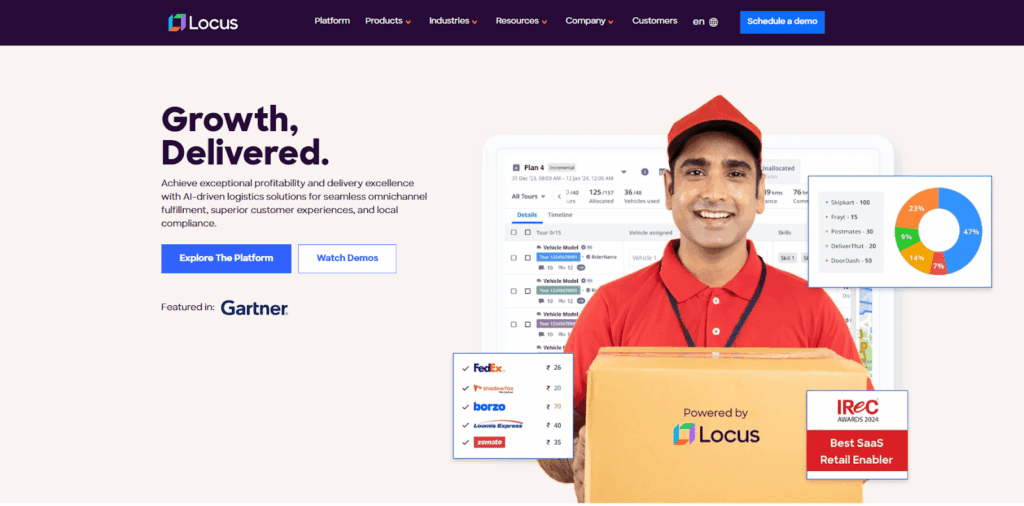
Locus is a purpose-built, agentic enterprise transportation management system covering the full order-to-delivery lifecycle, including network planning, multi-carrier execution, predictive visibility, hub operations, and settlement, on a single platform. It was designed from the start for transportation execution.
Dispatch Planning software, its core routing module, solves the Vehicle Routing Problem across 180+ simultaneous constraints, roughly six to nine times the depth of most competitors. A proprietary geocoding engine converts ambiguous addresses into precise delivery coordinates, which matters in APAC markets where address infrastructure is inconsistent and anywhere that first-attempt delivery rates are a cost lever.
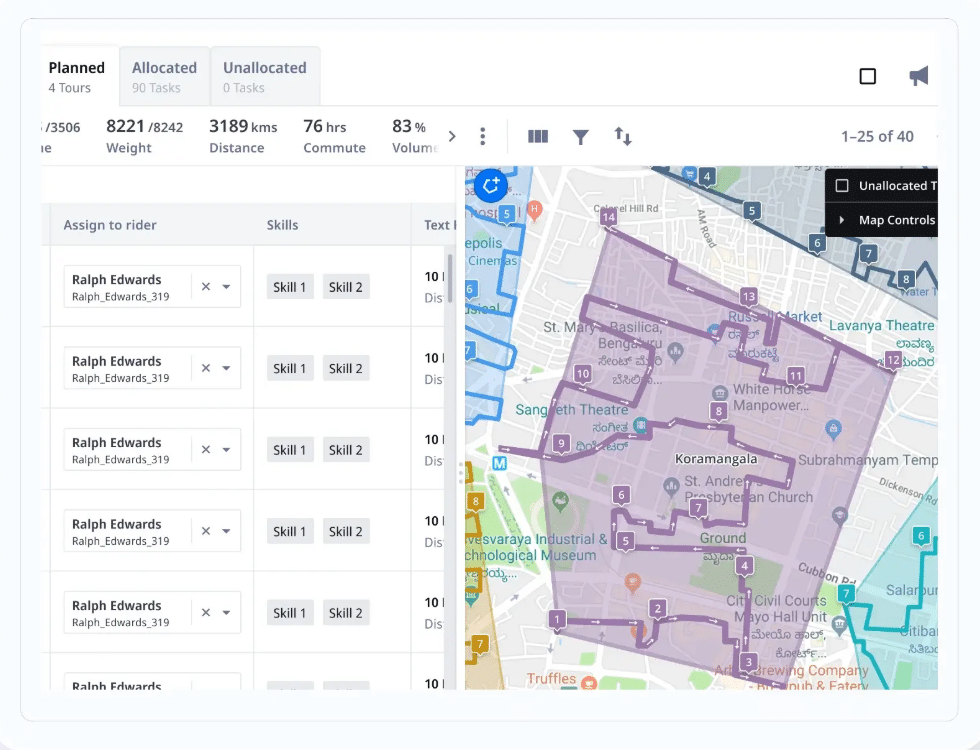
Locus runs across 30+ countries, has processed 1.5 billion+ deliveries, and has generated $320M+ in verified logistics cost savings for enterprise customers.
The Control Tower delivers 99.5% on-time delivery performance with a 38% reduction in WISMO contacts. Hub Operations cuts time under the roof by 40%.
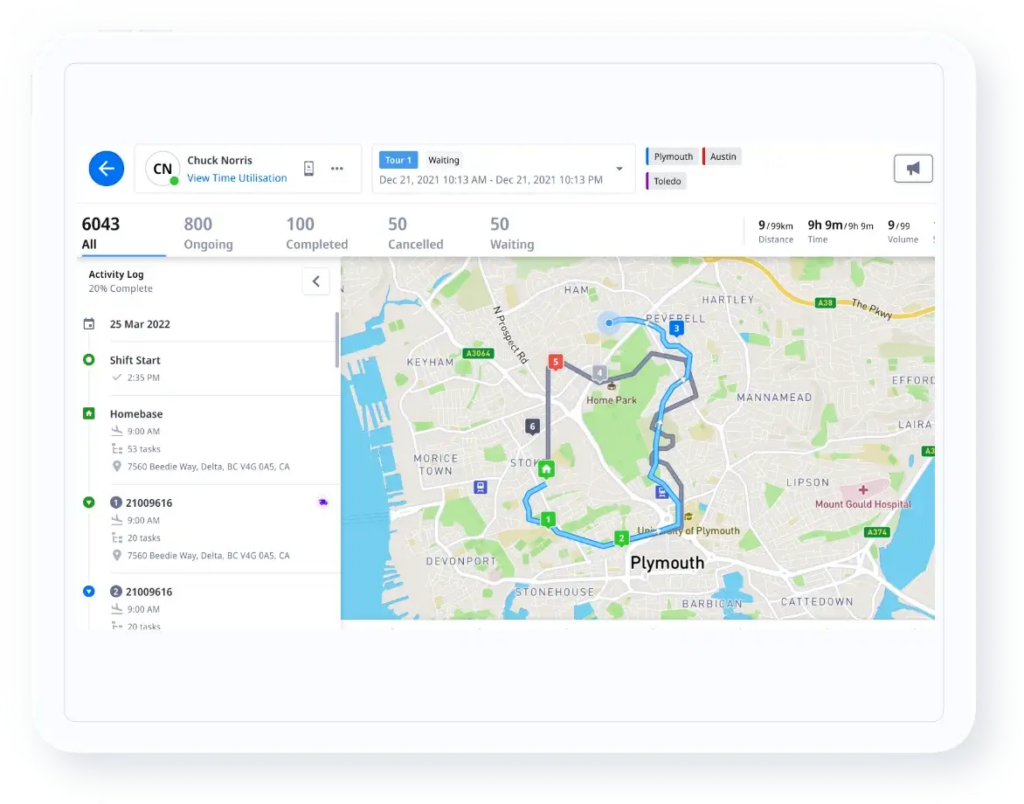
The Delivery Orchestration module has recovered $288M in revenue leakage through automated invoice reconciliation and carrier allocation optimization.
The platform connects via RESTful APIs to existing ERP, OMS, and WMS systems without replacing them. Pre-built connectors cover 1,000+ carriers and 3PL partners. The LOTR driver app runs in 20+ languages with full offline capability.
Locus has been recognized by Gartner as a Representative Vendor for three consecutive years.
Locus Key Features
- DispatchIQ route optimization across 180+ constraints: Processes driver skills, vehicle load profiles, customer time windows, fuel costs, and live traffic in a single optimization pass using proprietary algorithms
- Agentic Decision Intelligence loop: Detects anomalies, generates optimized responses, and executes or escalates based on configurable thresholds, bridging the gap between a visibility tool and a platform that actively reduces the cost of a decision
- BPMN Workflow Engine: Lets operations teams configure triggers, routing rules, and exception protocols without writing code, encoding operating logic directly into the platform
- Network-Aware Planning and Promise: Models delivery commitments against live network constraints, like carrier capacity, hub throughput, and zone-level demand, before a promise is made to the customer
- Control Tower with predictive SLA breach detection: Flags delivery risk 20+ minutes before breach and enables customers to reschedule without dispatcher involvement
- Delivery Orchestration diverse fleets: Consolidates owned fleet, contracted carriers, and on-demand 3PLs into a single allocation and performance tracking layer
- Hub Operations module: Automates sorting, load balancing, and picklist optimization for the intermediate hub layer
- Automated settlement: Reconciles invoices, captures digital proof-of-delivery, and flags exceptions in a single platform, recovering $288M in revenue leakage
Locus’ Pricing
Contact Locus for enterprise pricing. No public tiers. Guided evaluation available at locus.sh/schedule-demo.
Locus’ Pros
- Proprietary optimization algorithms
- 180+ variable route optimization, the highest in this comparison
- Purpose-built for transportation execution, not a bolted-on module
- API-first, connects to existing ERP/WMS/OMS without migration
- Agentic Decision Intelligence and BPMN Workflow Engine set it apart structurally from every other platform in this list
- Proven at scale across 1.5B+ deliveries, 30+ countries, 400+ cities
Locus’ Cons
- No public pricing
- Not a supply chain planning tool. Demand forecasting and S&OP are outside its scope
Who Locus Is Best For
Locus is built specifically for enterprise retailers, FMCG distributors, 3PLs, CEP operators, and e-commerce businesses managing high-volume, multi-carrier delivery operations across complex geographies.
2. SAP Transportation Management
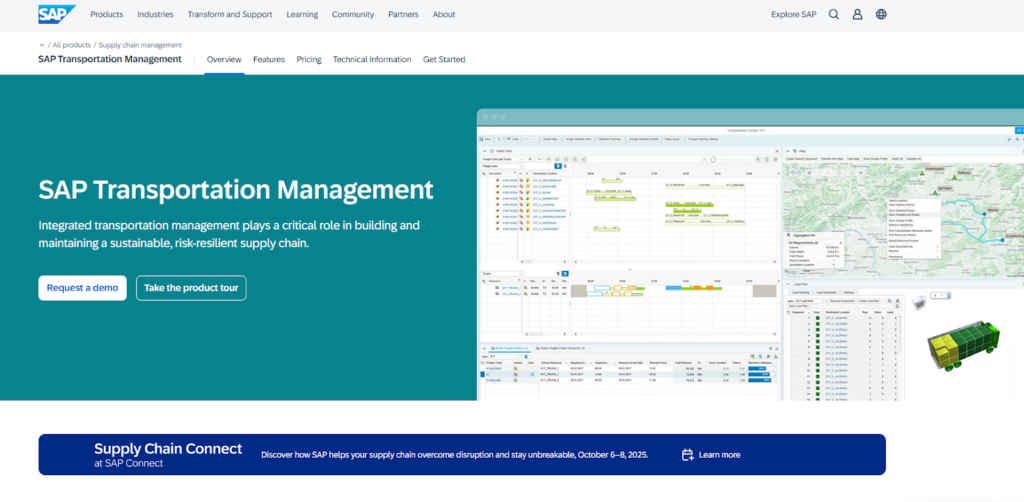
SAP TM sits inside the SAP supply chain portfolio, tightly integrated with SAP S/4HANA and SAP ERP. It covers freight order management, carrier tendering, route planning, freight settlement, and subcontracting. For enterprises running large SAP landscapes, the native integration removes the need for additional middleware.
The platform handles multi-modal freight planning across road, rail, air, and ocean. It is strongest in regulated, multi-country environments where compliance documentation and freight costing feed directly into financial systems.
SAP Transportation Management’s Key Features
- Freight order management: Covers carrier tendering, subcontracting, and multi-leg order consolidation across transport modes
- Multi-modal transportation planning: Coordinates road, rail, air, and ocean freight within a single planning layer
- Freight settlement and invoice verification: Reconciles carrier invoices against contracted rates and flags billing discrepancies
- Native SAP ERP integration: Connects directly to SAP S/4HANA for financial and operational alignment
- Cross-border compliance documentation: Generates customs declarations, trade documents, and compliance filings for international shipments
SAP Transportation Management’s Pricing
Contact SAP. Implementation requires certified SAP partners and carries significant professional services costs.
SAP Transportation Management’s Pros
- Deep native integration with SAP ERP and S/4HANA
- Multi-modal and cross-border freight coverage across road, rail, air, and ocean
- Established global support network with certified implementation partners
SAP Transportation Management’s Cons
- Complex and time-intensive implementation requiring certified SAP partners
- Route optimization depth limited compared to purpose-built TMS platforms
- High total cost of ownership driven by professional services and customization
- Limited fit for last-mile and multi-carrier orchestration at high delivery volumes
Who SAP Transportation Management Is Best For
It’s ideal for large enterprises standardized on SAP ERP that need transportation planning integrated directly into their financial systems, with freight management as their primary logistics challenge, rather than high-volume last-mile execution.
3. Oracle Transportation Management
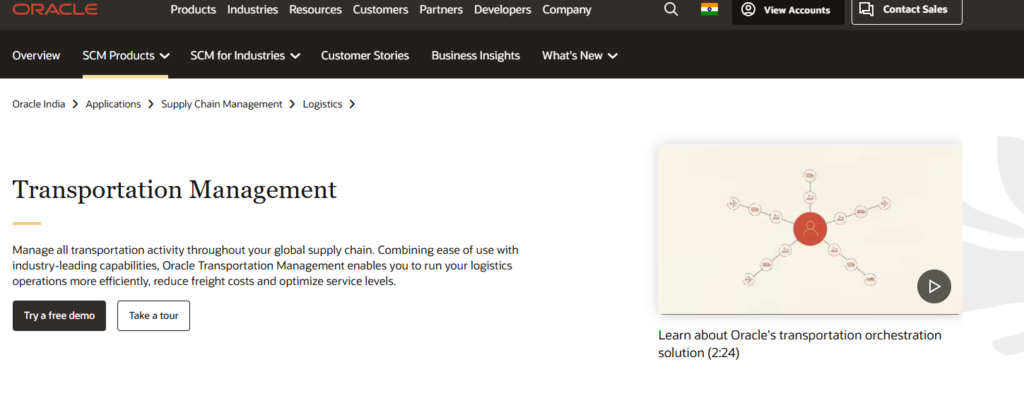
Oracle TM is a mature, multi-modal TMS covering transportation planning, execution, rate management, freight audit, and global compliance. It handles road, rail, ocean, and air freight within a single platform and is particularly capable in global trade compliance and cross-border documentation.
OTM connects natively with Oracle Cloud ERP and supports third-party ERP connections. Enterprises managing complex multi-modal freight networks across regions with different regulatory requirements have used it for years.
Oracle Transportation Management’s Key Features
- Multi-modal transportation planning and execution: Manages freight movement across road, rail, air, and ocean in a unified workflow
- Rate management and carrier contract administration: Stores carrier rates, contract terms, and bid history for automated rate selection
- Freight audit and payment automation: Validates carrier invoices against contracted rates and automates payment processing
- Global trade compliance and documentation: Generates trade documents, manages customs filings, and tracks regulatory requirements across regions
- Oracle Cloud ERP integration: Connects natively with Oracle Cloud SCM and supports third-party ERP configurations
Oracle Transportation Management’s Pricing
Contact Oracle. OTM is typically licensed as part of Oracle Cloud SCM, with implementation costs that reflect its configuration complexity.
Oracle Transportation Management’s Pros
- Broad multi-modal freight coverage across all major transport modes
- Comprehensive global compliance and trade documentation capabilities
- Mature platform with an established enterprise customer base
Oracle Transportation Management’s Cons
- Long, resource-intensive implementation cycles
- Limited real-time route optimization for last-mile delivery operations
- Steep learning curves for operations teams due to UI complexity
- Limited fit for high-frequency, multi-carrier last-mile networks
Who Oracle Transportation Management Is Best For
It is suitable for global enterprises managing multi-modal freight across international trade lanes, particularly where Oracle Cloud ERP is already in use.
4. FarEye
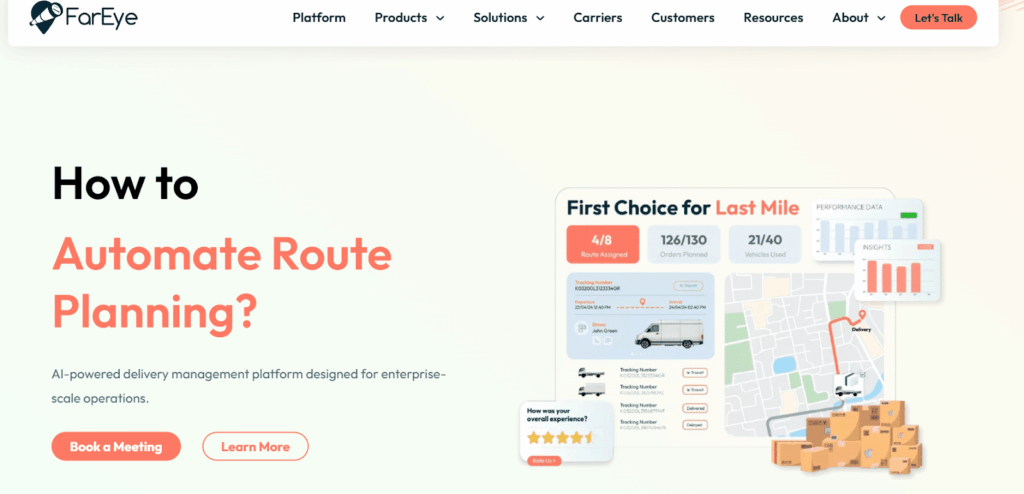
FarEye focuses on last-mile delivery and customer experience. Its strengths are delivery orchestration, predictive visibility, and the customer-facing delivery experience, including notifications, real-time tracking, and exception management.
Retailers and logistics companies that want to differentiate on delivery experience and reduce WISMO contacts use FarEye. It has built a growing presence in North America and Europe.
FarEye’s Key Features
- Last-mile delivery orchestration: Allocates orders across owned fleets, contracted carriers, and on-demand 3PLs from a single interface
- Predictive visibility and real-time tracking: Provides live shipment location with ETA predictions updated against traffic and route conditions
- Customer-facing notifications and ETA management: Delivers branded delivery updates across SMS, email, and app channels with dynamic ETA adjustments
- Delivery exception handling and rescheduling: Detects delivery failures and enables customers to reschedule without dispatcher intervention
- Analytics and SLA reporting: Tracks on-time performance, carrier SLA adherence, and delivery success rates across operations
FarEye’s Pricing
Contact FarEye. No public pricing.
FarEye’s Pros
- Customer experience and notification capabilities among the strongest in this comparison
- Intuitive interface suited to operations teams with limited technical training
- Faster deployment cycles compared to legacy TMS platforms
FarEye’s Cons
- Route optimization covers fewer simultaneous variables than purpose-built platforms
- Coverage weighted toward last-mile rather than full order-to-delivery orchestration
- Hub operations and settlement capabilities less developed than full-suite platforms
- Limited scale validation across high delivery volumes and multi-country operations
Who FarEye Is Best For
It is meant for retailers and carriers that prioritize delivery experience improvements and predictive visibility, with operations that are primarily last-mile rather than multi-leg.
5. Descartes

Descartes is a logistics technology company with a portfolio covering fleet routing, ELD and hours-of-service compliance, customs and global trade, and logistics data services. Its routing and scheduling capabilities are well-established for asset-heavy fleet operators in regulated transport environments.
The company has grown through acquisitions and addresses a range of logistics use cases, from final-mile routing to cross-border compliance to freight network optimization.
Descartes’ Key Features
- Fleet routing and scheduling optimization: Generates daily route plans for owned fleets factoring in vehicle capacity, time windows, and driver hours
- ELD and HOS compliance management: Monitors driver hours-of-service in real time and maintains electronic logging device records for regulatory compliance
- Customs and global trade data services: Provides tariff data, customs filing support, and trade compliance documentation for cross-border shipments
- Carrier network and rate management: Accesses Descartes’ logistics data network for carrier capacity, rates, and contract administration
- Mobile delivery management: Equips drivers with tools for proof-of-delivery capture, route navigation, and exception reporting
Descartes’ Pricing
Contact Descartes. Pricing varies by module and geography.
Descartes’ Pros
- Proven strength in regulated transport, particularly ELD and HOS compliance
- Broad logistics data and global trade capabilities
- Established customer base among asset-heavy fleet operators in North America
Descartes’ Cons
- Inconsistent integration across product lines due to acquisition-driven architecture
- Route optimization less advanced than purpose-built AI platforms
- Limited fit for high-volume, multi-carrier last-mile operations in APAC or MEA markets
Who Descartes Is Best For
Asset-heavy fleet operators in North America with compliance-heavy requirements, or enterprises that need global trade data alongside transportation management.
Blue Yonder Alternatives: Key Feature Comparison
| Feature | Locus | Blue Yonder TMS | SAP TM | Oracle TM | FarEye | Descartes |
|---|---|---|---|---|---|---|
| Route optimization (180+ variables) | Yes | Limited | Limited | Limited | Partial | Partial |
| Multi-carrier orchestration | Yes | Partial | Yes | Yes | Yes | Partial |
| Real-time control tower | Yes | Partial | Limited | Partial | Yes | Partial |
| Predictive SLA breach detection | Yes | Limited | No | Limited | Yes | No |
| Hub and warehouse operations | Yes | No | Partial | No | No | No |
| Agentic Decision Intelligence | Yes | No | No | No | No | No |
| BPMN Workflow Engine | Yes | No | No | No | No | No |
| Network-Aware Planning and Promise | Yes | Partial | Partial | Partial | No | No |
| Automated settlement and freight audit | Yes | Partial | Yes | Yes | Limited | Partial |
| Digital ePOD with photo and signature | Yes | Limited | Partial | Partial | Yes | Yes |
| Driver app with offline mode | Yes | Limited | Partial | No | Yes | Yes |
| 1,000+ pre-integrated carriers | Yes | Limited | Limited | Limited | Partial | Partial |
| API-first, no rip-and-replace | Yes | Partial | Limited | Limited | Yes | Partial |
| Returns and reverse logistics | Yes | Limited | Partial | Partial | Limited | No |
| Customer self-service rescheduling | Yes | No | No | No | Yes | No |
| Proprietary geocoding engine | Yes | No | No | No | No | No |
Locus is the only platform in this table built around an autonomous decision loop. Its Agentic Decision Intelligence detects exceptions, generates optimized responses, and executes or flags them based on configurable thresholds, instead of surfacing data for dispatchers to act on manually.
Combined with the BPMN Workflow Engine and Network-Aware Planning, these are structural differences that no other vendor in this table offers.
Blue Yonder Alternatives: Pricing Comparison
No major enterprise TMS vendor publishes standard pricing. License fees, implementation, customization, and ongoing support all contribute to the total cost of ownership, and the gap between initial license cost and actual TCO is widest for platforms with heavy professional services requirements.
| Platform | Pricing model | Implementation cost profile | TCO complexity | Transparent pricing |
|---|---|---|---|---|
| Locus | Modular, volume-based | Low to mid, API-first reduces integration burden | Low to mid | On request (schedule a demo) |
| Blue Yonder TMS | Subscription (cloud) or license (on-prem) | High, requires Blue Yonder-certified partners | High | No |
| SAP TM | License or subscription via SAP BTP | High, requires certified SAP SI partners | Very high | No |
| Oracle TM Cloud | Subscription via Oracle Cloud SCM | High, complex configuration | High | No |
| FarEye | Subscription, typically per-delivery or per-user | Low to mid | Low to mid | No |
| Descartes | Modular subscription | Mid, varies by product line | Mid | No |
The most relevant TCO differentiator is the professional services multiple. SAP TM and Blue Yonder TMS both carry significant implementation overhead, often exceeding license fees across a three-year horizon.
Platforms with API-first architecture and modular deployment, including Locus, typically carry lower TCO because integration does not require rebuilding adjacent systems.
Blue Yonder Alternatives: API and Integration Comparison
Integration architecture is often the binding constraint in enterprise TMS evaluation. A platform with strong optimization but a brittle integration model creates implementation risk that delays ROI and drains internal IT resources.
Locus
It connects to existing ERP, OMS, and WMS systems via RESTful APIs, with pre-built connectors for major SAP, Oracle, and Microsoft environments. Carrier onboarding uses a self-serve portal, and 1,000+ carriers are pre-integrated. The LOTR driver app requires no device replacement in most deployments. Sandbox and testing environments are available during evaluation.
SAP TM
This platform connects natively within the SAP ecosystem, which is an advantage for SAP-standardized enterprises and a constraint for those on mixed stacks. Third-party integration requires middleware and adds implementation scope.
Oracle TM Cloud
This tool connects natively with Oracle Cloud ERP and supports third-party integrations through Oracle Integration Cloud. Cross-platform integration is achievable but typically requires dedicated integration work.
FarEye
The TMS platform supports RESTful API integration with most major OMS and ERP platforms. Its lighter footprint means integration timelines are shorter than those of the large platform vendors, though deep ERP integration requires additional development.
Descartes
It offers API connectivity across its portfolio, but integration consistency varies across product lines, given its acquisition-built architecture. Enterprises on a single Descartes product line generally have better integration experiences than those mixing modules from different acquisitions.
Blue Yonder TMS
This integrates natively with the Blue Yonder suite. Integration with non-Blue Yonder systems, including SAP or Oracle, typically requires the canonical data model and additional middleware configuration.
Blue Yonder Alternatives: Security and Compliance
Here’s how the Blue Yonder alternatives stack up when it comes to security and compliance:
- Locus supports SOC 2 and ISO-aligned security controls, GDPR, and HIPAA compliance. VPC and private cloud deployment, SSO and SAML authentication, role-based access control, and full audit trail logging are all available. Data residency options cover regional compliance requirements
- SAP TM runs on SAP’s enterprise security infrastructure, including SOC 2 certification, GDPR tooling, and SAP Identity Management for access control
- Oracle TM Cloud is backed by Oracle Cloud Infrastructure’s compliance certifications, including SOC 1/2/3, GDPR, and HIPAA. Supports fine-grained role-based access and comprehensive audit logging
- FarEye holds GDPR compliance and SOC 2 Type II certification. Security posture suits enterprise deployments, though regional compliance tooling is less extensive than the larger platforms
- Descartes maintains SOC 2 compliance globally. Capabilities cover North American and European enterprise requirements
Blue Yonder Alternatives: Customer Support
Support quality in enterprise TMS often matters more than any feature list. A platform that works well during implementation but goes quiet when a production SLA is at risk rarely survives the next renewal cycle.
- Blue Yonder draws consistent feedback in Gartner Peer Insights reviews about slow escalation paths and declining support quality after go-live. At its price point, post-implementation responsiveness is a recurring complaint
- SAP and Oracle both run global support networks, but enterprise escalation routes through tiered service structures that slow critical-incident resolution. Dedicated support resources require premium contracts
- FarEye generally gets positive marks on support responsiveness, particularly in its growth markets. Tends to give customers more direct access to implementation and customer success teams
- Descartes runs a global support organization, but support quality varies by product line
- Locus offers dedicated account management, 24/7 live support for enterprise deployments, and transparent pricing on support tiers. The implementation model includes parallel-run support so operations teams can validate performance against live benchmarks before full cutover
Why Enterprises Are Switching to Locus
When an enterprise’s most acute pain is in transportation execution, and their current platform was designed to solve a different problem, the case for switching is straightforward.
Legacy and planning-heritage TMS platforms share a recognizable profile. Implementation cycles stretch 12 months or longer, professional services costs often exceed license fees, and the route optimization was built for freight planning rather than optimizing 500 daily last-mile deliveries across a mixed fleet of owned and contracted vehicles.
Locus was designed for that second problem. It connects to existing ERP, OMS, and WMS infrastructure via APIs, without rebuilding data models or replacing adjacent systems.
Proprietary algorithms process 180+ variables in a single optimization pass, including driver skills, vehicle load profiles, customer time windows, fuel costs, and live traffic. That depth of optimization is what converts planning theory into a measurable reduction in cost-per-delivery.
Enterprise deployments produce consistent outcomes: 25% increase in delivery efficiency, 45% more deliveries per day from the same fleet, 20% cost savings on ground resources, and 99.5% on-time delivery.
Across Locus customers, $320M+ in logistics costs have been saved, and $288M in revenue leakage recovered.
For enterprises in retail, FMCG/CPG, 3PL, and manufacturing, the picture is the same. Faster time to ROI, a platform built for last-mile and all-mile execution, and a vendor whose product investment goes into making transportation cheaper and more reliable.
How to Transition from Blue Yonder to Locus
No TMS migration is zero-risk. Any vendor that says otherwise is not being straight with you. What a well-structured migration does offer is a controlled, phased process so teams can validate performance before full cutover.
Locus uses a phased implementation model. Integration with existing ERP, OMS, and WMS systems happens via RESTful APIs, so the migration does not require replacing data infrastructure or rebuilding adjacent systems.
Pilot deployments let operations teams run Locus alongside existing tools in a defined geography or business unit, measure performance against current benchmarks, and resolve configuration questions before scaling.
Pre-built connectors for major ERP environments reduce integration timelines. The LOTR driver app requires no device replacement in most deployments. Carrier onboarding uses a self-serve portal, and 1,000+ carriers are already pre-integrated.
The right starting point is a guided evaluation using actual network data. Locus’s solutions team can assess your volume, fleet mix, and carrier structure to model the expected impact on cost-per-delivery before any contract is signed.
Schedule a demo to get started.
Frequently Asked Questions (FAQs)
1. How does Locus compare to Blue Yonder for transportation management?
Blue Yonder’s transportation module was added through product extensions and acquisitions onto a supply chain planning core. Locus was purpose-built for TMS. For route optimization, carrier orchestration, real-time visibility, and settlement, Locus offers deeper capabilities and faster deployment.
2. What are the main limitations of Blue Yonder’s TMS module?
Enterprise users frequently cite complex implementation timelines, high professional services costs, limited real-time route optimization depth, and support quality that declines after go-live. The platform performs better as a planning tool than as a high-frequency execution engine.
3. How does Blue Yonder compare to Oracle for transportation management?
Oracle TM is stronger in multi-modal freight, cross-border compliance, and global trade documentation. Blue Yonder’s TMS is more closely tied to its supply chain planning stack. Neither platform is optimized for high-volume last-mile execution at the depth of purpose-built TMS platforms.
4. What does enterprise TMS pricing look like in 2026?
No major enterprise TMS vendor publishes standard pricing. Total cost of ownership includes license fees, implementation and professional services, customization, ongoing support, and upgrade costs. Platforms with API-first architecture and modular deployment typically carry lower TCO than those requiring full implementation cycles to access core modules. Contact Locus to discuss pricing.
5. Does Locus integrate with SAP, Oracle, and other ERPs?
Yes. Locus integrates with SAP, Oracle, and other major ERP, OMS, and WMS platforms via RESTful APIs. It connects to existing infrastructure rather than replacing it. Pre-built connectors reduce integration timelines for common enterprise system configurations.
6. What industries does Locus serve?
Locus serves enterprise customers in retail, e-commerce, FMCG/CPG, 3PL, CEP (courier, express, and parcel), and manufacturing across 30+ countries. Blue Yonder serves a broader supply chain planning market, including demand planning and inventory optimization, which are outside Locus’s scope.
7. How long does a Locus implementation take?
Locus’s phased deployment model, API-first architecture, and pre-built integrations mean most enterprise deployments reach operational go-live significantly faster than traditional TMS implementations. Exact timelines depend on integration complexity, fleet structure, and carrier network. The team runs a guided evaluation using your actual operational data before full deployment begins.


General
Blue Yonder Pricing, Plans, and Features: Is It Worth the Investment in 2026?

Mar 26, 2026
Blue Yonder keeps pricing off its website. This guide breaks down its modules, TCO factors, and how it compares to Oracle, SAP, Manhattan, and Locus.
Read more
General
Top 10 Fleet Routing Software for Enterprise Logistics Teams in 2026
Mar 27, 2026
Most fleet routing software lists were written for small couriers. This one was not. Top 10 platforms evaluated on what actually matters at enterprise scale.
Read moreInsights Worth Your Time




















Blue Yonder Alternatives for Transportation Management: The Enterprise TMS Comparison for 2026