

Featured, Supply Chain Optimization
Reduction of carbon emissions by minimizing fuel-miles

Authors: Arpita Mishra and Zubin Pradhan
Key Takeaways
- Road transport is the largest contributor to global transport emissions, with passenger and freight operations accounting for approximately 75% of total transport-related carbon emissions.
- The GLEC framework provides a standardized approach for calculating logistics carbon emissions, making it practical for companies of all sizes to measure and manage their environmental impact.
- Route optimization can achieve up to 10% reduction in travel distance, directly translating to proportional decreases in carbon emissions and fuel consumption.
- Locus’s AI-powered routing engine helps companies track and reduce carbon emissions by optimizing delivery routes, with savings quantified in terms of equivalent trees planted per year.
Supply chain enterprises have the prime social responsibility of adopting sustainability measures and controlling the negative impact of logistics on the environment. In terms of global transport emissions, the road sector is by far the largest emitter, with passenger and freight transport contributing nearly three-quarters of the overall transport emissions. The logistics sector, in general, contributes to around 8-10% of overall carbon emissions. source.
At Locus, we understand that sustainable logistics is the best way forward for long-term growth. Our routing engine decreases travel distance, resulting in faster deliveries, better operational efficiency and more importantly, lesser carbon emissions. Now, with the release of our latest feature, you can track the carbon emissions saved by utilizing Locus’ efficient AI-led routing algorithms.
We will display the carbon emissions saved and translate this to the number of trees planted in a year to offset those emissions. This added context helps one understand why it is so important to optimize routes and minimize fuel miles. A new era has begun, where transparency around the impact of a company’s supply chain becomes the norm, and we, at Locus, want to be your partner in achieving a carbon-neutral future.
We use the updated Global Logistics Emissions Council (GLEC) framework to calculate the carbon emissions. Carbon accounting for logistics is still a relatively new practice. The complexity of the sector necessitates a relatively simple and practical approach that companies of all sizes and institutional capacities can apply and hence the GLEC Framework. source
Supply Chain Sustainability and Profitability with Green Logistics Download WhitePaper Now!
Let’s take an example:
We have a vehicle making a delivery run. While optimizing the route, Locus returns a 10% efficiency on the distance to travel. The carbon emission saved is the product of this efficiency, the original distance (without Locus optimization) and the emission factor (a representative value related to the quantity of CO2 released per KM).
If we were to divide this number by the carbon emissions offset by a tree per year, the result would be equivalent to the number of trees required (per year) to offset the carbon emission saved by Locus, thereby figuratively planting those number of trees!
Now let’s take the above example and crunch some numbers.
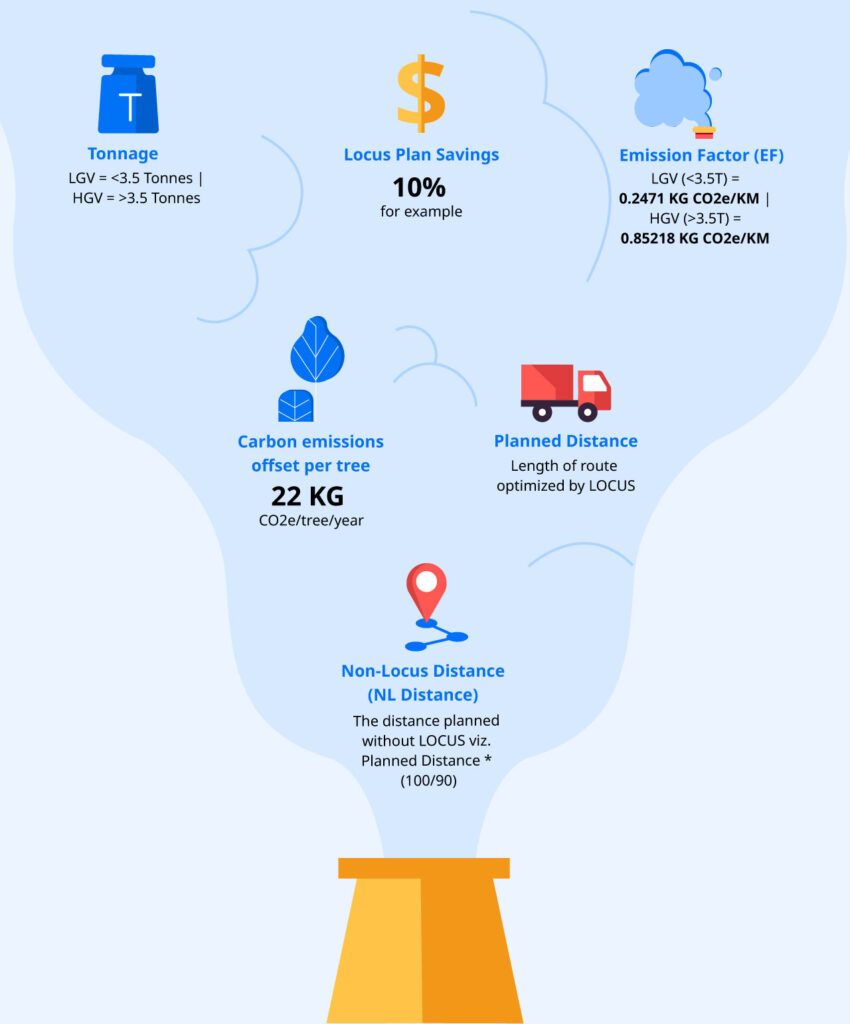
For an LGV on a 1000KM tour planned by LOCUS:
- Planned carbon emissions = 1000* 0.2471 = 247.1 Kg CO2e
- Carbon emissions saved = 1000*(100/90)*0.1* 0.2471 = 27.67 Kg CO2e
- Trees required to offset the otherwise saved CO2 emission by LOCUS planning = 27.67 (carbon emissions saved) / 22 = 1.26 trees/year
Planned vs. Executed
Now we all know there may be times when riders deviate from the route planned by Locus due to on-ground reasons. For example, maybe a street cordoned off, or a sporting event has caused traffic to swell up in a particular area. In this case, the distance executed by the rider will differ from what Locus had originally planned. This too is taken into account.
The Executed Distance is the actual distance covered by the rider in order to complete the deliveries.
With this, Locus gives you a side-by-side comparison of the ‘savings’ planned vs executed.
Executed savings for the earlier example is as follows:
Executed Distance: 900KM
- Actual carbon emissions = 900* 0.2471 = 222.39 Kg CO2e
- Carbon emissions saved = 900*(100/90)*0.1* 0.2471 = 24.71 Kg CO2e
- Trees required to offset the actual saved CO2 emission = 24.71 (carbon emissions saved) / 22 = 1.12 trees/year
In an ever-changing world where the effects of climate change are fast becoming reality, it is in our best interest to do everything we can to avoid potentially irreversible damage to our planet. Locus is building the new operating system of logistics to enable a greener planet!

Featured
The Art of Problem-Solving: Shantanu Bhattacharya’s Journey from DNA to Data Science

Jun 14, 2021
Key Takeaways There are some people who love what they do and there are others who love their work so much they decide to name their pet project after their daughter. Locus’s Chief Data Scientist, Shantanu Bhattacharyya belongs to the latter. But to call Shantanu a mere data scientist does not do justice to his […]
Read more
Featured
GoTo Merger – A Super App, Woke Consumers, and A Transforming SEA Economy

Jun 23, 2021
2019. That was the year when I first experienced the true power of wielding an app where I could hail a cab, order food or simply get parcels delivered anywhere in the city, all from a single interface. Although India had advanced reasonably well in the ride-hailing, food and b2c deliveries, and fintech industries individually […]
Read moreInsights Worth Your Time

















Reduction of carbon emissions by minimizing fuel-miles