

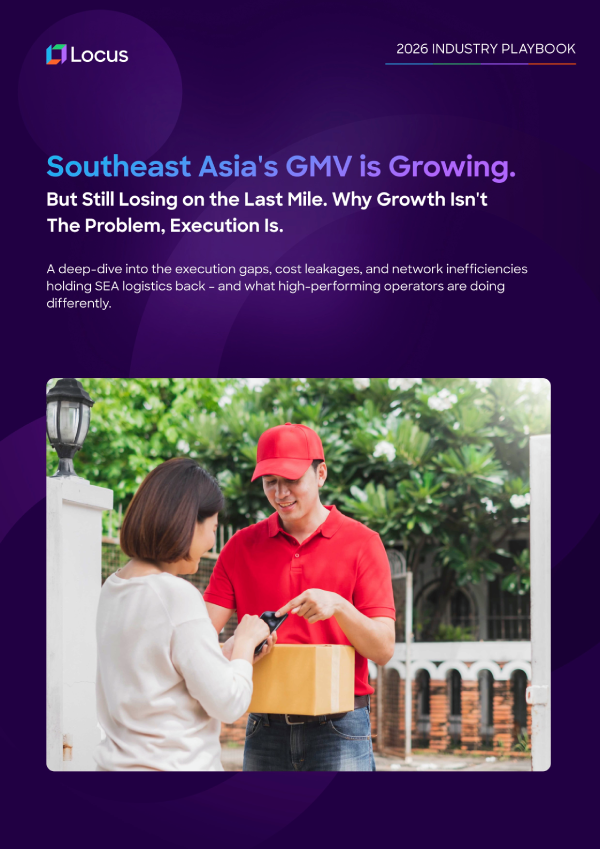
Southeast Asia’s GMV is Growing. But Still Losing on the Last Mile.
Why Growth Isn’t The Problem, Execution Is
Southeast Asia’s e-commerce market is scaling rapidly, but logistics economics are not keeping pace. Last-mile costs now consume 40–50% of total logistics spend, while nearly 73% of operations still rely on hybrid or manual planning.
of total logistics spends consumed by the last-mile
of operations in SEA still rely on hybrid or manual planning
of GMV, SEA's logistics cost
Southeast Asia handles a massive volume of online orders, driven by one of the fastest-growing digital economies in the world. As of recent data, the region processes roughly 15 to 16 billion e-commerce parcels annually. But even though order volumes are increasing, challenges like intensifying congestions, low delivery density, and fragmented cross-border networks, are driving inefficiencies. The result: cost per delivery isn’t coming down.
Key Takeaways from the Playbook
Scale without density increases cost, not efficiency
Fragmented demand and static routing lead to longer routes, fewer drops per trip, and rising cost-per-delivery.
Execution gaps—not demand—are eroding margins
Manual planning, poor coordination, and lack of real-time visibility create delays, reattempts, and underutilized capacity.
Cross-border complexity is a hidden bottleneck
SEA’s logistics opportunity is regional, but operations remain siloed—leading to breakdowns at carrier handoffs and border transitions.
High-performing operators close the loop between planning and execution
Dynamic routing, real-time ETAs, coordinated handoffs, and scenario planning enable 15–25% efficiency gains and measurable margin recovery.
Case Study
Learn how one of Indonesia's largest CPG distribution companies leveraged advanced routing to reduce delivery costs by 20%.
Download the Playbook
Want to See What the Data Means for Your Operations?
Our team can walk you through the findings and what they mean for your business.